Kommende Veranstaltungen
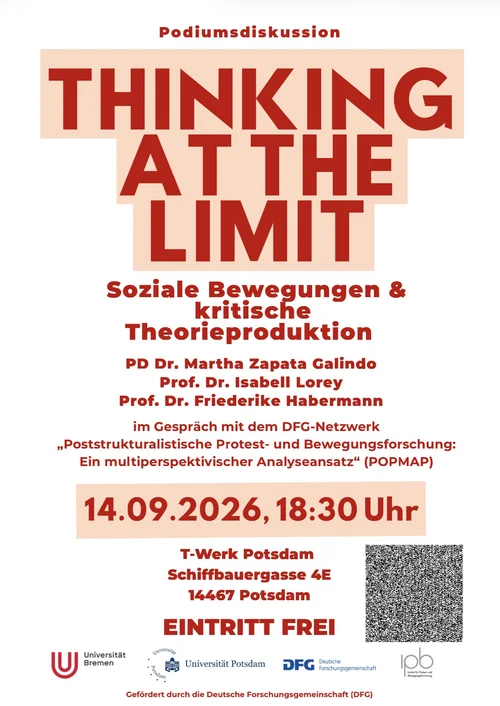
Thinking at the Limit: Soziale Bewegungen und kritische Theorieproduktion
Fishbowl-Diskussion mit anschließendem Empfang
Montag, 14. September 2026, 18.30-20.00 Uhr, T-Werk Potsdam, Schiffbauergasse 4e, 14467 Potsdam
Theorien entstehen in konkreten sozialen Kontexten, sind geprägt von unterschiedlichen Perspektiven und politischen Konjunkturen. Von dieser Einsicht ausgehend lädt das DFG-Netzwerk POPMAP (Poststrukturalistische Protest- und Bewegungsforschung: Ein multiperspektivischer Analyseansatz) zu einem öffentlichen Gespräch mit drei Wissenschaftlerinnen aus unterschiedlichen kritisch-feministischen Traditionen des Poststrukturalismus ein: Martha Zapata Galindo (FU Berlin), Isabell Lorey (Kunsthochschule für Medien Köln) und Friederike Habermann (Hochschule Darmstadt). Die Moderation übernimmt Fabian Schuppert (Universität Potsdam).
Seit jeher stehen poststrukturalistische Theorien und soziale Bewegungen in engem Austausch miteinander. Theoriebildung wird von sozialen Bewegungen und Protesten geprägt, u.a. von den Neuen Sozialen Bewegungen der 1970er, migrantischen Kämpfen und dem Klimastreik. Zugleich finden Begriffe, Argumente und Denkansätze, die theoretisch entwickelt wurden, Eingang in die Praktiken und das Vokabular von Sozialen Bewegungen, um z.B. die machtdurchdrungene Produktion von Identitäten und gesellschaftlichen Realitäten kritisieren zu können.
Trotz dieser engen Beziehungen zwischen sozialen Bewegungen und Theorie ist eine poststrukturalistische Bewegungsforschung im deutschsprachigen Raum unterrepräsentiert. Aus dieser Einsicht heraus hat sich das DFG-Netzwerk POPMAP gegründet, das diese Veranstaltung organisiert.
Ausgehend von den eigenen Erfahrungen und Perspektiven in wissenschaftlichen und aktivistischen Kontexten möchten wir uns gemeinsam mit den geladenen Gästen und dem Publikum der Beziehung zwischen Praxis und Theorie widmen. Das Veranstaltungsformat haben wir bewusst offen gehalten: ein Gespräch, das in eine kollektive Runde mit Raum für Beiträge und Fragen aus dem Publikum übergeht. Wir möchten insbesondere auch Aktivist:innen und politisch interessierte Menschen mit einem nicht-akademischen Hintergrund zu einer Teilnahme an der Diskussion ermutigen.
Im Anschluss laden wir herzlich dazu ein, zu einem Getränk und Snacks zusammenzukommen.
Das wissenschaftliche Netzwerk „Poststrukturalistische Protest- und Bewegungsforschung: Ein multiperspektivischer Analyseansatz“ (POPMAP) ist ein von der Deutschen Forschungsgemeinschaft gefördertes Netzwerk aus 20 Wissenschaftler:innen unterschiedlicher Disziplinen aus dem deutschsprachigen Raum, das aus einer poststrukturalistischen Perspektive soziale Bewegungen, Selbstorganisierungsprozesse und widerständige (Alltags-)Praxen erforscht. Das Netzwerk ist aus dem Arbeitskreis „Poststrukturalistische Perspektiven auf Soziale Bewegungen“ des Instituts für Protest- und Bewegungsforschung (ipb) hervorgegangen.
Kontakt: Dr. Judith Vey, Universität Bremen/BTU Cottbus - Senftenberg, veyub-tupde
Die Veranstaltung ist eine Kooperationsveranstaltung des Socium der Universität Bremen, des Lehrstuhls für Politische Theorie der Universität Potsdam und des Instituts für Protest- und Bewegungsforschung. Sie wird durch die Deutsche Forschungsgemeinschaft (DFG) gefördert.

Fall 2026 Work-in-Progress Seminar on Just Climate Transitions
Das “Work-in-Progress” Seminar ist pre-read konzipiert, das heißt, dass die Texte vor der Veranstaltung verteilt werden, um beim Seminar selbst diskutiert zu werden. Die Veranstaltungen werden in englischer Lautsprache stattfinden. Es ist offen für alle, bei Interesse steht Kerstin Reibold für den Meeting-Link und die Artikel zur Verfügung (kerstin.reibolduuitpno).
September 4, 2026: Silvia Weko (Friedrich-Alexander-Universität Erlangen-Nürnberg): The political economy of ignorance in Europe’s “twin transition”
Europe’s ‘twin transition’ has taken on a strategic autonomy edge: the climate and digital transitions should not only provide growth and reduce emissions, but also avoid creating new geopolitical dependencies. Such state attempts to govern risks raise new –and reopen old – questions about the relations between states and business in the (global) political economy. Using the examples of energy and digital platforms, I argue that states’ abilities to govern geoeconomic risks are hindered by their inability to pinpoint the nodes in economic systems which are the sources of value and power. This confusion is partly by design and has to do with the power of private governance, as firms seek to control this information. Many actors in the energy sphere are highly dependent on Big Tech (Weko, 2026) but they may seek to obscure or downplay existential risks that could invite regulation and harm their market positions. At the same time, coalitions of business actors with lower risks such as the automotive industry use securitized framings of trade – particularly with China – to acquire additional resources and strengthen their positions against international competition. This results in a political economy of strategic ignorance (McGoey, 2012), where firms obscure some risks and magnify others; and politicians avoid pushing for better information because of the potential political difficulties of addressing what they might find.
October 2, 2026: Joachim Raich (University of Vienna): Ecological grief as a political emotion
Many experience ecological grief in the face of mounting losses of ecosystems, landscapes, territories and biodiversity caused by the ecological crises. Whereas grief has received considerable attention from political philosophers, ecological grief has so far hardly been addressed in its political significance. This is a problem, because ecological grief can act as a powerful political force, and yet we only have a poor grasp of how we should respond to it politically. Thus, we must develop a political understanding of it. One ought to start by acknowledging that grief carries transformative potential but that it is also deeply ambivalent, because it can be turned into either retributive or emancipatory politics. Consequently, we should analyze how ecological grief is represented and articulated publicly in speech and action, because it depends on these representations which way its transformative potential is turned.
November 6, 2026: Fausto Corvino (American University of Armenia): Who should bear responsibility for the greenhouse gas emissions generated by large language models?
This article examines how responsibility for greenhouse gas emissions arising from large language models (LLMs) should be allocated across countries. It contends that the recursive production–consumption structure of the LLM value chain, in which user activity remains embedded in the productive process, calls into question the normative foundations of established methodologies of emissions accounting. Territorial accounting misallocates responsibility by attributing emissions according to where they physically occur rather than the distribution of effective control over emissions-generating activities. Consumption-based accounting, by contrast, places excessive responsibility on end-users despite their limited agency and incomplete information about the environmental consequences of their choices. Consequently, neither territorial nor consumption-based accounting fully reflects the conceptions of responsibility commonly invoked to justify these methodologies. To address these limitations, the article proposes a hybrid accounting approach that explicitly combines control- and demand-centred conceptions of responsibility. Under this approach, a portion of emissions from LLM data centres should be recorded in an international inventory subject to coordinated global governance, while the remainder would continue to be recorded territorially.
December 4, 2026: Maria Kourpa (CUNY):Against the alienation from nature: A Defense of Eco-socialism
Human activity has transformed the planet at an unprecedented rate, pushing Earth’s ecological systems toward critical limits. Extractive practices devastate ecosystems while intensifying climate change, biodiversity loss, and ecological instability. Together, they reveal a global pattern of environmental destruction that threatens planetary resilience and human survival.
In this presentation, I introduce a new way to approach radical ecology, grounded in Marxian theory of capitalist alienation. I argue that the alienation from the natural environment is a hidden form of alienation with its own merit for an eco-socialist framework. The alienation from nature under capitalism creates understandings about the non-human world not as a living and breathing entity with its own space for creation and growth to which we belong, but as a source for the extraction of raw materials needed for the reproduction of the capitalist system. This alienation from nature reflects on the understanding of nature as a gift that keeps on giving to humans, consumed for our well-being according to Marx, but also depleted for constant economic growth under capitalism.
The essay contends that redefining humanity’s relationship with nature requires abandoning capitalist modes of production altogether. Using the social ecology of Bookchin (2015), Barca (2024), Saito (2024), and Magdoff and Williams (2017), I form a defense of eco-socialism that grows in the here and now and pushes for political changes that build concrete eco-socialist communities outside capitalism.
These structures are anti-hierarchical, based on democratic self-governance and horizontality for the management of resources to achieve liberation for humanity and nature. They can get inspiration from non-Western non-alienated conceptions of the relationship with nature, like the one of radical reciprocity (Battistoni, 2025; Takacs, 2023), and engage in direct action, like ecotage. However, I do not support a version of anarcho-primitivism but I defend a concrete utopian confederalism that combines local ecological efforts with the use of technology and the surplus production of capitalism (Bookchin, 2015).