Chemistry of Functional Molecules and Materials | Master
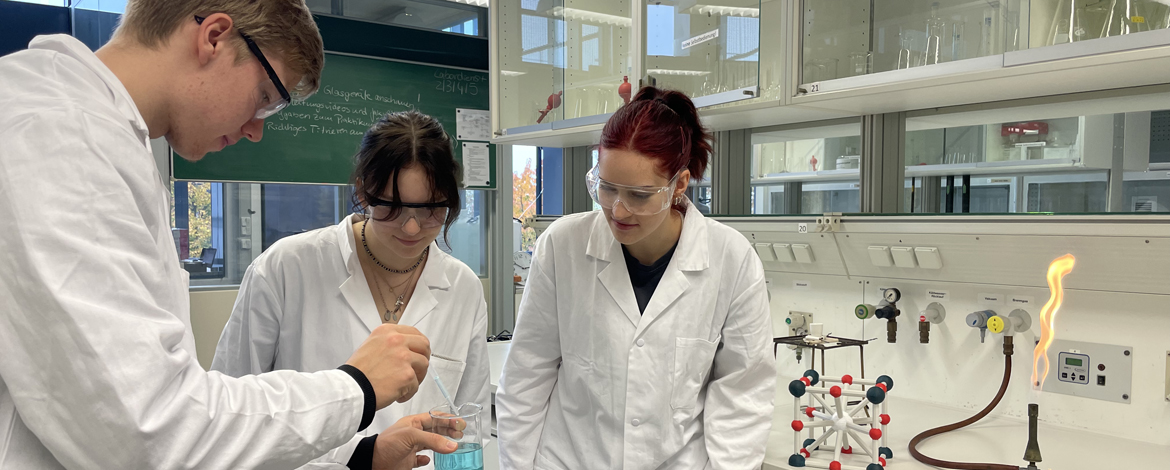
The research-oriented master’s degree program Chemistry of Functional Molecules and Materials provides students the opportunity to experience chemistry as a key science for solving global challenges. Innovative materials, which are developed through sustainable processes, play an important role in this. They are used in biomedicine, crop protection, and the chemical industry, for example as catalysts to manufacture products with greater selectivity, energy efficiency, and effectiveness, thereby contributing to improved healthcare, resource utilization, and sustainability. The English-language degree program prepares you for future-oriented research and a career in the industry in a comprehensive manner, especially in biomedicine, environmental technology, and the chemical industry.
| Name | Chemistry of Functional Molecules and Materials |
| Degree | Master of Science |
| Standard period of study | 4 Semester |
| Credit points | 120 |
| Language of instruction | English |
| Start of program (1st semester) | Summer and winter semester |
| Campus | Golm |
| Fees & Charges | Semester fees and charges: yes Tuition fees: no |
Program Content
In the master’s degree program Chemistry of Functional Molecules and Materials you will acquire in-depth knowledge in the fields of organic, inorganic, physical, and theoretical chemistry as well as biochemistry and materials science. Your studies focus on the development, application, and interaction of functional molecules and materials, which play a decisive role in areas such as catalysis, biomedicine, sensor technology, and sustainable technologies. You will learn to plan and conduct scientific projects independently and to solve complex chemical problems. Special emphasis is placed on the development of sustainable chemical processes that do not require fossil resources and are designed to be energy-efficient. You will also be taught about interdisciplinary connections to physics and biology in order to develop a comprehensive understanding of chemical processes. Through practice-oriented modules and close dovetailing with current research topics, you will acquire skills in data analysis and the modeling of chemical systems.
Course Objective and Future Career Options
The objective of the master's degree program is to train you to become a highly qualified chemist who is able to manage complex scientific issues and work in an interdisciplinary manner. After completing the program, you will be able to plan and conduct research projects independently and present the results both orally and in writing. The program prepares you for demanding positions in the chemical and pharmaceutical industries, at universities and research institutions (e.g., as part of a doctoral program), and in government agencies or non-governmental organizations. You will be highly qualified for a career in research and development, quality management (e.g., production processes), the patent system (e.g., for further training to become a patent attorney), or science communication (e.g., in journalism).
Prerequisites for Admission to the Master’s Program
In general, the prerequisite for master’s degree studies at the University of Potsdam is a first academic degree qualifying for a profession, such as a bachelor’s degree, with 180 CPs. Your first degree should be in chemistry or a in a natural sciences or engineering subject relevant to the program. You should be able to provide evidence of having obtained 60 CPs in chemistry. You should also provide evidence of practical laboratory skills in general, inorganic, organic, and physical chemistry through laboratory attendance periods amounting to at least 12 CPs.
In addition, English language skills that correspond to at least B2 level and German language skills of at least A1 level of the Common European Framework of Reference for Languages are expected.
You will find the subject-specific admission requirements in the Admission Regulations.
Program Structure
During the four semesters of the program you will earn a total of 120 CPs from the following modules and your final thesis. The specialization in Materials and Interfaces or Molecular and Biomolecular Chemistry may be included on the degree certificate if the respective courses were taken.
For more information, please consult the subject-specific Degree Regulations or the Departmental Advisory Office.
Modules | Credit points |
|---|---|
| Mandatory Modules | 24 CP |
| Materials and Interfaces – Polymers | 6 CP |
| Materials and Interfaces – Solid State Systems | 6 CP |
| Modern Synthesis Strategies and Methods in Molecular Chemistry | 6 CP |
| Analytics, Theory and (Bio-) Applications | 6 CP |
| Specialization lab course module Students can complete two specialization lab course modules amounting to 6 CP each. One specialization lab course module can be replaced by an elective module (see “Elective modules”). | 6 - 12 CP |
| Specialization Materials and Interfaces | 6 CP |
| Specialization Molecular and Biomolecular Chemistry | 6 CP |
| Elective modules Depending on whether one or both lab course modules have been completed, four or five of the following modules must be completed. | 24 - 30 CP |
| Modules in the specialization area Materials and Interfaces | 6 CP each |
| Modules in the specialization area Molecular and Biomolecular Chemistry | 6 CP each |
| Cross-Disciplinary Modules | 6 CP each |
| Research projects 2 research projects amounting to a total of 30 CP must be completed. One Research Project 1 and one Research Project 2 must be completed. | 30 CP |
| Materials and Interfaces – Research Project 1 | 15 CP |
| Materials and Interfaces – Research Project 2 | 15 CP |
| Molecular and Biomolecular Chemistry – Research Project 1 | 15 CP |
| Molecular and Biomolecular Chemistry – Research Project 2 | 15 CP |
| Master's thesis | 30 CP |
| Total | 120 CP |
Advantages at a Glance
- Research orientation: Close connection between theory and practice through research-related modules and direct involvement in working groups via projects.
- Interdisciplinary approach: Connections to related disciplines such as biology and physics expand your prospects and career opportunities.
- Professional orientation: Close collaboration with industry, production facilities in our FabLab and field trips systematically prepare you for practical work.
- Flexibility: You will be able to define your individual focus through a variety of elective modules and expand your interests through research projects.
- Future orientation: The degree program is an optimal preparation for future challenges in the areas of sustainability, biomedicine, and environmental chemistry.
- Key competences: In addition to technical skills, you will also develop your social and communication skills through teamwork and scientific presentations.
Contact
Institute of Chemistry | Dr. Sascha Eidner | Departmental Advisor
Application
Do you want to study in the master’s degree program Chemistry of Functional Molecules and Materials at the University of Potsdam? Then you should take the next step and get more information about the current application and enrollment procedures on the Application and Enrollment pages.
Wichtige Links
This description is based in part on information from the subject-specific regulations for a master’s degree in Chemistry of Functional Molecules and Materials at the University of Potsdam dated July 24, 2024 (AmBek No. 25/24, p. 1025).