Open Science at the University of Potsdam
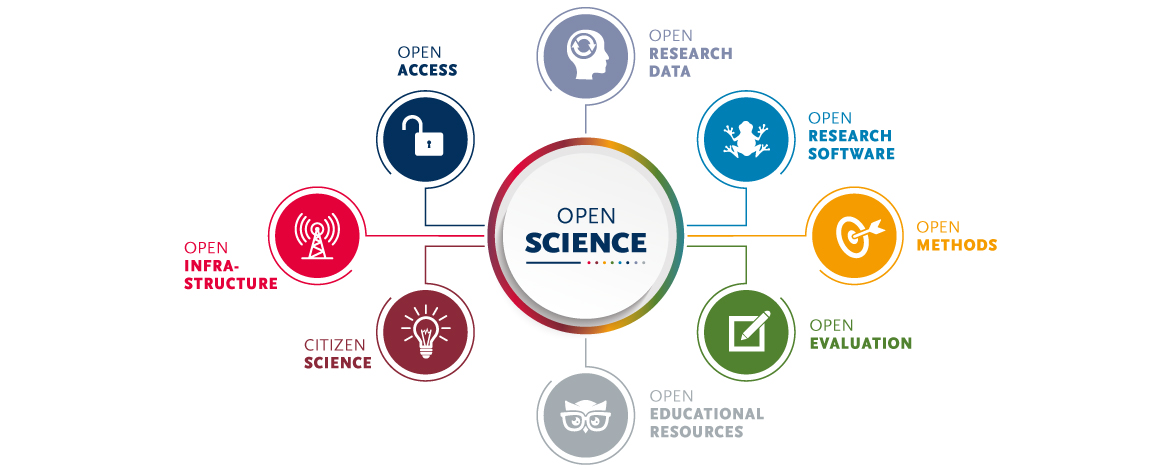
Open Science areas of action
Picture: University of Potsdam | ZIM 2023 (CC BY 4.0)

The term Open Science bundles strategies and procedures that aim to consistently use the opportunities of digitisation to make all components of the scientific process as openly accessible, comprehensible and reusable as possible via the internet. This is intended to open up new possibilities for science, society and the economy in dealing with scientific findings.

The University of Potsdam pursues Open Science as an integral part of its good scientific practice and its striving for excellence and has laid down this fundamental claim in various documents. In some fields of action, Open Science is already vital practice and substantial progress can be shown; other fields of action are at the beginning of the development process.

The coherent visualisation, targeted development and networking of all fields of action as well as the development of synergies are the main objectives of the Open Science Guidelines of the University of Potsdam. The process is supported by the researchers and teachers in the faculties and the qualified staff in the supporting institutions.

- Open Science Guidelines of the University of Potsdam, 2023


https://www.allianzschwerpunkt-digitalitaet.de/2025/09/25/webinar-reputation-und-open-science/

Reputation and Open Sciencen at the Allianz-Initiative „Digital Information“

“Reputation and Open Science: How should the evaluation of scientific achievements evolve?” Here you will find further information and the presentation slides from Dr. Kostädt and the other participants. 

https://yerun.eu/2025/10/spark-8-open-science/

University of Potsdam: Openness through Collaboration

The Open Science activities of the University of Potsdam are featured in the YERUN Spark Newsletter.

https://www.educalliance.eu/news/kes-digital-humanities

EDUC Research Strengthening Ties in Digital Humanities

Under the EDUC-WIDE Knowledge Exchange Scheme, Masaryk University’s Digitalia MUNI ARTS and the University of Potsdam’s Theodor Fontane Archive and Network Digital Humanities are redefining collaboration in the Digital Humanities.

https://www.educalliance.eu/storage/files/media/file/142/original.pdf

EDUC-WIDE Partners Deliver Open Science Recommendations

This report presents a set of recommendations for institutional Open Science implementation across the EDUC Alliance. It offers targeted, actionable recommendations to support alliance-wide alignment with European Open Science priorities.

https://www.ul.ie/sustainability/doctoral-school-2025-engaged-research-design-for-sustainability

Doctoral School 2025 - Engaged Research Design for Sustainability

University of Potsdam contributed an Open Science workshop to the Doctoral School 2025 - Engaged Research Design for Sustainability by the University of Limerick, supported by YERUN and Erasmus+ Blended Intensive Program (BIP).

https://oabb.pubpub.org/open-science-policies-eine-handreichung

Open Science Policies: A guide from the Open Research Office Berlin

The Open Access Office Berlin (now Open Research Office Berlin) has compiled five case studies on open science policies in this handbook, including one on the University of Potsdam.

https://doi.org/10.5281/zenodo.10722161

Poster at the IDCC

Open Science Policy and Practices at the University of Potsdam - Our poster at the 18th International Digital Curation Conference (poster on Zenodo).

https://www.uni-potsdam.de/de/nachrichten/detail/2024-10-09-wir-muessen-das-potenzial-von-open-science-im-curriculum-verankern-ulrike-lucke

Interview Prof. Dr. Lucke

“We need to embed the potential of open science in the curriculum” – State Teaching Award winner Ulrike Lucke on good digital teaching


https://www.uni-potsdam.de/en/headlines-and-featured-stories/detail/2024-04-25-if-i-could-i-would-make-tomorrows-open-science-infrastructures-available-today

Interview Dr. Kostädt (CIO)

“If I could, I would make tomorrow’s Open Science infrastructures available today”. From: Portal Wissen 1.2024