LemaS-Transfer: The Complex Task (2023-2027)
Funding: Bundesministeriums für Bildung, Familie, Senioren, Frauen und Jugend (BMBFSFJ)
The LemaS-Transfer research consortium (2023–2027) is working within the framework of the joint federal-state initiative “Leistung macht Schule” to embed the promotion of potential and talent in schools and classrooms for the long term. The focus is on designing learning environments in such a way that all children and adolescents, regardless of their origin, gender, or social background, receive the best possible support and encouragement in developing their individual talents. (cf. www.lemas-forschung.de, n.d.)
While subject-specific diagnostic tools, training concepts, strategies, and products were developed through a participatory process between teachers and researchers at the University of Giessen under the leadership of Prof. Dr. Wolfgang Hallet, these will be disseminated across the broader school landscape in LemaS-Transfer with the support of the LemaS team at the University of Potsdam and passed on to teachers at the transfer schools. This dissemination takes place through a process of training multipliers who were already involved in the first LemaS phase and providing professional development for new network teachers by LemaS multipliers. This work is divided into four distinct areas, known as content clusters. Content Cluster 4, “Languages,” focuses on subject-specific, focus-oriented professional development for teachers and multipliers in language subjects (German and English), into which the English subject is integrated through the multiplication of task orientation and the model of the complex task.
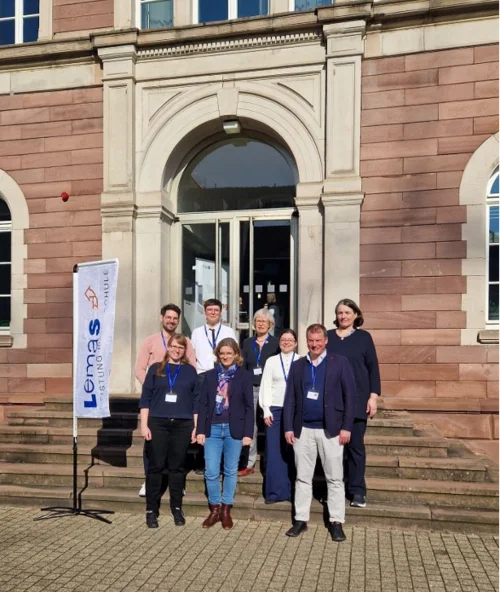
As part of the LemaS Transfer team for English at the University of Potsdam, Prof. Dr. Britta Freitag-Hild and Dr. Claudia Müller support multipliers across Germany in their efforts to disseminate the concept of the “complex task” (based on Wolfgang Hallet) at transfer schools. This support for multipliers is guided by the overarching training concept of the “Languages” content cluster. This concept aims to support multipliers at the qualification level, and indirectly, stakeholders at the school level, in a research-based, action-oriented manner and through close co-constructive collaboration, to further develop schools and (foreign) language instruction so that all adolescents can realize their potential and talents. The LeamS Transfer team at the University of Potsdam is also supported by Prof. Dr. Wolfgang Hallet, who continues to promote the transfer of knowledge through close collaboration with teachers at the LeamS schools and through research.
It was demonstrated in the first phase of LemaS that the complex task is particularly well-suited for identifying young people’s talents due to its complexity, richness of stimuli, and openness. Working on this complex task reveals abilities that had previously gone unnoticed by both teachers and students themselves. This leads to a shift in instructional design, in which the roles of teachers and students are redefined and the quality of instruction is further developed. Further insights on this topic, professional development opportunities, and materials can be found on the following websites, among others: begabungslotse.de, Language Learning Log, and in LemaS Volume 3.
In addition to close collaboration between academia and the field in the professional development of teachers, accompanying research is being conducted through interviews with multipliers to identify successful transfer and implementation processes in the school context. The English research group also examines the conditions necessary for the successful implementation of this complex task in English language instruction. A longitudinal study using interview data examines the practical perspective on the effectiveness of transferring the complex task.