Aktuelles / News
New website | What can Cicero and the ancient past teach us about corruption?
Dr Marta García Morcillo, Lecturer in Ancient History, and Dr Nick Freer, Lecturer in Classical Philology at Newcastle University, have launched a new website exploring corruption, power and responsibility through the writings of Cicero.
The website examines how the works of the Roman statesman Marcus Tullius Cicero and the trial of Gaius Verres – a provincial governor accused of corruption – offer insights into abuse of power, political accountability and moral responsibility.
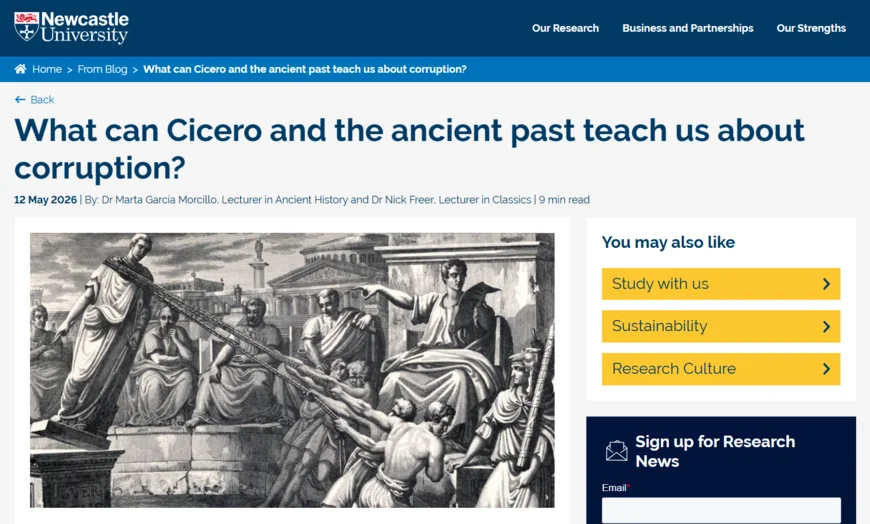
It highlights issues such as bribery, political manipulation and the misuse of authority – challenges that shaped the Roman Republic and continue to influence political life today.
The website also presents the student educational project “Corruption in the Spotlight: Cicero vs Verres”. Through the study of Cicero’s speeches, the project encourages students to reflect on justice, civic responsibility and the challenges of corruption. (See below.)
ClassicsFest 2025 | Corruption In The Spotlight: Cicero versus Verres
On May 16, 2025, the Lit & Phil, the historical library in Newcastle upon Tyne, England, hosted a performance entitled “Corruption In The Spotlight: Cicero versus Verres”, written by Kirsten Luckins, as part of ClassicsFest 2025: Why Cicero Matters, a collaboration between the Lit & Phil and the School of History, Classics & Archaeology at Newcastle University. The idea for the theatrical production and the new perspective on the defense in this still-famous corruption and extortion trial of Gaius Verres, the former governor of Sicily, arose during several seminars conducted by Dr. Marta García Morcillo and Dr. Nick Freer from the School of History, Classics, and Archaeology at Newcastle University and the Twisted Transfers project in collaboration with students. Following the performance, a panel discussion took place in front of a large audience between Dr. Marta García Morcillo, Kirsten Luckins, Dr. Kathryn Tempest, Dr. Laura E Hope, and students involved in the project.
Fake news, tax fraud and bribery – not today’s headlines but those of ancient Rome. Join us in exploring the roots of political corruption by looking at the Roman Magistrate Gaius Verres, whom Cicero famously put on trial (70 BC) for offences including spreading fake news. With contributions from sixth form students across the region, writer Kirsten Luckins reimagines the trial and puts a spotlight on its contemporary parallels. Performed by Wambui Hardcastle and Eilís Konstantina and presided over by Prof. Deveral Capps, Dean of Leeds Law School. This is a collaboration with Classics for All, Newcastle and Durham Universities and the Lit & Phil.
The project was made possible through a collaboration with Classics for All North at Durham University. For more information about the performance and the actors, please visit the Lit & Phil website here. The following photos provide a small impression of the event.


In addition, both parts of the event were recorded. You can find them below and on the Lit & Phil YouTube channel.
Book presentation
On March 24 at 10am there will be a book presentation of the first volume 'Corruption in the Graeco-Roman World. Re-Reading the Sources' of the new 'Twisted Transfers' series. The event will take place online under the following Zoom link. You will also find it on the poster of the event.
Here you can find the pulishers website.
Twisted Transfers: Discursive Constructions of Corruption in Ancient Greece and Rome (12.-14.04.23)
The Twisted Transfers research group organises a conference (12.-14.04.2023, London) in which various speakers will investigate the multiple sides of corruption in antiquity. A detailed programme can be found here.
Please register for attendance.
6th Twisted Transfers Workshop - University of Potsdam, 15.-16. December 2022
The 6th Twisted Transfers Workshop will take place at the University of Potsdam, on the 15th and 16th of December 2022.
On Thursday 15.12. at 6 p.m. the Keynote lecture will be given by Dr Andrew Sanchez (University of Cambridge), titled: Systemic Criminality and Capitalism.
If you want to join the Zoom Meeting, please register by sending an email to the chair's office by the 14th of December.
Corruption as social practice: an interpretive approach - Dr. Lucy Koechlin (Basel) 3rd Workshop Keynote
At the third twisted transfers workshop, the keynote by Dr. Lucy Koechlin (Universität Basel) „Corruption as social practice: an interpretive approach“ will take place on 10th of June at 6 pm CET s.t. Please register in advance by sending an e-mail to: sekretariat-altertum[at]uni-potsdam.de
For further information, please click here.
„There are few terms that are as loaded as corruption. Wisely, the United Nations Convention Against Corruption, notably all about (preventing) corruption, refrained from a definition and thus allowed the international community to focus on solutions, rather than unproductive definitional blame games between North and South. Although the social sciences have devoted reams of articles to exploring corruption, these are regularly loaded in a similar way; corruption has all too often been conceptualised simplistically, premised on ahistorical, positivist assumptions about social and economic change that evidently do not do justice to empirical complexities. Fortunately, pertinent critiques have contributed to the increasingly conventional acknowledgement of more sophisticated approaches. The argument in this paper zooms in on a particular blind spot to which less attention has been paid. Rather than think about corruption in terms of social change or political economy, corruption will be conceptualised in terms of social practice. An interpretive approach to social practice focuses on the layered meaning-making in context, informed by habits, judgement as well as imagination of social actors.
Drawing on case studies from Tanzania, Kenya and Switzerland, the meanings and actions of social actors will be explored to shed light on how „corruption“ is enacted and evaluated in everyday life. Ultimately, the insights seek to contribute to a more nuanced understanding of the social agency of actors through the lens of “corruption”.
Twisted Transfers at the European Social Sciences History Conference
The 2020 conference of the European Social Sciences History Conference, which has been postponed to March 24-27, 2021, will also take place online. This applies therefore also to the session “Discursive Constructions of Corruption in Ancient Rome”, organised by Prof. Dr. Filippo Carlà-Uhink and Dr. Marta García Morcillo, which is now bound to take place on Wednesday, March 24, 2.30-3.45 pm CET and contains papers by both organisers, Dr. Sema Karatas and Dr. Christian Rollinger. As the timetable of ESSHC is not completely finalised yet, please check their homepage for further information.
Talk by Filippo Carlà-Uhink at the University of Exeter
On Wednesday, February 3, at 4 pm CET (3 pm GMT) Prof. Dr. Filippo Carlà-Uhink will give a talk within the series of research seminars of the Department of Classics and Ancient History of the University of Exeter. The title of the talk is “‘Environmental Trust’ as Context and Condition for Economic Transactions: The Case of Ancient Rome”. If your are interested to participate, please write an mail to: twistedtransfers(at)uni-potsdam.de!
Lectures by Cristina Rosillo Lopez and Marta Garcia Morcillo
Our project members Cristina Rosillo Lopez and Marta Garcia Morcillo will give two lectures as part of the New Work on the Roman Republic lecture series. The sessiones will take place on Zoom, registration is requiered.
For further Information click here.
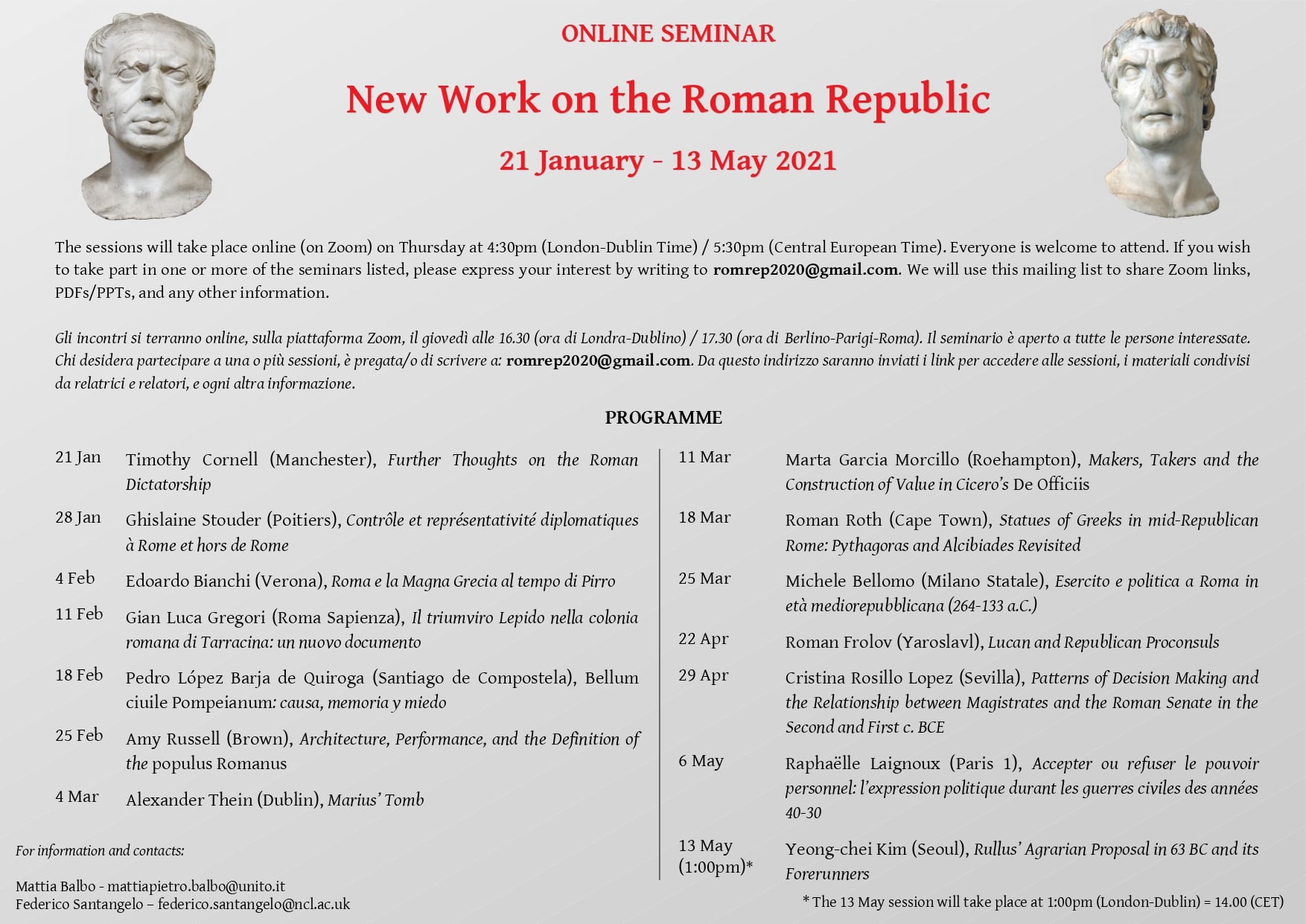
11th March: Marta Garcia Morcillo - Makers, Takers and the Cosntruction of Value in Cicero´s De Officiis.
29th April: Cristina Rosillo Lopez - Patterns of Decision Making and the Relationship between Magistrates and the Roman Senate in the Second and First c. BCE.
2nd Twisted Transfers Workshop - 17th / 18th Dec.
According to the pandemic situation, the second workshop of the DFG project "Twisted Transfers", including the lecture with Prof. Ronald Kroeze (17th December) The Presence of a Past Problem. Corruption in Historical Perspective was online. Did you miss the lecture? The video is available in our podcast!
First Research Group Meeting
The first Research Group Meeting has taken place on Friday 5th of june via Zoom. Researchers from London, Potsdam and many other cities and countries were brought together.