Flexible Perovskite Solar Films
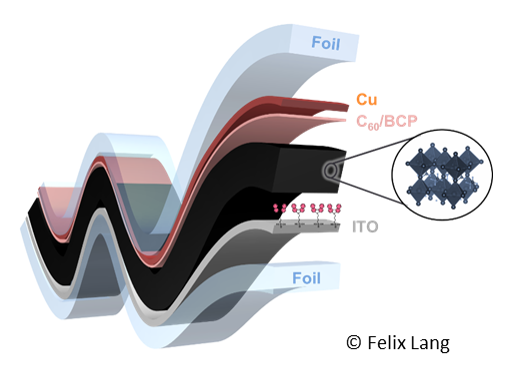
Ultra-lightweight and flexible solar films that offer high energy conversion efficiency at an affordable price could be a breakthrough technology in combating excessive CO2 emissions from non-renewable energy sources, which are responsible for global warming. Unlike conventional rigid solar cells on glass, flexible solar films offer a better carbon footprint and could find even wider application due to their potentially lower price. Their low weight also enables their use in future electric aircraft and other aerospace applications. Ultra-light solar films would also allow for easier integration into architecture, as greenhouses, warehouses or factory buildings often cannot support heavy photovoltaic systems.
Download Transfer Offer 25-09 (PDF, 741 KB)

Understanding Complex Systems
Prof Wiesner’s research is concerned with shaping the tools, from information theory and other areas of applied mathematics, to study the dynamics of natural and social complex systems.
The research is rooted in the philosophy of science and complexity. A precise definition of terms such as self-organisation, emergence, and robustness make much of the research transferable to the social sciences.
Download Transfer Offer 23-05 (PDF, 661 KB)

Disordered Semiconductors
The research group “Optoelectronics of Disordered Semiconductors” of Prof. Dr. Safa Shoaee is interested in understanding and developing low cost, large area environmentally benign photovoltaic technologies. Therefore the team is studying disordered carbon-based semiconductors, in particular organic semiconductors, to find out how these materials, electrically and optically perform, and which of their properties influence how efficiently they convert light energy into electrical energy.
Download Transfer Offer 22-06 (PDF, 524 KB)