May 2026: Another Bachelor’s thesis completed in NamTip
The successful completion of a Bachelor’s thesis by Carlo Renner at the University of Potsdam marks another valuable contribution to the NamTip project’s capacity building and research on Namibian rangeland systems. The thesis provides important insights into the combined effects of grazing pressure and drought on semi-arid ecosystems and contributes to the project’s ongoing work on desertification tipping-point dynamics in rangelands.
Carlo Renner completed his Bachelor’s thesis in 2026, titled “Interactive Effects of Grazing Pressure and Drought on Rain-Use Efficiency in Namibian Rangelands” under the co-supervision of Dr. Mark Bilton and Dr. Ildikó Orbán. His research investigated how grazing intensity and experimentally induced drought interact to influence rain-use efficiency (RUE), an important indicator describing how effectively vegetation converts rainfall into biomass and thus a key descriptor of rangeland health.
The study was based on the TipEx experiment, a full-factorial field experiment in central Namibia, where different grazing intensities were combined with drought treatments. In addition, the inclusion of sites with contrasting land-use histories enabled the analysis of ecosystem responses under both more degraded and healthier rangeland conditions. The thesis particularly focused on the interaction of multiple environmental drivers and the potential emergence of tipping-point behavior under prolonged stress.
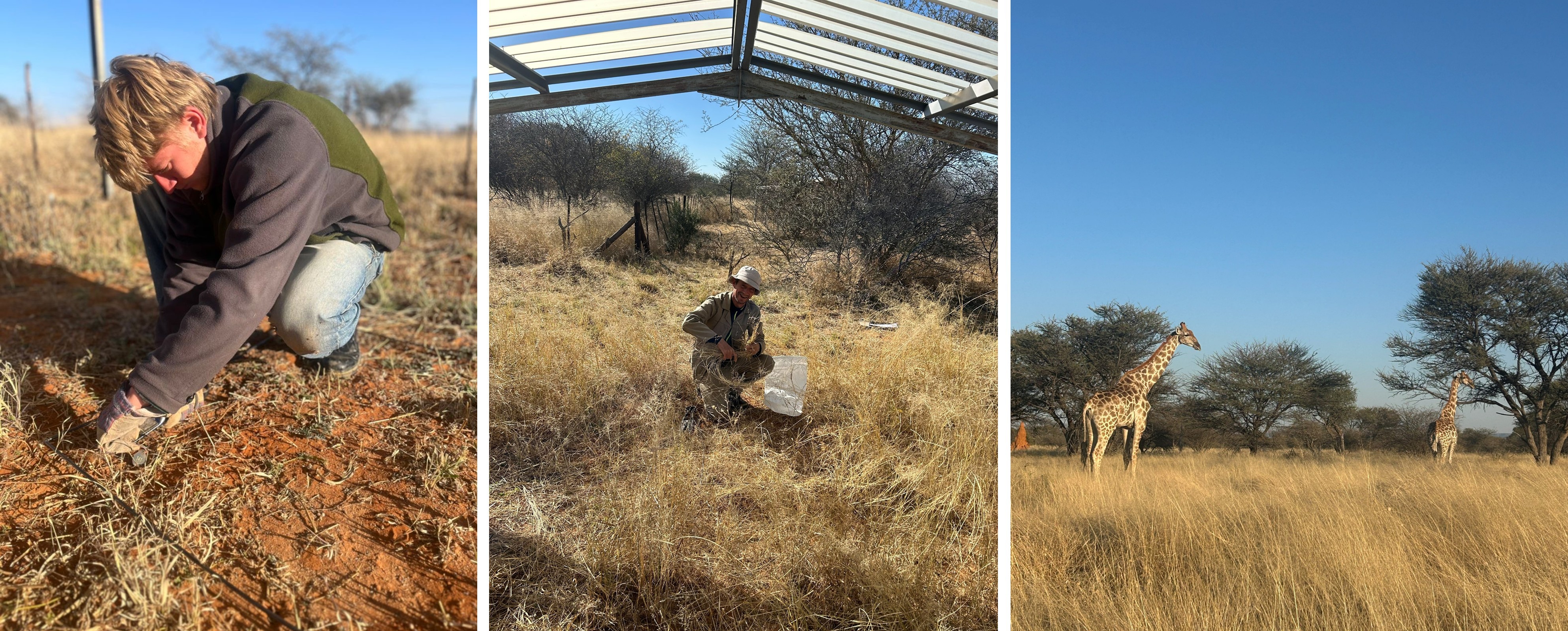
As part of his work, Carlo Renner participated in the final field campaign in 2025 (Fig. 1) and subsequently processed the collected samples in the laboratories of the Namibian University of Science and Technology (NUST). His involvement in both field and laboratory work provided valuable practical experience and further highlighted the importance of interdisciplinary collaboration within the NamTip project.
The results of the thesis demonstrate that, despite the generally high drought resistance of semi-arid vegetation, degraded rangelands are considerably more vulnerable to prolonged drought conditions. Furthermore, the effects of grazing were strongly dependent on both land-use history and water availability. At the same time, the study found that the system retained a notable capacity to recover once environmental conditions improved, indicating a surprisingly high resilience of semi-arid vegetation. Even under severe drought and extensive grazing pressure, no clear threshold behavior indicative of a tipping point was observed.
Overall, the findings underline the importance of considering multiple interacting drivers when assessing rangeland dynamics and emphasize the need for sustainable rangeland management strategies under increasing climatic stress.
The NamTip team congratulates Carlo Renner on the successful completion of his thesis and thanks him for his important contribution to the project.