December 2025: New publication on advancing grazing pressure assessment in semi-arid rangelands
Dryland grasslands cover vast areas of our planet and support millions of people who depend on livestock for their livelihoods. Yet these ecosystems are highly vulnerable: droughts and heavy grazing can degrade the land, reduce forage for animals, and threaten the long-term health of rangelands. A key challenge in rangeland research and management is accurately assessing grazing pressure. Most studies rely on simple proxies such as distance to the nearest water source, but grazing behaviour is far more complex. Cattle movements are affected by vegetation dynamics, fencing, terrain, and management practices, resulting in highly variable grazing pressure even over short distances.
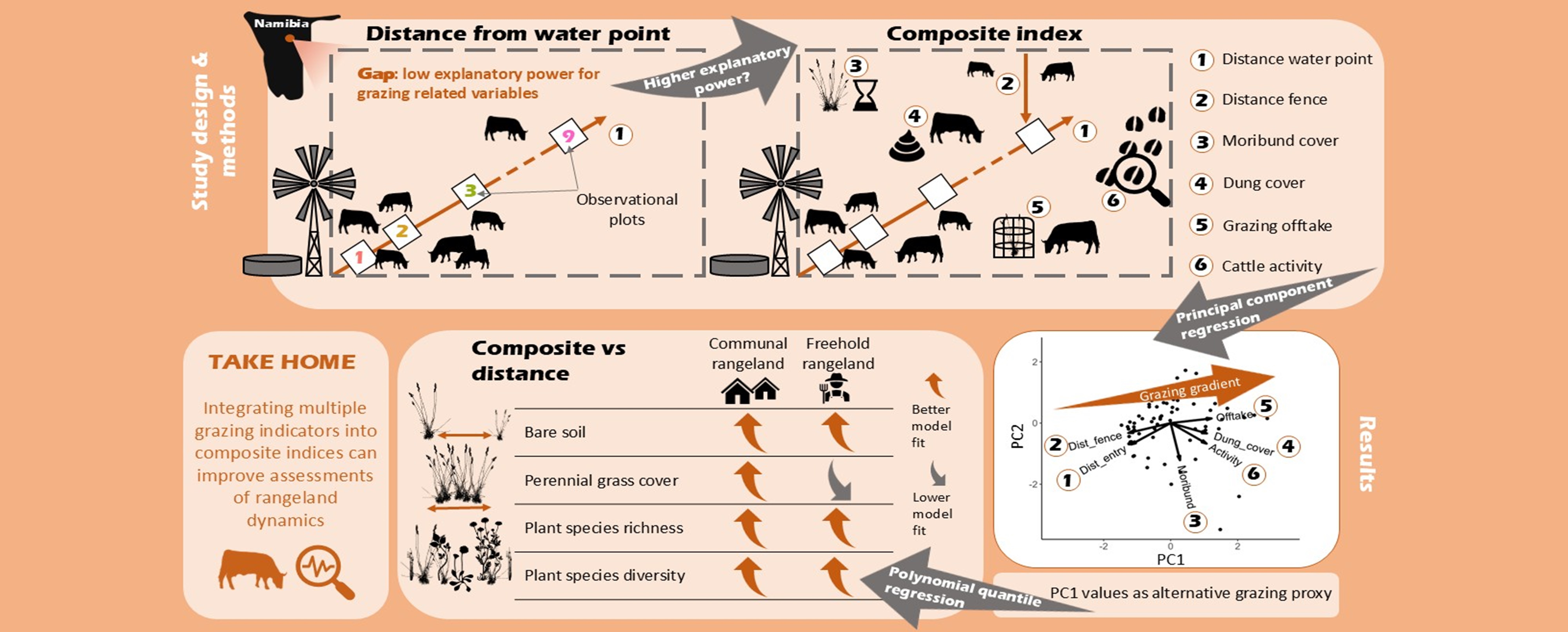
In a new study led by PhD student Lisa-Maricia Schwarz, we developed composite grazing indices that combine several indicators of cattle activity, including grazing intensity, plant material left behind, and distance-based measures. These indices were tested in Namibian rangelands managed under different land-tenure systems, as part of the NamTip project. Our results show that the more detailed indices explained vegetation patterns – such as bare soil, perennial grass cover, and plant diversity – better than traditional distance-based metrics. This was especially true for plant diversity, which responded clearly to grazing pressure captures by the composite indices but not by distance alone.
Overall, our study demonstrates that composite grazing indices offer a more precise, fine-scale representation of grazing pressure in semi-arid rangelands. They offer a valuable tool for researchers seeking to quantify or approximate grazing impacts at the plot level, enabling more detailed investigations of vegetation dynamics and ecosystem responses to grazing.
The full paper, which was published on Ecological Indicators, can be found here.