News from the University of Potsdam

Subjects
Selected Subject:
Environmental scientist Prof. Dr. Thorsten Wagener | Photo: Seila Fernandez Arconada

In High International Demand – University of Potsdam among Top 10 in Humboldt Ranking for the First Time

The University of Potsdam is held in high regard by researchers from abroad. This is the result of the current Humboldt Ranking, in which it was …
The research team in Namibia | Photo: Olwen Evans

Where Kudu and Springbok Live – Researchers from Potsdam examine if good wildlife management can help the savanna

The savanna is in danger. The African grasslands - picturesque groups of trees on wide plains, large herds of wild animals passing by, vigilantly eyed …

Alternative Milk from Peas – Start-up VlyFoods believes in nutritional value and environmental protection

Oat, rice, soy or almond milk - plant-based alternatives to classic cow’s milk are trendy and in increasing demand. Nicolas Hartmann, Niklas Katter, …
Hot summers are no longer an exception in Potsdam. | Photo: AdobeStock / Katja Xenikis

Keeping Cool During a Heat Wave – How cities can better cope with climate change

Heat waves, thunderstorms, hail, and heavy rainfall - extreme weather events are becoming increasingly common. Such events pose an enormous challenge …
Artist‘s view of heat transport in a trilayer metal composite material. | Image credit: Felix Stete/Jan Pudell

Hot Electrons – a very special form of heat transport in metals

When heating a platinum layer on nanometer scales, heat can be transferred by hot electrons through a copper layer into a nickel layer without …
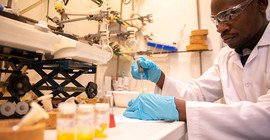
George Kwesiga at the lab | Photo: Tobias Hopfgarten

The mediacal treasure trove of nature – Chemists from Potsdam and their African colleagues are researching new active substances from plants

Nature provides an abundance of medically effective substances. Only a fraction of them is known so far. Especially in poorer countries, where very …
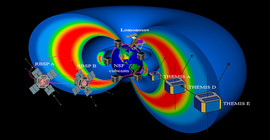
Scientific satellites traverse the challenging region of near-earth space known as the Van Allen radiation belt. | Figure: Yuri Shprits; background: NASA

Giant particle accelerator in the sky – Electrons are locally heated to extremely high energies within the Van Allen Radiation Belts, new study finds

The Earth’s magnetic field is trapping high energy particles. When the first satellites were launched into space, scientists led by James Van Allen …
Dr. Matthias Hartlieb at the lab | Photo: Tobias Hopfgarten

Fighting Pathogens – Chemist Matthias Hartlieb develops substances that could replace antibiotics in the future

Since April 2019, Dr. Matthias Hartlieb has been a postdoc research fellow in the Open Topic Initiative of the University of Potsdam. His research …
Bioreactor for cultivating microorganisms in the innoFSPEC lab | Photo: Ernst Kazcysnki

Not Without Alternatives – Bioplastic made from waste replaces conventional plastics

Plastic is a part of our everyday life. It has been made from oil, natural gas, and coal for over 100 years. The negative consequences of this flood …
In the embryonic zebrafish heart, the endocardium that is forming cardiac valve leaflets is divided into two subpopulations (here, cyan and yellow). | Photo: Federica Fontana

Strong evidence – Essential regulatory gene for the formation of heart valves discovered

By studying zebrafish embryos, the animal physiologist Prof. Salim Seyfried and his team have identified a new blood flow-regulated gene (Vegfr3/Flt4) …