
Environments in and as Networks: A Digital Humanities Hackathon
Potsdam, 15-17 April 2026
What? A collaborative event on challenges and research perspectives in Digital Environmental Humanities, focusing on the methodology of network analysis, on the idea of environments as networks, and on the representation of environments in neural networks
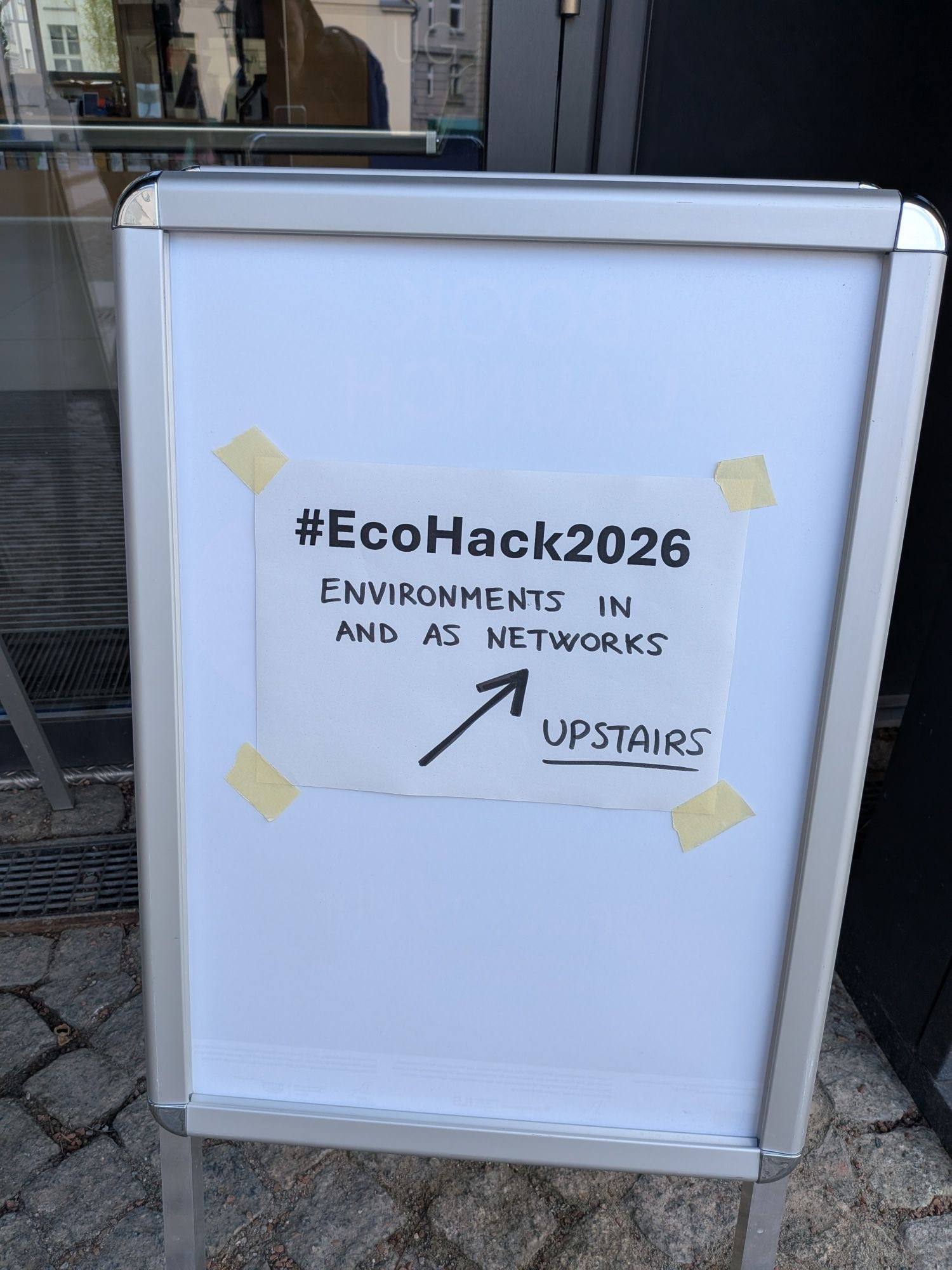
Where? Brandenburg Museum for Future, Present and Past (Am Neuen Markt 9, 14467 Potsdam)
When? 15 April 2026 to 17 April 2026 | see timeline for the pre-hackathon programme
| Wednesday 15 April | Thursday 16 April | Friday 17 April | |
| 9:00 | Arrival, welcome coffee | Arrival, welcome coffee | |
| 9:30 | Hacking | Hacking | |
| 11:00 | Coffee break | Coffee break | |
| 11:30 | Hacking | Hacking | |
| 13:00 | Arrival, registration, welcome coffee break | Lunch (buffet at venue) | Lunch (buffet at venue) |
| 14:00 | Opening, Pitches, Find a team | Hacking | Final presentations |
| 16:00 | Coffee break | Coffee break | Coffee break |
| 16:30 | Find a team, First gathering | Hacking | Final presentations |
| 18:00 | End Day 3 | ||
| 18:30 | End Day 1 | Dinner (buffet at venue) | |
| 19:00 | Dinner (restaurant, self-pay) | ||
| 19:30 | Late Bird Hacking (optional, until 21:00) |
What is this all about?
Ecology is about relations: “Nothing is connected to everything; Everything is related to something” (Donna Haraway). In this sense, human-environment-relations and more-than-human-relations are important notions in the Environmental Humanities. The network’s relational model – as a data structure, a method of visualisation, and an epistemic metaphor – in turn has become a central paradigm in Digital Humanities. Concepts such as embeddedness, the prevalence of interactions and connections over entities and actors, and the systemic openness and dynamism of network-like structures inform both formal and cultural network theory as well as Environmental Studies.
In our Digital Humanities Hackathon we will probe the ties between network thinking and environmental research through digital methods. On the one hand, we will examine how environments (captured in environmental data or media) can be modeled and analyzed as networks. On the other hand, we will explore how environments themselves are represented within the media networks of the past and present. And beyond all this, the question arises how environments are represented and processed in the new realities of the neural networks of current AI architectures.
Our hackathon welcomes researchers who would like to join us in our exploration on the interplay of networks and entangled environments from the perspective of Digital Humanities, Cultural History, and Media Studies.
Nice. But what is a hackathon?
The primary aim of a humanities hackathon, as we understand it, is to create a shared open space in which the participants take time to discuss and experimentally explore topics at the intersection of Digital Scholarship and Humanities. Therefore, a hackathon is not so much about producing finished results or presenting final products, but of jointly exploring possible paths, developing prototypes, discovering spaces of practice.
Challenges are at the heart of a hackathon. A challenge is a task to be approached in teams (but in particular cases also individually) during the entire hackathon. Challenges can be the development of software or website prototypes, the execution of digital analyses on databases, archives, repositories, the building or processing (cleaning, enrichment, etc.) of data sets, the design of a data model, the creation of a new (maybe data driven) theory, and so much more. Participants faced with a challenge are usually asked to produce a specific outcome by the end of the hackathon (a poster, a website, a piece of software, a dataset, a concept paper, etc.). Challenges can be submitted to the organizers before the hackathon and will then be presented on this website. Together with spontaneous ideas, these challenges will be pitched at the beginning of the hackathon, after which teams will be formed to work on selected challenges during the hackathon. Everyone is welcome to propose challenges. You will find the respective form at the end of this website.
Okay. But what exactly will happen?
The hackathon itself is an on-site event with an estimated 40 to 50 friendly participants that will take place in Potsdam from 15 to 17 April. Additionally there will be a series of pre-hackathon events leading up to the hackathon, including a kick-off, lectures and workshops on methods. Please take a look at our timeline.
| Title | Description | Proponent(s) |
| Does Distance to Animals Change Their Appreciation? | Investigate whether physical distance to animals influences how people write about them by analyzing historical newspapers to find animals, measure their proximity to humans, and track changing sentiments over time - testing the theory that urbanization changed human-animal relationships. | Arjan van Dalfsen |
| Human-Environment Relations in Historical Periodicals (1890-1980) | Examine how relationships between humans, environments, technologies, nature, infrastructure, and landscape were depicted across different historical periods using digital methods to analyze international periodicals and early environmental movement journals from 1890-1980. | Birgit Schneider et al. |
| EcoCor: The Next Generation | Further development of the EcoCor prototype and integration of MCP tools. // Sub-challenge (Thomas Haider et al.): annotating agency of non-human entities in EcoCor. | Peer Trilcke, Mareike Schumacher et al. |
| Early Modern Print and Its Environmental Conditions | Build a network of agents involved in publishing about weather and climate events in early modern Europe (16th-18th century) by clustering historical prints around specific events, places, and publishers as first steps toward understanding Little Ice Age traces in literature. | Joana van de Löcht et al. |
| The (Dis)temporality of Networks in Digital Environments | Investigate how AI and digital environments create an "extended contemporaneity" by mapping how temporal language has changed over the last decade, comparing AI-generated texts with traditional humanities writing to understand digital infrastructure's influence on how we experience and express time. | Charlotte Coch et al. |
Challenges overview


Organisers
Potsdam Network for Digital Humanities
Sören Barkey, Anna Busch, Luca Giovannini, Birgit Schneider, Peer Trilcke
Contact: digital-humanities@uni-potsdam.de
Bluesky: https://bsky.app/profile/dhpotsdam.bsky.social #EcoHack2026