
Adaptivity in Learner-Teacher Interaction
In social interactions between human learners and teachers, it is crucial for the teacher to develop a model of the learner—one that takes into account the learner’s knowledge, motivation, and emotions. This model allows the teacher to tailor tasks and learning support to the individual learner. Conversely, the learner must develop a model of the teacher, which provides insights into the teacher’s knowledge, instructional style, and individual characteristics such as trustworthiness or patience.
The development of such mutual understanding is a core component of successful social interactions in learning contexts. However, empirical research on how learners and teachers develop these reciprocal models—and, consequently, how adaptive social interactions can be established—is still limited (Corno, 2008). In contrast, in robotics, the properties of synthetic learning and teaching agents can be deliberately modified and adapted. Against this background, the question arises: how can learners and teachers be optimally aligned with task demands, the current context, and the specific characteristics of their interaction partners?
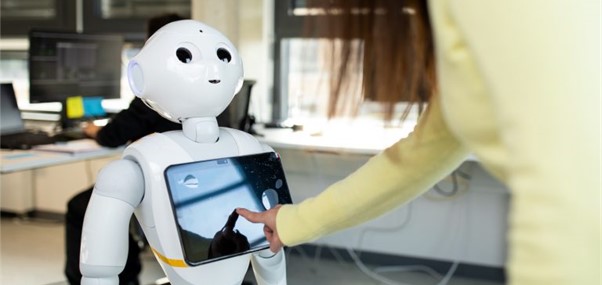
In this project, we build on findings from previous projects (Excellence Cluster SCIoI, Project P06 & Project P31) and investigate if and how principles of adaptive teaching strategies can be applied to social interactions between humans and artificial agents (Human–Robot Interaction, HRI) as well as between artificial agents (Robot–Robot Interaction, RRI).
In the subproject on School Education / Empirical Classroom Research, we focus on the following questions:
- To what extent can principles of adaptive teaching and learning, as described in instructional psychology, be applied to social interactions between humans and artificial agents?
- How do learners and teachers develop mutual mental models of one another in social interactions, and which cognitive, motivational, and emotional processes govern this adaptivity?
- How do situational factors influence the selection and effectiveness of adaptive teaching strategies?
Funding and Collaboration
The DFG-funded research project is part of the Excellence Cluster “Science of Intelligence” (SCIoI: www.scienceofintelligence.de) at the Technische Universität Berlin and Humboldt University Berlin, in collaboration with the University of Potsdam, Freie Universität Berlin, Charité – Universitätsmedizin Berlin, and the Max Planck Institute for Human Development.
The project is conducted in cooperation between the Department of School Education / Empirical Classroom Research at the University of Potsdam (Prof. Dr. Rebecca Lazarides) and the Adaptive Systems research group at Humboldt University Berlin (Prof. Dr. Verena V. Hafner).
More information about the project can be found here:
https://www.scienceofintelligence.de/research-projects/project_50/
Publications
Ackermann, H., Lange, A. L., Hafner, V. V., & Lazarides, R. (2025). How adaptive social robots influence cognitive, emotional, and self-regulated learning. Scientific Reports, 15, 6581. https://doi.org/10.1038/s41598-025-91236-0
Ackermann, H., Henke, A., Chevalère, J., Yun, H. S., Hafner, V. V., Pinkwart, N., & Lazarides, R. (2025). Physical embodiment and anthropomorphism of AI tutors and their role in student enjoyment and performance. npj Science of Learning, 10(1). https://doi.org/10.1038/s41539-024-00293-z
Contact
If you have any questions regarding the research project, please contact:
Helene Ackermann (helene.ackermann@uni-potsdam.de)