
Business Informatics specialist Dr. Edzard Weber from the University of Potsdam knows the potential that lies in comprehensive data collections and wants to convey its value to his students. For some time now, he has been letting them develop ideas in his courses on how the UDP data can be used in a profitable manner – both economically and socially. "The students slip into the role of companies, both public and private, large and small, and then look for ways to use the UDP databases for their business model," the scientist explains. In doing so, they go through a complete development process: from the initial idea to the business plan, technical data evaluation and modeling, to programming a user interface, such as an app, for users and customers. In the past semester alone, 23 students tried their hand at a prototype. They optimize the availability of rental bikes, enable civic engagement in the water supply of city trees, ensure intelligent maintenance of playgrounds, or enable smart waste disposal. All this requires comparatively little effort.
Students develop business ideas
One example is Danilo Neubern's "Gieß Game," a gamification app designed to motivate and empower citizens to care for the city's vegetation and monitor the health of its trees. To do this, he analyzes information from sensors that are stuck in the ground next to a number of trees in Potsdam and record how well they are being watered. The app integrates game elements such as achievements, levels, and points to encourage participation. Through sponsorships, companies can contribute their own trees and special incentives—for Neubern, this is an opportunity for cooperation between the public and private sectors.
With her project "SmartPlayCare Potsdam," Mobina Naserizadeh has created a monitoring and maintenance system for playgrounds. To that end, she evaluates geographic and statistical data on parks, resident groups, and elementary school catchment areas in Potsdam to identify playgrounds with high usage or in areas with many children. "This allows the city to plan more specifically when and where maintenance work is necessary," the student explains. She also wants to give people the opportunity to get involved – "with a citizen participation platform where damage can be reported directly on site via a QR code."
Onur Günzel’s goal is to improve environmentally friendly mobility. He also uses various UDP data sets for his evaluation: live information on the availability of rental bikes at certain locations, traffic count data to analyze movement patterns, but also event and weather data, and information on tourist bike routes. With the help of that data, bike rental companies can better plan how, when and where to distribute their bikes in order to optimally meet demand. Working on this has "shown me how quickly digital solutions can be created to tackle real urban challenges," Günzel says.
Practical experience with added value
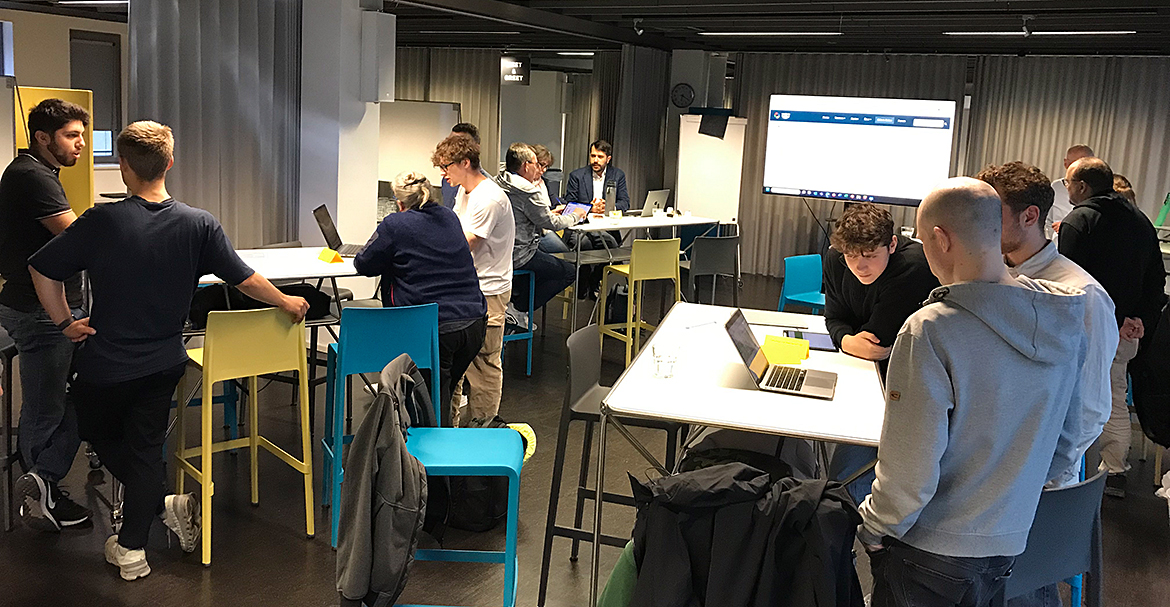
To demonstrate this potential – for companies, but also for urban society – nine of the students presented their ideas to Potsdam’s residents in October 2025 at the Potsdam Lab in the Science Forum. "We wanted to show the city's business community: Look how easy it is to develop or improve a business model with publicly available data and without a large IT department. It doesn't hurt – and the added value is enormous," Edzard Weber says.
Project work with practical relevance is a matter close to Edzard Weber’s heart, especially with regard to his students. He has been incorporating such elements into his courses for several years now. "I think that economics students should experience at an early stage how science enters society and solves problems or improves things there – and they also need to understand how important it is to communicate their research and findings to the public. People outside the university think differently than teaching staff and need to be convinced of the usefulness first and foremost."
The feedback from his students proves the Business Informatics expert right: "Some are surprised that the transfer to practice works so differently from the theory they learn as students – and I can clearly see that students first have to learn to communicate with the 'outside world'." But those who persevered are enthusiastic. "I found this kind of practical project work very exciting because it directly shows how computer science and data analysis can create real added value for everyday life," says Mobina Naserizadeh. Danilo Neubern emphasizes that the project strengthens the connection between academic learning and real-world impact. "It allows students to test ideas that directly affect their community while gaining a deeper understanding of civic engagement, sustainability, and the use of technology to strengthen civil society." Onur Günzel also finds the practical work with real data from the Urban Data Platform (UDP) extremely valuable and motivating. "It builds an important bridge between theory and the professional world."
For Edzard Weber and his colleagues, this is reason enough to integrate these practical aspects even more deeply in the academic program. With new program regulations for Business Informatics, he intends to enable students to actively participate in the exploitation that ensues for their own and other people's projects and to further develop their ideas. "In doing so, we are deliberately creating a space where failure is also allowed in order to gain valuable experience and try out innovative approaches," says Weber. "The focus is on initiatives and projects that originated in the university context here in Potsdam and can be continued."
Some seminar projects are already being further developed—such as Tobias Duda’s project, in which he is working on a smart waste system for the city's public trash cans, now as part of his bachelor's thesis. With the help of sensors that measure the fill level of the containers, it is possible to predict when they will be full and need to be emptied. Even the amount of waste per section or waste type is recorded. "This allows us to make the disposal process more efficient, which is beneficial for the company and reduces the burden on the environment," the student says. "I would like to continue working on how companies can implement this most easily, for example in my master's thesis."
Edzard Weber’s work with urban data is really just getting started—and it's important: "With our projects, we are also promoting the data platform, because if we do not find anyone at the local level who wants to utilize the data, sooner or later a big player from elsewhere will come along and implement such solutions on a large scale—and take over the entire business segment."
Urban Data Platform (UDP) Potsdam
The Urban Data Platform is the digital heart and central data marketplace of Smart City Potsdam, developed and operated by “Stadtwerke Potsdam” on behalf of the capital city’s government. The UDP processes and visualizes a wide range of data from various areas. Trial operations have started and the first data is now available.
https://urbanedatenplattform-potsdam.de/
Further information
About Dr. Edzard Weber: https://lswi.de/lehrstuhl/personen/wissenschaftliche-mitarbeiter/dr-rer-pol-edzard-weber?lang=en
About Potsdam Lab: https://www.wis-potsdam.de/de/potsdam-lab-raum-moeglichkeiten