
Prize Recipient of 2018: Gladys Tzul Tzul
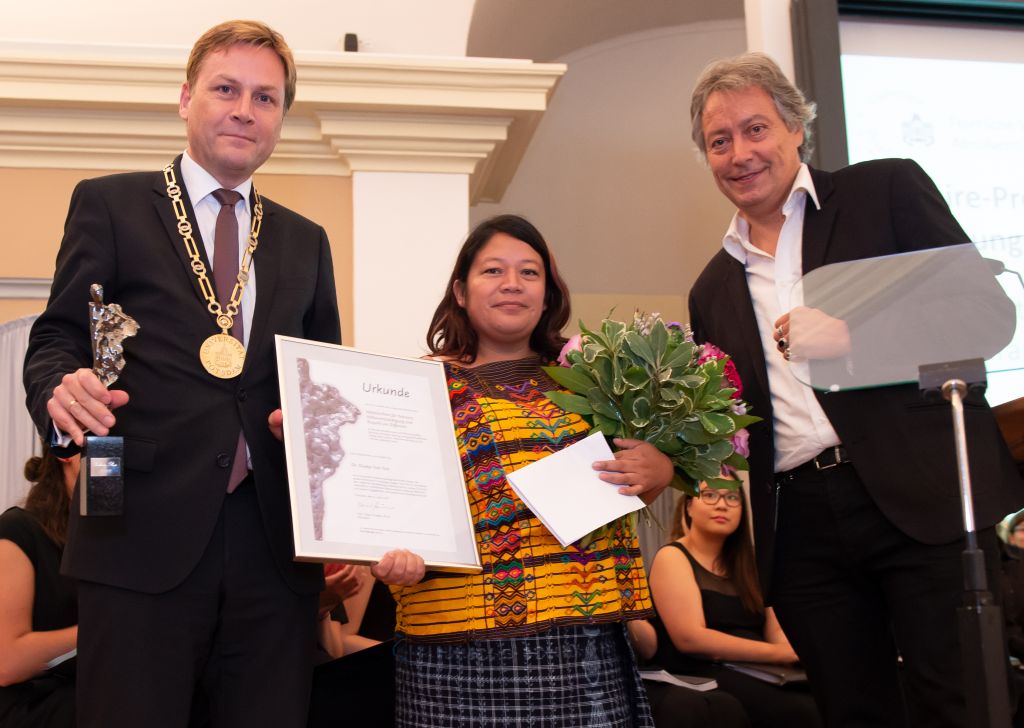
The Guatemalan sociologist Dr. Gladys Tzul Tzul receives the "Voltaire Prize for Tolerance, International Understanding and Respect for Difference" of the University of Potsdam in 2018 for her work on behalf of the indigenous population in Central America. Gladys Tzul Tzul specializes in indigenous systems of government, their power structures and the struggle between local and state authorities in Guatemala. She earned her doctorate in sociology at the Benemérita Universidad de Puebla (BUAP) in Mexico. Tzul Tzul is the founder of Amaq, an institute that provides legal advice to indigenous peoples.
Mrs. Tzul Tzul, you have publicly denounced the genocide under the presidency of the recently deceased Efraín Ríos Montt in Guatemala between 1982 and 1983, and you have been involved for many years with the indigenous communities, the so-called "comunidades", in Guatemala. What problems do you see regarding the political and social situation of indigenous peoples in your home country?
Guatemala is a country where indigenous communities have managed to maintain their own systems of government. Despite the repression and genocide of the 1980s, women, men and children continue to work to preserve their water sources and community areas. Historically, the comunidades have contributed to their own livelihood. At the same time, however, they have also supported the democratisation process in post-war Guatemalan society. The problem now is the continuing antagonism between the indigenous population and the Guatemalan state. The state denies the indigenous comunidades and does not recognise the existence of the communal territories with their own systems of government. Twenty years after the signing of the peace treaty, the majority of the comunidades have regained their strength and are searching for their dead. During this search, those affected also met engineers from hydroelectric companies, who in turn were looking for places where they could build new power plants. In other words: where the indigenous communities create life, the state and money try to force death. This conflict in Guatemala has still not been resolved, and looting and expropriation are still wanted by the government.
In what way have you stood up for the rights of the indigenous population in your homeland in recent years?
The indigenous communities have historically fought for their rights and I have tried to join their struggle. Accordingly, I have participated in various legal proceedings in defence of indigenous government systems. I have been to courts and have explained the functioning of Community law in relation to nature conservation and forms of social self-regulation. In these times of capital accumulation, we are witnessing the recomposition of the republican legal apparatuses. Thus, what was not a crime in the past is now considered a crime. Thus hundreds of indigenous community representatives are being prosecuted. Several lawyers defending the indigenous authorities in court have asked me to participate in these trials as an expert. There I was faced with challenging research issues and criticism, both of indigenous government systems and the state legal system. I have also participated in several community celebrations, because the comunidades also take time for beauty. These celebrations are a reminder that not so long ago this was also the way of celebrating.
What drives you personally?
I spent many years at the university reading about indigenous rebellions and struggles and politics in Latin America. Thanks to my scholarships, I was able to do research in the archives on the struggles of community members and community council when the abolition of tribute payments or the liberation of their leaders was being discussed. At the same time, I grew up in this context, I have seen demonstrations in favour of water protection or meetings where it was decided to protect the Community's national borders. Both my scientific work and my personal experience have broadened my horizon.
And I will never forget the mass communal funeral on 5 October 2012, when the comunidades rejected the violence of the Guatemalan state. Yes, it was like a book about the dead, in which the fallen of the war appeared in the voices of those present. This image drives me, it hurts and drives me.
Moreover, during the discussion about the constitutional reform, I experienced how the indigenous representatives spoke with the state in a personal way and "per you". The dignified way in which the indigenous authorities defended the comunidades they had elected was almost identical to the disputes at the end of the 19th century. From a scientific point of view, this impressed me. I heard the indigenous mayor of Sololá say to the parliamentarians "We do not want recognition, we have already been elected by our assemblies. What we want is for you not to consider our actions in our own system of government a crime."
All this is what motivates me to support the communal indigenous resistance that has continued for five centuries in spite of the genocide. It is also because it is precisely this form of community that has given many of us the material basis to educate ourselves and professionalize ourselves.
You are threatened with persecution in your country. How did it come about and what consequences does your commitment have for you personally?
This situation arose after the massacre of 4 October 2012, when we fought to be allowed to remember the victims. We were threatened and for a long time I was afraid to speak publicly again. Such threats force us to remain silent, we cannot continue our lives as before. People become more suspicious, but we must continue to believe in life and in the struggle.
What future do you wish for the people in your home country?
The comunidades have life projects. In the Nebaj region, people are rebuilding their land with more than twelve cultures. The communities continue to plant organic corn, which will feed several generations. There are comunidades with a universe of life that hopefully will not be destroyed, not only for the benefit of the communities but also for the world. I hope that my research can contribute a little to the preservation of this community world.
We thank you for the interview!
BACKGROUND INFORMATION
On the Situation of the Indigenous Population in South America
In every Latin American country, the current situation of the Indigenous population varies. While new opportunities for political, social, and cultural participation have opened up in Bolivia, the situation for Indigenous communities in many Central American countries remains precarious. The centuries-long disenfranchisement of Indigenous peoples across the American continent has, in recent decades, led to new forms of cross-border cooperation, such as communal self-governance. In this way, communities resist impoverishment and the many different forms of discrimination they face. In Guatemala, too, Indigenous participation exists at the municipal level, particularly in so-called “comunidades.” Many of these communities elect representatives who, independently of the state legal system, act as their own mayors. At the national level, however, political participation is largely denied to the Indigenous population. Although the decades of genocide have ended, discrimination against large segments of the Indigenous population persists—despite the significant efforts of scholars such as Gladys Tzul Tzul and writers such as Rodrigo Rey Rosa.
Civil War in Guatemala
Between 150,000 and 250,000 people were killed during the Guatemalan Civil War from 1960 to 1996. Most of the victims belonged to the Indigenous population, particularly various Maya ethnic groups. They were murdered in systematic massacres carried out by the army and right-wing paramilitary forces.
Massacre in October 2012
On October 4, 2012, members of numerous Quiché communities, a Maya population group, protested in the Guatemalan department of Totonicapán against a planned constitutional amendment. The then Minister of the Interior, Mauricio López Bonilla, ordered the peaceful protest to be dispersed. When soldiers ended the road blockade of approximately 6,000 people by opening fire, eight people were killed and more than 40 were injured.