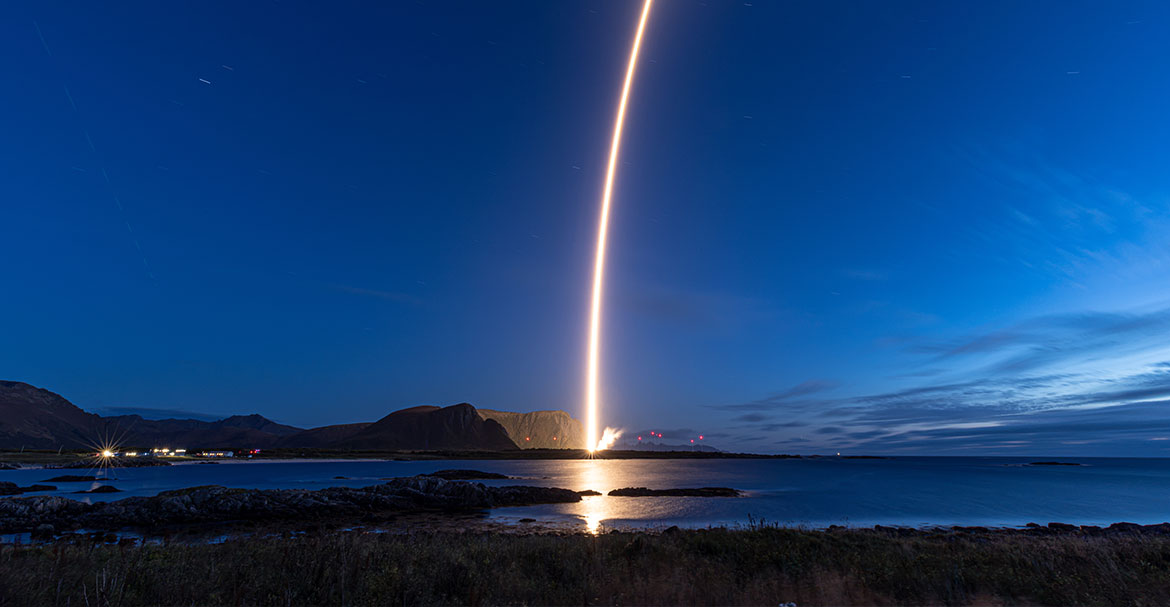

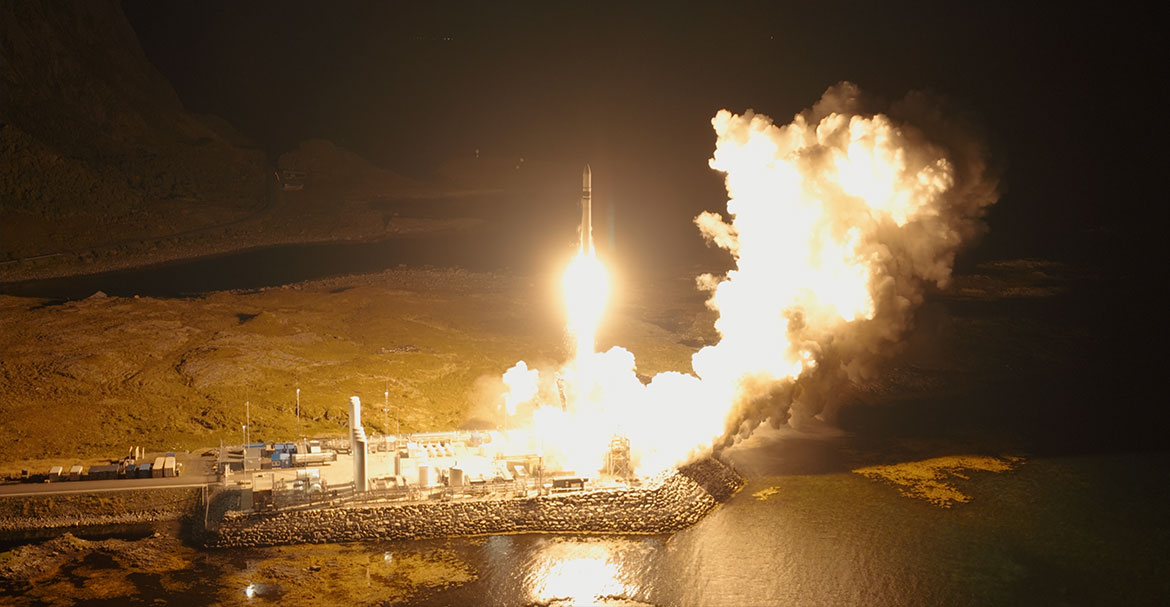
How exciting was it to see the satellite launch successfully?
It was an incredibly beautiful moment. Over the course of several years, an enormous amount of volunteer, scientific, and engineering work—and a great deal of passion—went into this project. For me, it was particularly exciting to know that the space-optimized perovskite solar cells we developed in Potsdam were finally on their way into space. At the same time, everyone remained intensely focused: The operational phase begins immediately after launch. Once initial radio contact with the satellite has been established, everything has to be thoroughly checked before the experiments can be activated and the first data received.
How is the solar cell data transmitted back to Earth, and what were the first signals you received?
The data is transmitted using RACCOON OS, TU Berlin’s Linux-based open-source operating system. It was developed as part of the RACCOON Proof of Concept (PoC) at TU Berlin and is being created in close collaboration with partners from academia and cybersecurity research. RACCOON OS is completely open source, including key components for mission operations and data processing. That’s a first!
In fact, at 2:02 a.m. on September 6, the first signals from the satellite’s radio beacon were received over Australia’s east coast via SatNOGS, the open-source global ground station network. At 2:21 a.m., BEESAT-1 hacker PistonMiner decoded the first message: “HELLO WORLD FROM CYBEESAT.”
What makes the collaboration with the engineers at TU Berlin so special?
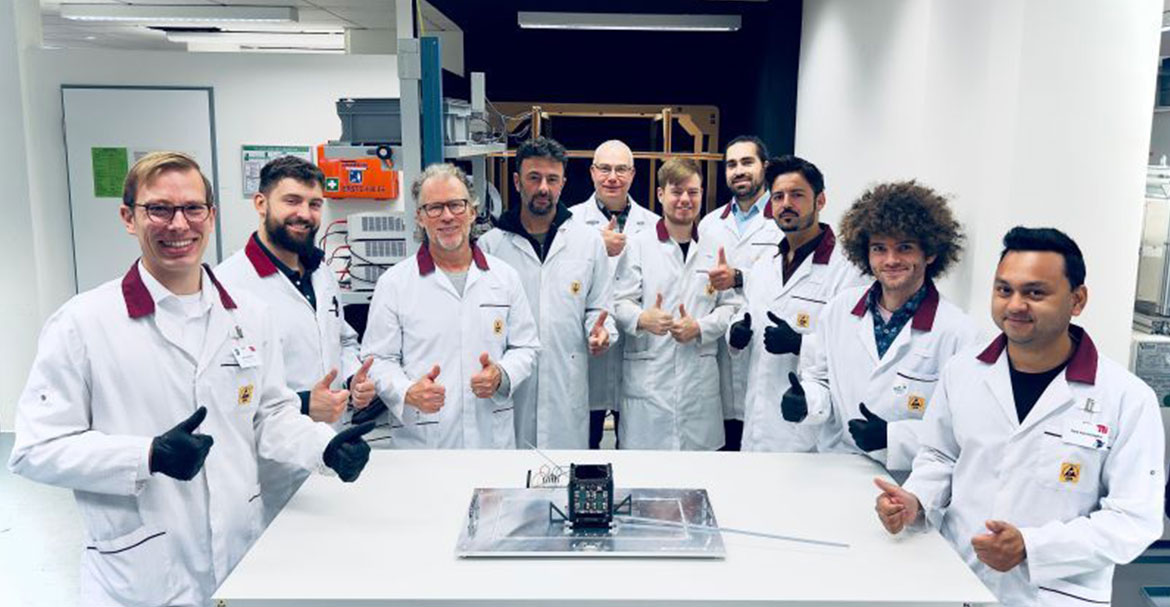
The collaboration brings together cutting-edge photovoltaic research and real-world space technology. We had to adapt our solar cells so that they would operate reliably not just in the lab but under the actual conditions encountered by a satellite. The extreme temperature fluctuations in space are particularly challenging: Several times an hour, temperatures can range from around -40 °C in Earth’s shadow to as high as 80 °C in full sunlight. Overcoming this challenge is an important step not only toward using these cells in space but also toward developing more robust perovskite solar cells for use here on Earth.
One particular highlight was joining our TU Berlin colleagues in Andøya to work on the satellite and our payload and to see the Spectrum rocket up close.
Several Berlin start-ups are also involved, including Quantum Galactics, which supplied the CyBER OBC—the heart of the satellite and the computer that also runs the ROSI software.
Why is perovskite the semiconductor material of the future for solar cells?
For us, perovskite is an almost ideal semiconductor for solar cells. It absorbs light extremely well, which means that layers thinner than a human hair are enough to produce efficient, ultrathin solar films. What’s more, perovskite solar cells can be manufactured using relatively small amounts of material and energy. The material therefore promises a smaller carbon footprint than many established technologies, making it ideal for an energy revolution here on Earth.
Another crucial advantage for spaceflight is the material’s high radiation tolerance. It can even repair itself, making it an interesting option for demanding missions. In the long term, we are therefore thinking beyond satellites in Earth orbit to missions to the Moon and Mars—or even large orbital solar farms. Turning such visions into reality will require a new generation of inexpensive, ultrathin, yet highly efficient solar films that can be rolled out or unfolded over large areas in space.
CyBEEsat is a learning and demonstration mission. What does that mean?
Regardless of how the mission itself unfolds, the project represents an important step for the partners involved, for academic spaceflight in Germany, and for the continued development of independent European space capabilities. Another important aspect is that students at TU Berlin will operate CyBEEsat in the future.
For us specifically, it means the first in-orbit test of our perovskite solar cells for space applications. We’re already dreaming about our next joint tests beyond Earth orbit.
Project Partners
Academic partners
Technische Universität Berlin, Chair of Space Technology (project lead, integration, operations)
University of Potsdam, ROSI Research Group (ROSI primary scientific payload)
Berliner Nanosatelliten Allianz e.V. (satellite bus subsystems)
Start-ups and small and medium-sized enterprises (SMEs)
2BCOM GmbH (ground segment support)
Aerospace Innovation GmbH (AISEP experiment)
NanoCube GmbH (VHF communication systems)
ElmSpace UG (passive nutation damper)
Quantum Galactics GmbH (1U bus, CyBER onboard computer, Galactic EPS, solar panels)
CyBEEsat carries several scientific and technology demonstrators, including:
- Primary payload – ROSI (University of Potsdam): Radiation-tolerant perovskite-based solar cells for investigating performance degradation in orbit. Measurements from the experimental solar cells are transmitted via a regular telemetry beacon to SatNOGS, a worldwide network of ground stations.
- CyBER onboard computer (Quantum Galactics GmbH): A high-performance, redundant onboard computer system with a focus on IT and system security.
- RACCOON OS (TU Berlin, RACCOON e.V.): A novel open-source operating system for satellite missions with a focus on cybersecurity.
- VHF transceiver (NanoCube GmbH): VCOM, a compact VHF communication system for short-duration missions.
- Passive nutation damper (ElmSpace UG): A passive actuator for attitude stabilization and nutation damping in Earth orbit.
- AISEP additive manufacturing demonstrator (Aerospace Innovation GmbH): An experiment testing spaceflight components made from innovative materials using additive manufacturing.
Updates on the “Onward and Upward” mission: https://isaraerospace.com/mission-updates-overview
Watch the video (in German) “Mit Teamspirit ins All: CyBEEsat auf Raumfahrt-Premiere“: https://youtu.be/ITvxOzBMf5A
TU Berlin press release:
https://www.tu.berlin/news/detail/hello-world-from-cybeesat
Contact:
Dr. Felix Lang, Institute of Physics and Astronomy
Head of the ROSI Freigeist Research Group
Phone: +49 331 977-5630
felix.lang.1uuni-potsdampde