
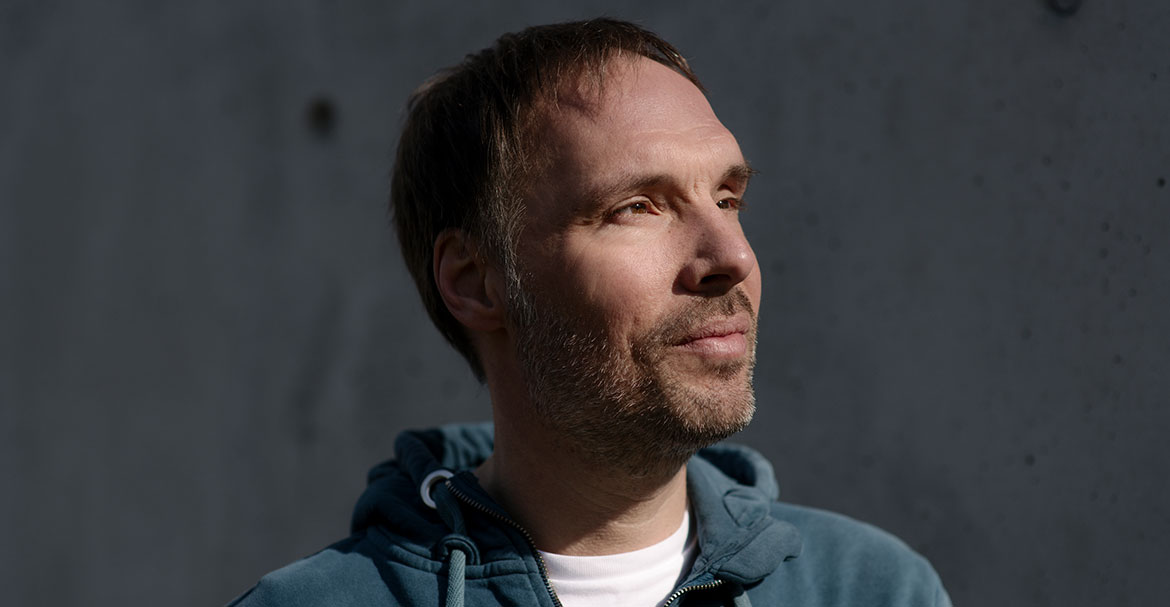


“Stevie Wonder has this condition too,” says Peter, smiling. As a result of the retinal disease, he developed constant eye tremors, which quickly lead to fatigue. Today, the professor is dealing with another consequence: “Presumably, the poor posture of my head due to my visual impairment led to long-term compression of my spinal cord; the muscles in my left arm and hand have been partially paralyzed ever since. For me as a pianist, that’s actually the hardest limitation.” After graduating from high school, Peter first studied special education, then German language and literature, school music, piano, and music theory, with the aim of becoming a teacher. But when he, who was living in Berlin-Mitte at the time, was assigned a teaching internship on the outskirts of the city without consideration for his visual impairment, he decided against a career in teaching. He applied to the University of Music and Drama in Rostock and was immediately offered a position as an artistic assistant, later being appointed honorary professor. In March 2024, he was appointed to the University of Potsdam and has not regretted this decision so far. “I have been very warmly welcomed in the music department, especially by the students, which means a lot to me.”
“It is a scandal that many people with disabilities and chronic illnesses are additionally confronted with precarious employment and poverty. It is crucial that those affected receive a good education. This is where the university can make an important contribution.” Philip Peter
Technical aids and rest periods
To keep visual strain at work to a minimum, Philip Peter now uses a range of aids. Among other things, plenty of natural light and good additional lighting, dictation software, and a large screen on a height-adjustable desk are important. Nevertheless, working on the computer causes him to get tired quickly. “When I answer 30 emails a day, I often have terrible headaches in the evening.” That is why he encourages students to stop by in person whenever possible instead of writing to him. Rest periods and balance, such as regular exercise, are also particularly important to the professor. Nevertheless, he is on campus in Golm four out of five workdays. “But I’ve stopped working ten hours a day,” he says. Peter is more than satisfied with the University of Potsdam as an employer. “From the very beginning, the UP has been incredibly professional. Katrin Völker from the Representative Body for Severely Disabled Persons was already involved in the hiring process, which unfortunately is not a matter of course,” says Peter. “Although I initiated the purchase of equipment suitable for the visually impaired myself, Völker helped me a great deal with it. I also received straightforward support from the faculty administration and the chancellor.” Völker serves as the point of contact for individuals with a recognized degree of disability of 50 or higher. For example, she ensures the workplace is appropriately equipped and conducts workplace inspections together with the head of security and the company physician. Height-adjustable desks and screen readers for computers are among the most requested assistive devices. More than a third of the university community at the University of Potsdam lives with disabilities, chronic illnesses, or mental health conditions – often without an official diagnosis. This also includes neurodivergent conditions such as ADHD or autism. Many affected individuals have no formal confirmation or must wait a long time for a diagnosis. Annette de Guzmán Guzmán is the Inclusion Officer for Employees. She supports anyone who needs help, whether they have a diagnosis or not. She works with people who have rheumatic, orthopedic, or gastrointestinal conditions, cancer, depression, or epilepsy. “From the outside, these health issues aren’t always visible, but they’re usually very burdensome in everyday work life,” she says. For people with severe disabilities, Peter would like to see them directly asked about their needs when starting a new job, for example regarding initial equipment, which all people with severe disabilities are legally entitled to. “The money is there, but many people don’t even know that the state has a fund for this.” However, this also comes at a price of a very different kind: namely, the bureaucratic burden that employees must manage. Peter compiled a 60-page document to justify the need for equipment suitable for a visually impaired person. The investment, however, paid off for the professor. Today, the specially lit music room in the department makes an important contribution to his health and well-being. Philip Peter teaches piano improvisation, music theory, and arranging here. For him, teaching is by far the best part of his job: “I’m interested in the people I work with, and I learn a lot from them.” In teaching, the auditory aspect plays a major role, which is an advantage for him. “I have very good hearing and a good musical memory.” In seminars, he encourages students not to raise their hands but to call out. He has students send him homework electronically so he can enlarge it on the screen, and he also gladly accepts audio recordings. The students react to all of this “completely calmly,” Peter says. The 18% reduction in teaching duties to which people with severe disabilities are entitled by law is still far from sufficient for him, however. The professor would like to see significantly more flexibility in this area.
“We should realize that eventually, we will all have special needs in some form. For me, inclusion means looking at what unites us.” – Annette de Guzmán Guzmán
Accessible campus
Not least, the lighting on campus becomes a particular problem for him in the evenings. Whenever possible, he prefers to have someone accompany him. Inclusion Officer Annette de Guzmán hopes to finally secure sufficient funding to eliminate such barriers. “On an inclusive campus, there would be tactile guidance systems, hearing loops, and elevators everywhere. Unfortunately, the reality is quite different.” Even standard measures like strip markings on stairs are missing, even though guidance and orientation systems benefit not only visually impaired people but also neurodivergent people. According to Guzmán, however, a new climate of humanity is also needed. “We should realize that eventually, we will all have special needs in some form. For me, inclusion means looking at what unites us.” From Völker’s perspective, too, a different way of working together is needed to break down barriers. “Inclusion starts in the mind,” she says. Prof. Peter wants to show other people with disabilities or illnesses that they can still achieve a great deal. During his preschool medical exam, the doctor had doubts about whether he would be able to succeed in a regular school, the musician recounts. “Today I have several degrees and am a professor. That may also be due to the nature of my disability. A visual impairment is perhaps easier to compensate for than, say, a mental illness.” But even today, the professor still finds it difficult to call in sick. “I have a responsibility to a number of students; they need me.” He often can’t get his work done in the given time. That occasionally leads to friction or a lack of understanding. “At a university, everyone basically works too much. There’s a lot of pressure to be visible, which comes at the expense of creative freedom in the mind.” Annette de Guzmán, who views health as a continuum, is also no fan of the “higher, faster, further” mentality. “No one is absolutely healthy. And some people simply have a lot of stressors in their lives, whereas others benefit from protective factors that enable them to succeed despite a bumpy path. Prof. Peter is someone who manages to do that.” To promote the resilience and individual resources of those affected, the inclusion officer also offers empowerment programs.
“Inclusion starts in the mind!” – Katrin Völker
Participation is also a financial issue. Through peer-to-peer counseling, inclusion cafés, and the awareness campaign “Bist Du ein Hingucker? (“Do you Have a Closer Look?”), the UP inclusion team not only addresses those affected but also colleagues and managers. Philip Peter has volunteered to serve as a role model for the campaign, which will run until the end of 2026. “I keep noticing that people with disabilities hide themselves and want to do everything exactly like everyone else,” he explains. “But in the long run, this behavior takes a lot of energy. With the right technical aids, more energy is left for other things. I want to show that strength also means seeking help.” According to Peter, society doesn’t sufficiently recognize that disabilities often unlock talents that are less pronounced in others. “There are a lot of soft skills that people with disabilities possess in abundance. Many are organized, team-oriented, and empathetic. But the focus often lies on what someone cannot do.” The music professor believes that our society should tolerate and allow for more heterogeneity. Yet participation is still a matter of money. “It is a scandal that many people with disabilities and chronic illnesses are additionally confronted with precarious employment and poverty. It is crucial that those affected receive a good education. This is where the university can make an important contribution.” The professor has often thought about what he would do if there were a surgery that could restore his vision to 100 percent. “I’m not sure if I would do it. My visual impairment is a part of me. Without it, I wouldn’t be who I am today.”
Contact the Inclusion Team: https://www.uni-potsdam.de/en/inclusive-university/overview
More info on the inclusion campaign “Bist Du ein Hingucker? (“Do you Have a Closer Look?”): https://www.uni-potsdam.de/en/inclusive-university/are-you-an-eye-catcher-become-visible-together
This article appeared in the university magazine Portal - Eins 2026 „Inklusion“.