
Ghazaleh Madani comes from Isfahan, a city known for its magnificent mosques and palaces, blooming gardens, and majestic bridges spanning the Zayandeh Rud River. The young Iranian woman misses her homeland. “That’s where I was born,” she says with an open expression, sitting upright in her office chair in a sterile laboratory building in the Science Park on the outskirts of Potsdam. Of course, she could return home. And yet she can’t. “It makes me sad. I don’t want to see that,” she says, worn down by the regulations of the authoritarian regime that make it almost impossible for women to pursue their own paths. “Most of them are actually well educated, especially in science: highly qualified.”
Music or biology?
For Ghazaleh’s parents, her mother a teacher and her father working in the oil industry, it was also a given that their daughter would attend university. The only question was: music or biology? Ghazaleh fought for a year and a half to be allowed to perform on stage with other musicians as a violinist in Iran. It was a strenuous effort that she couldn’t sustain in the long term. So she decided to study biotechnology, with a particular focus on cancer research. An uncle had fallen ill, and later her mother as well. She wanted to do something.
But why Germany? After completing her bachelor‘s degree, Ghazaleh came to Potsdam to pursue an international master‘s degree in biochemistry and molecular biology at the University of Potsdam. Her professor at the time, Katja Hanack, who had developed a technology for producing antibodies, introduced her to the possibilities of applied research. And then chance played its part. At an online conference where Madani presented her biotechnological ideas for cancer research, she met her compatriot Dr. Omid Nejati, who was working on similar topics in Turkey and had 15 years of experience. Together, they got started, taking advantage of the start-up-friendly environment at the university and the science park.
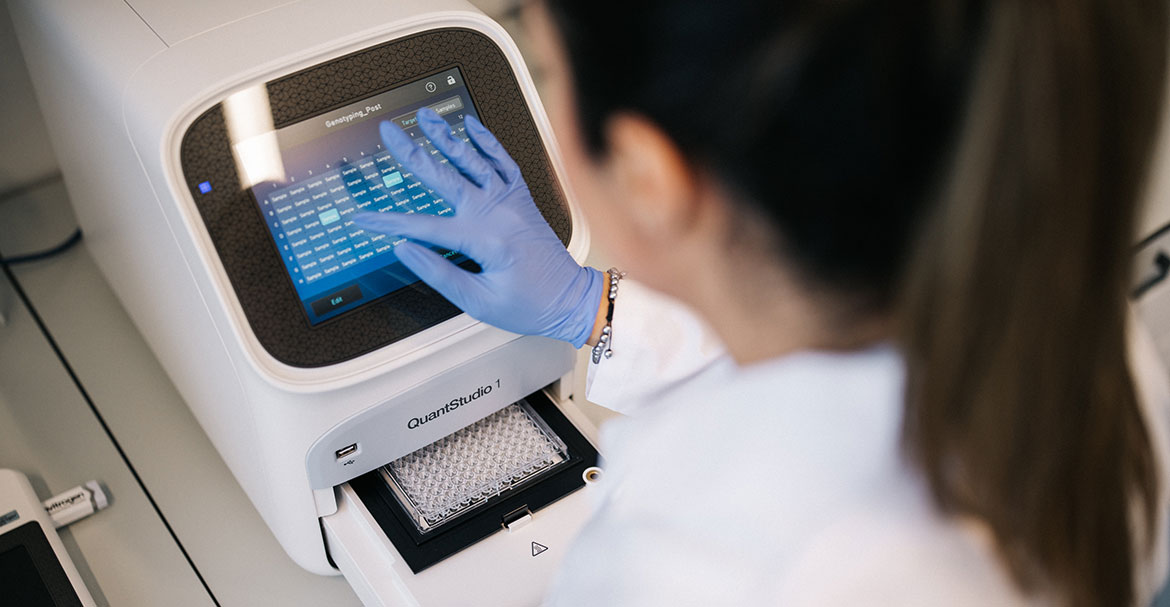
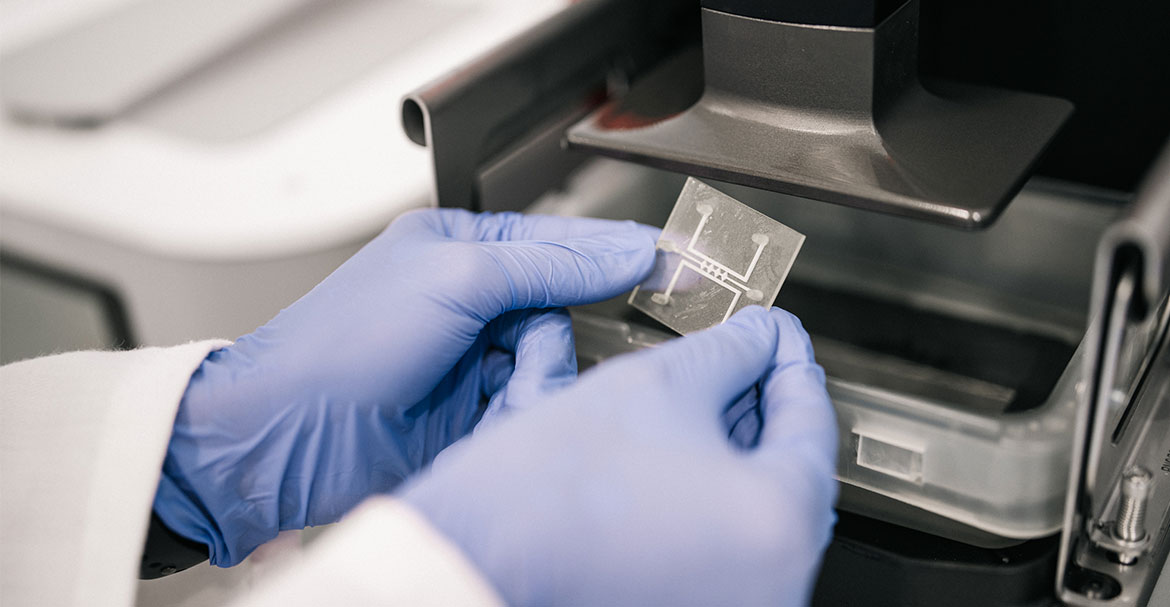
The four-person CanChip team develops high-precision tumor-on-a-chip models that offer significant advantages over traditional methods such as 2D cell cultures and animal testing. Complex tumor-biological processes are replicated here in a controlled microenvironment.
Fewer side effects, better quality of life
This technology allows the effectiveness of drugs to be tested under conditions that closely resemble human tumors, enabling patients to receive individually tailored and more effective chemotherapy. Side effects can be reduced through such a personalized treatment approach. It improves patients‘ quality of life and reduces the burden of lengthy clinical trials,“ Madani is convinced.
Last but not least, tumor-on-a-chip technology makes an important contribution to animal welfare by significantly reducing the high number of animal experiments required in cancer research. “During my master‘s degree, I worked for a company that conducted research on rats and mice. That was difficult to bear. So I looked for an alternative,” explains the biotechnologist in fluent, almost accent-free German.
Ghazaleh Madani learned the foreign language while working part-time in a café during her studies. “I’m a real perfectionist, but here I had to learn to live with making mistakes. That’s how I realized that it doesn’t make sense to avoid doing something just because it might not be perfect.”
Having the courage to start something new, to try something new, to endure frustration – this now helps the founder manage CanChip. Still, the hurdles are sometimes high. “Only 2% of all investments go to companies run by women,” she criticizes, explaining that it’s not just the idea that matters, but above all the person behind it. With professional expertise and strong arguments, she ultimately managed to convince an investor. “Without my partner, who is German and knows his way around the business world here, I probably wouldn’t have been able to do it,” says the entrepreneur, who would like to see a denser network of deep-tech start-ups in her field. “Not just ten or twelve, but 50 - 60 members would be ideal to achieve something together." Too often, bureaucracy and documentation requirements, long processing times, and complex standardization procedures test her patience. Especially since, as managing director, she has already planned the next steps. “Two additional laboratories have been reserved. We have the capacity to grow, want to attract new customers, and hire staff for this purpose.”
In order to attract skilled professionals, the graduate maintains close ties with her university, and plans to offer a workshop for students and present the new technology for which the patent process is underway. Her strategic goal is clearly defined: to further develop the platform and become a leading provider, not only in Germany but internationally.
Ghazaleh Madani studied biochemistry and molecular biology at the University of Potsdam. In 2025, she was named “Newcomer of the Year” for her start-up.
Zur CanChip GmbH: https://canchip.org/
This text was published in the university magazine Portal - Zwei 2025 „Demokratie“. (in German)
Here You can find all articles in English at a glance: https://www.uni-potsdam.de/en/explore-the-up/up-to-date/university-magazine/portal-two-2025-democracy