
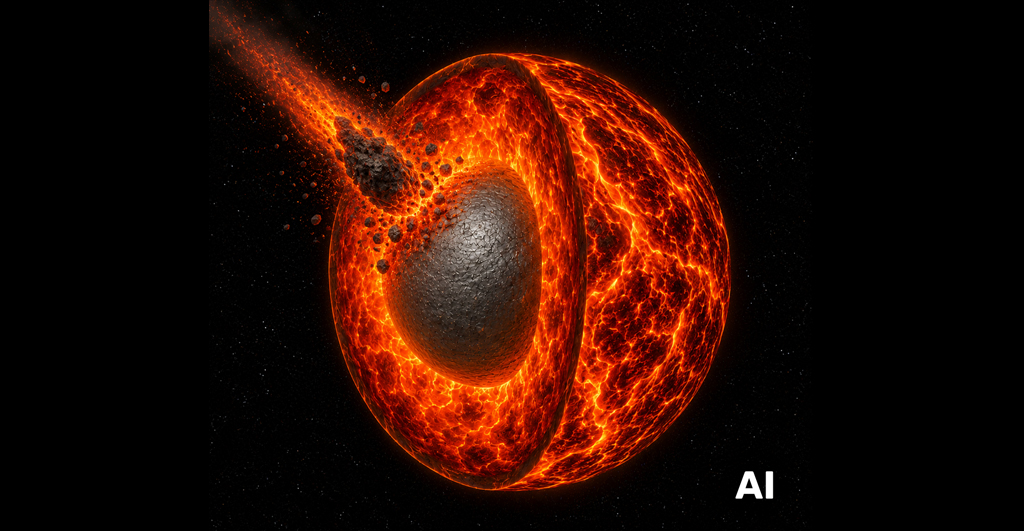
Contrary to the “late-veneer” hypothesis proposed in the 1970s, a recent study shows that, after the formation of its core, Earth likely did not receive any significant influx of siderophilic material—elements with a strong chemical affinity for iron. This is one of the findings of the DFG-funded GEPRIS research project “Highly Siderophilic Elements: A Window into Earth’s Accretion” (2019–2026). The project is led by the Institute of Geosciences (University of Potsdam) in cooperation with the Institut de minéralogie, de physique des matériaux et de cosmochimie (Sorbonne Université / CNRS / Muséum national d’Histoire naturelle).
Dr. Ingrid Blanchard, who conducted her research at both the Institute of Geosciences in Potsdam and Sorbonne Université, led an international team of researchers that succeeded in gaining these new insights. The scientists simulated in laboratories the extreme pressure and temperature conditions that prevailed during the Earth’s formation. The study was published in the journal “Science Advances” (https://doi.org/10.1126/sciadv.aef0411)
Background Information on the Project
The formation and differentiation of the Earth in chemically distinct envelops started about 4.5 billion years ago. The biggest chemical fractionation of Earth’s history separated the silicate mantle from the iron rich core. Elements were partitioned between the two reservoirs depending on their chemical affinity for silicate (lithophile element) or iron (siderophile element). Most of the respective composition of the mantle and the core was established once the differentiation ceased, about a hundred million years after the beginning of accretion. However, the abundance of the so called Highly Siderophile Elements (HSE) in the mantle is at odds with the generally accepted scenario whereby siderophile elements segregated in the forming core. Indeed, they display a chondritic relative abundance in the mantle. Chondrites are a class of meteorites reflecting the composition of the early Earth. To explain this, it was proposed that a “late accretion”, or “late veneer”, composed of carbonaceous meteorites bombarded the Earth, once the core formation ended, bringing HSEs to the Earth’s mantle. The abundance of HSE in the mantle would be a signature of this late accretion. This late accretion is also sometimes proposed as the step that brought water to the Earth, allowing life to develop. Nevertheless, one possible explanation of the overabundance of HSE in the Earth’s mantle could be that their core-mantle partitioning was affected by the extreme pressure and temperature of the Earth’s differentiation. Indeed, high pressures and/or high temperatures can modify the metal-silicate partitioning behavior of those elements. This has never been tested experimentally at the accurate conditions of the differentiation, and could potentially change our view of the accretion and differentiation of the planet.
In this project, the metal-silicate partitioning of HSE at the pressure and temperature that were the ones of the differentiation was investigated using diamond anvil cell coupled with laser heating system. The results from state-of-the-art experimental and analytical techniques were combined with core formation models in order to decipher the contribution of core-mantle differentiation on the budget of HSE in the mantle and its implication on constraining the contribution by late accretion in the evolution of the Earth’s mantle.