
In a new discovery published in Nature Communications, scientists of the University of Potsdam and Stockholm University have unveiled the intricate molecular mechanism by which a specialized protein complex twists and stretches its target to insert a critical metal ion—essential for life-sustaining biological processes.
The research, led by Dr. Maximilian Kahle, Dr. Pia Ädelroth, and Dr. Petra Wendler, focuses on the NorQD complex, a molecular machine in bacteria that enables the insertion of iron into cytochrome c-dependent nitric oxide reductase (cNOR)—a key enzyme in denitrification, a process vital for soil health and nitrogen cycling.
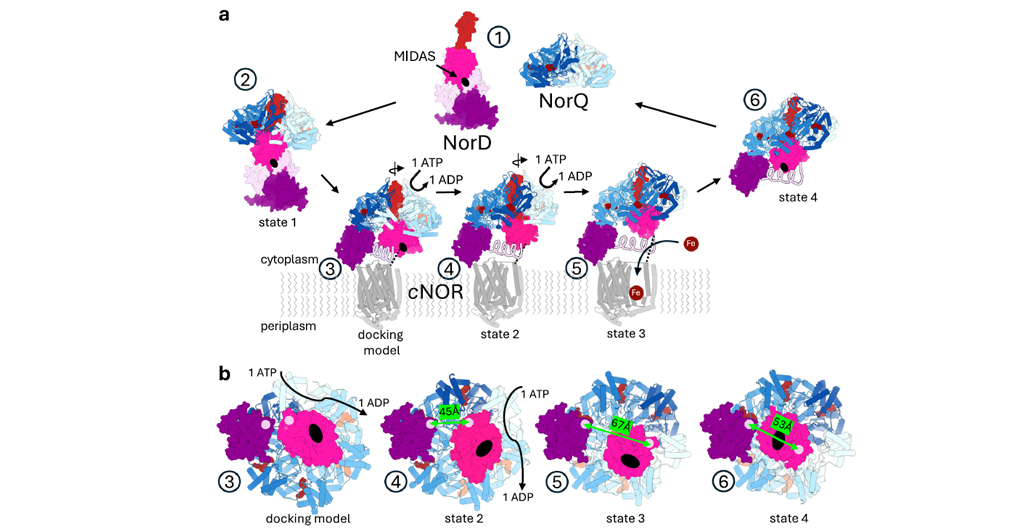
Using cutting-edge cryo-electron microscopy (cryo-EM), the team captured high-resolution snapshots of the NorQD complex in action. They discovered a remarkable "twisting mechanism": the NorQ ATPase forms a hexameric ring that grips its partner protein, NorD, via a finger-like extension from NorD’s VWA domain that threads into the central pore of NorQ. This interaction, combined with a second anchor at NorD’s N-terminus, creates a lever system. As NorQ subunits hydrolyzes ATP they rotate the NorD complex like a corkscrew. This rotation stretches a flexible linker region in NorD, generating mechanical force that remodels the target cNOR protein. This structural change opens up the enzyme’s active site, allowing the insertion of a non-heme iron (FeB) cofactor—without which cNOR is completely inactive.
“This is like a molecular wrench turning a bolt to unlock a door,” explains Dr. Wendler. “The NorQD complex doesn’t just bind to cNOR—it actively twists it open using mechanical energy from ATP.”
The study also reveals a potential redox switch: under oxidizing conditions, a disulfide bond forms in NorQ, halting ATP hydrolysis and effectively pausing the machine. This suggests a built-in regulatory mechanism, possibly linking metal insertion to cellular redox state.
The findings not only solve a long-standing mystery in metalloprotein biogenesis but also provide a new paradigm for how AAA+ ATPase complexes—found across all life forms—remodel their targets. The twisting mechanism may be a common strategy used by similar chaperone systems, including those involved in ribosome assembly and chlorophyll production.
“This work reveals a fundamental principle of cellular engineering,” says Dr. Ädelroth. “Nature uses mechanical force, not just chemistry, to build and maintain complex molecular machines.”
The research was supported by the German Research Foundation (DFG) and the Swedish Research Council, with high-resolution cryo-EM data collected at the Swedish National Facility.
Link to Publication: Kahle, M., Appelgren, S., König, F. et al. NorQD AAA+ complex drives metal insertion by a twisting mechanism. Nat. Commun. (2026). https://doi.org/10.1038/s41467-026-71044-4
Contact:
Prof. Dr. Petra Wendler
Institute of Biochemistry and Biology
E-Mail: petra.wendler@uni-potsdam.de