News from the University of Potsdam

Subjects
Selected Subject:
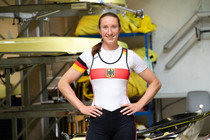
Maren Völz steht in einer Bootshalle.

“Strength, Endurance, and the Right Technique” – Potsdam student Maren Völz rows in the national team

“It feels great to glide across the water,” Maren Völz says enthusiastically. However, the rower knows from many years of experience that it takes a …
Das Bild zeigt Prof. Dr. Thorsten Wagener. Das Foto ist von Sandra Scholz.

In High International Demand – University of Potsdam among Top 15 in New Humboldt Ranking

The University of Potsdam is held in high regard by researchers from abroad. This is the result of the current, revised Humboldt Ranking, in which it …
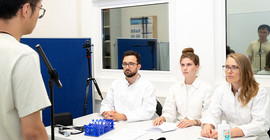
Three apparently unhappy examiners ask the test subject to solve difficult problems and pose uncomfortable questions.

Stress Fest at the Stress Test – A visit to Prof. Dr. Pia-Maria Wippert’s laboratory

A plain and white-painted room in the historic building no. 12 at Neues Palais, one table, three chairs. Nothing suggests that things are about to get …

University of Potsdam Once More in Group 201–250 in THE Ranking of Best Universities Worldwide

In the current 20th edition of the renowned “Times Higher Education” (THE) ranking, the University of Potsdam was able to retain its top position from …
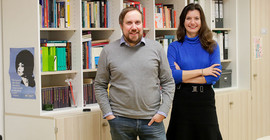
Prof. Fabian Schuppert and Janina Walkenhorst

Climate Change for Millions – Researchers analyze which administrative structures cities need and how participatory formats can be successful

Berlin is getting hot. Nowhere else in Germany was the summer of 2022 as warm as in the capital: 20.6°C on average – and thus one and a half degrees …
Prof. Dr. Ariel D. Stern

Digital Health Researcher Ariel D. Stern Moves from Harvard to the University of Potsdam with Humboldt Professorship

Digital health expert Ariel D. Stern, currently a professor at Harvard Business School, has been awarded an Alexander von Humboldt Professorship and …
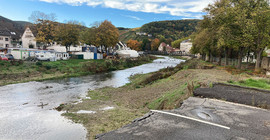
The researchers of the KAHR project are investigating what lessons can be learned from the flood of the century and how such devastating damage can be avoided in the future.

After the Flood – what can be learned from reconstruction in the flooded areas along the Ahr and Erft rivers

In July 2021, parts of Rhineland-Palatinate and North Rhine-Westphalia experienced one of Germany's most severe natural disasters after 1945. The …
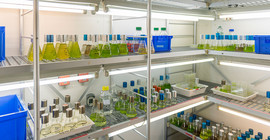
The walk-in sample chamber from the "DynaTrait" project.

Diversity Provides Stability – In the Priority Program “DynaTrait”, biologists combine mathematical models, field studies, and laboratory experiments to explore how nature works

It is comfortably warm and bright in the climate chamber. At first glance, you don’t see that the numerous glass flasks filling the illuminated …
Hund balanciert Kaffeetasse auf dem Kopf

Coffee with Dog – Milena Rabovsky analyzes language processing in the brain through neural networks and primarily relies on learning effects through prediction errors

Listen up: “The dog was bitten by the man.” – Got it? No? Good! When we read or hear something, our brain often already knows what will come next. …
Ötztal in Austria

Understanding Extremes – The Research Training Group NatRiskChange develops methods for the analysis and quantification of natural hazards and risks in a changing world

Changing conditions, such as global warming and land use, can strongly influence the occurrence of natural hazards and the risk they pose. “It is the …