News from the University of Potsdam

Subjects
Selected Subject:
Prof. Dr. Tim Dietrich

Astrophysicist Prof. Dr. Tim Dietrich receives IUPAP Early Career Scientist Prize

A good start in 2023: Astrophysicist Prof. Dr. Tim Dietrich receives IUPAP Early Career Scientist Prize in General Relativity and Gravitation and a …
Geoscientist Dr. Gerold Zeilinger wearing AR glasses

Using AR Glasses to Get a Better View - Gerold Zeilinger wants to use augmented reality to make landscape planning decisions easier

“Many people cannot imagine complex objects in space when they see them on a flat plan or map. If, for example, a wind turbine is to be erected or a …
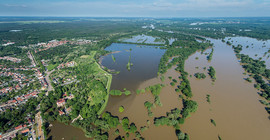
Lifeboat in flood disaster

Better to Have a Warning! – Researchers Examine 2021 Flooding Catastrophe From the Perspective of Those Affected

In July 2021, devastating floods caused by heavy rainfall occurred in Rhineland-Palatinate and North Rhine-Westphalia, and to some extent also in …
Behavioral experiment with wild rodents.

“We Recognize Animals as Individuals” – Researchers of the University of Potsdam investigate the personalities of wild animals

Jana Anja Eccard knows her mice well. For 27 years, she has been researching the behavior of small rodents in numerous experiments, both in the …
“The three phases of exceptional dynamics: (1) Predation on the unprotected bacteria by predators, (2) toxin formation as cooperative defence and recovery of the bacterial population, (3) filament formation as individual defence through evolution and stabilisation of densities”.

In the end, it’s the individual advantage that counts – Bacteria rely on cooperation and evolution in order to defend themselves against predatory protists

Eating and being eaten is a normal process in nature. These predator–prey dynamics help to stabilise ecosystems. It ensures that individual species do …
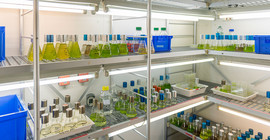
Installation of a solar-powered telemetry base station.

With Kudu, Eland, and Springbok – How Wildlife Management Can Help the Savanna

The savanna: individual groups of trees stand picturesquely on wide plains, large herds of wild animals pass by, watched vigilantly by prides of lions …
Prof. Dr. Ilko Bald

Tracing Single Molecules – Potsdam researchers use nanoengineering for diagnostic procedures and to study chemical reactions

Since 2018, chemist Prof. Ilko Bald and his team have been researching how to place single molecules precisely within artificial DNA nanostructures. …
Lake No Lake is a lake in British Columbia (Canada), dammed by the Tulsequah Glacier in the background (estimated height 150-200 m), which empties several times a year. In the 1990s, this lake, when full, held a volume of over 700 million cubic meters of meltwater. This photograph shows the lake almost completely emptied on 9/16/2022 with icebergs left on the lake bottom.

Dangerous Water – Outburst floods from ice-dammed glacial lakes have changed dramatically

Glaciers in high mountains can dam lakes, some of which burst out suddenly, posing a hazard to human settlements downstream. To better understand …

30 Million Euros for Digital Education – The University of Potsdam Leads Networking and Transfer Office

Over the next three years, the German Federal Ministry of Education and Research (BMBF) will provide 30 million euros in funding for the networking …
Prof. Henrike Müller-Werkmeister

Shorter than the blink of an eye – Prof. Henrike Müller-Werkmeister can watch molecules in action with ultrashort laser beams


The sun was one of the first objects to be studied spectroscopically. As early as the 19th century, the researchers Robert Bunsen and Gustav Robert …