
Around the world with a pedometer
Prof. Dadaczynski did not let himself be deterred—and it is now clear that he was onto a topic of growing importance. In 2013, he was able to work on the subject for the first time in a research project at Leuphana University of Lüneburg as part of the “Innovation Incubator” program funded by the European Commission. “We worked with pedometers that looked a bit like Tamagotchis back then. You clipped them to your belt or put them in your pocket. We had 300 of them, which we distributed to the participants,” he recalls. The data collected by the trackers was integrated into a mobile game app that allowed users to take a trip around the world based on the number of steps they took.
“We compared the results with a control group without pedometers and found that our game actually motivated people to take more steps. So we achieved a positive health effect through gamification,” Dadaczynski says. In 2016, he published the first German-language book on the topic: “Promoting Health Through Play.” A new edition is currently planned, completely revised, and updated to reflect the latest research. “While we had to do a lot of convincing with the publisher back in 2016, we didn’t have to explain anything at all for the new edition. The topic is now well established,” the researcher says.
Discovering health services through gaming
For a while, Prof. Dadaczynski served as head of department at the Federal Centre for Health Education (now the Federal Institute of Public Health (BIÖG)), where he focused on evaluating measures to implement the Act on Strengthening Preventive Health Care. He accepted his first professorship in 2018 at Fulda University of Applied Sciences in East Hesse. There, he headed the newly established Chair of Health Information and Communication and continued his research on health in the school context as well as digital solutions for public health. The “Nebolus” app, which he developed there with his team, also combines playfulness with health topics. The idea behind Nebolus is to make young people aware of health services in their area and to break down barriers. “While psychotherapeutic capacities are exhausted, health promotion and prevention services are often not used. This is partly because mental health issues are stigmatized, and young people don’t dare to seek out support services or speak with professionals. On the other hand, young people often don’t know what relevant services exist in their area—hence the name Nebolus,” explains the health researcher. Based on this insight, an app was developed that allows users to complete so-called “rallies,” playfully discovering health services in their area and talking to their providers.
To do this, Nebolus uses stories told via voice messages that players gradually complete by visiting locations in their area and scanning QR codes. The app has already been used in over 60 different locations. One reason the app has been so well received is that Nebolus offers a framework that is highly customizable. Providers who want to use Nebolus can work with templates or develop their own story and thus tailor the rally to local conditions. The app can also be personalized in terms of content. “We’ve already received many inquiries from universities that want to help new students find their way around campus, particularly regarding health-related issues.” For example, the app is being used in a project at the Technical University of Munich to help expectant parents find suitable healthcare services in their area. And in cooperation with Kempten University of Applied Sciences, an accessible version was developed so that Nebolus can also be used by elderly adults and people with disabilities.
Team player
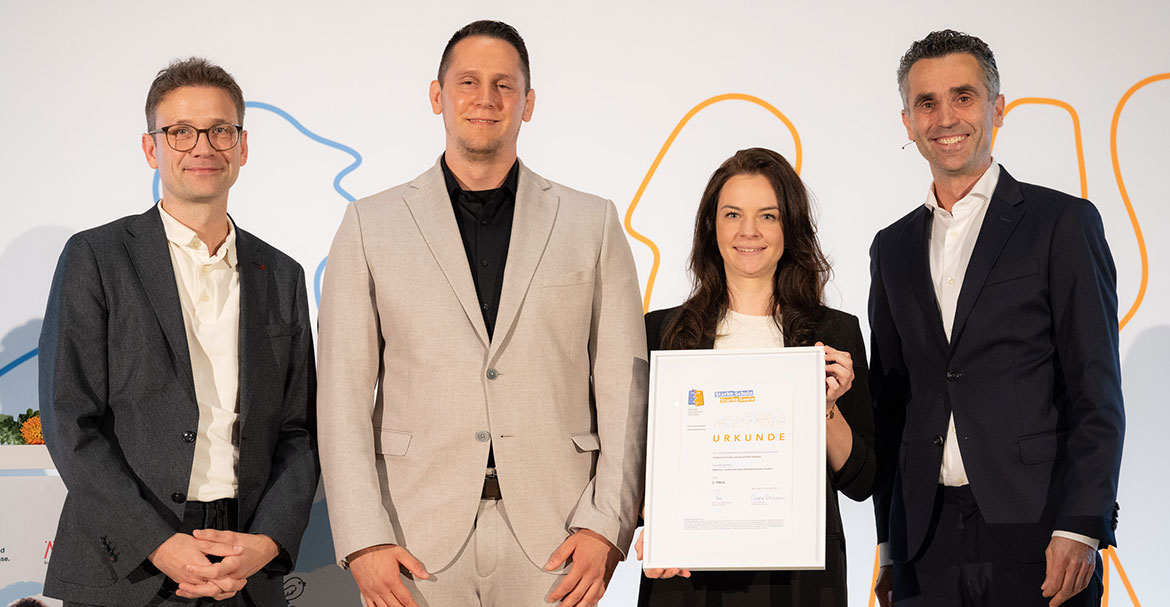
Nebolus has not only been well received – it is currently used by about 170 healthcare providers in Germany – but has also won several awards: the Hessian Health Award in 2022 and the Berlin Health Award in 2025. It was important to Kevin Dadaczynski that everyone involved in developing the app received recognition: “Without my team and external service providers like graphic designers and IT developers, Nebolus wouldn’t exist. When we won the Hessian Health Award, we invited everyone, went up on stage together, and celebrated our achievement.”
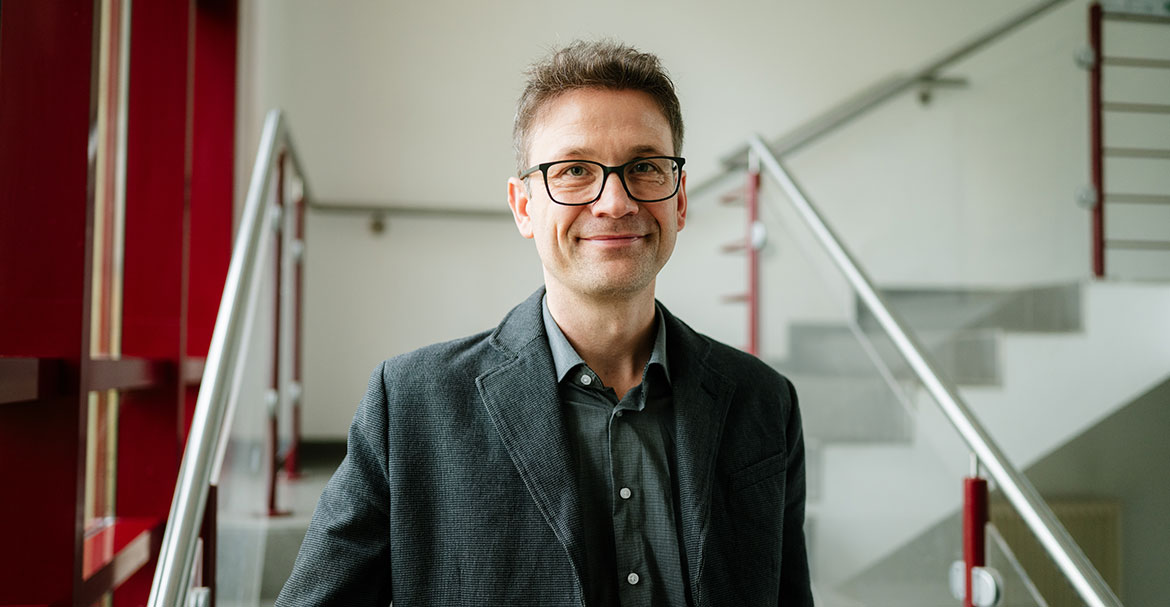
He has been Professor of Health Education in Sport at the University of Potsdam since April 2025 and was able to bring at least part of his team with him, namely Mareike Brockmann, who is responsible for communications related to Nebolus, among other things. He is currently expanding the newly established chair and has settled in well in Potsdam: “I can find a home here for my projects, a kind of space where new ideas can emerge. The ‘Professors’ Summer Party’ was also great. There, newly appointed professors compete against veteran professors in a quiz. We, the new professors, lost by just one point—it’s apparently never been that close before,” Dadaczynski says happily. He also really appreciates the helpfulness within the faculties and the spatial proximity to other research areas: “The Institute of Geosciences and the Institute of Environmental Sciences and Geography are right next door. I can just knock on their door and ask if they’d like to discuss geographic information systems.”
Geographic information systems play a key role in Prof. Dadaczynski’s new project, “Buttrfly.” The app aims to foster more participation and a voice in health-related issues, enabling users to flag problems in their local communities. The goal is to make participation as accessible as possible: “We’re integrating several so-called Ecological Momentary Assessments (EMAs), which are methods that allow users to report issues directly the moment they notice them. Is there a broken bike path that makes it harder to ride a bike more often in daily life? Then you can simply take a photo of it, briefly describe it via text or voice message, place a pin on a map at the location, or all of the above. “This directness helps prevent forgetting and memory distortions, which frequently occur in retrospective surveys.” The aim is to make local needs visible that might otherwise remain hidden or where people wouldn’t know who to turn to with their problem. At the same time, healthcare providers should also be able to create participatory scenarios and respond dynamically to needs.
Chocolate-covered broccoli
But Kevin Dadaczynski knows that gamification is not a panacea. All too often, this buzzword is used to make unattractive topics seem more appealing: “We call this ‘chocolate-covered broccoli.’ Not everyone likes broccoli, so to make it more appealing, we dip it in chocolate sauce. The problem is that eventually the chocolate coating gets nibbled off, and there is still broccoli underneath.” So, an open research question is how to combine content and playful methods in a way that keeps users engaged in the long term.
This is often particularly difficult with children. Health and school form another major focus of Prof. Dadaczynski’s research. But for children and adolescents, health topics are generally not very interesting. “It doesn’t help to come at them with a wagging-finger attitude and say that they must live healthily now so they can benefit from it in 20 years,” Dadaczynski notes. And that often applies even to adults. New digital offerings are highly likely to be used only by those who already live health-consciously. This can exacerbate existing inequalities. So how can we encourage greater participation in health-related issues? This is the focus of the DFG project “Making e-participation work for transformations” – eParT for short – which Dadaczynski initiated and in which he is involved through two projects. “Among other things, we want to examine how playful mechanics can be used to foster lasting motivation for using digital participation formats. This ties my projects together very nicely: the playful component of Nebolus and the participatory approach of Buttrfly.”
More about Buttrfly: https://www.buttrfly.de/
More about Nebolus: https://nebolus.net/
This article appeared in the university magazine Portal - Eins 2026 „Inklusion“.