You took part in the European Student Assembly 2026. Can you give us an overview of your experience?
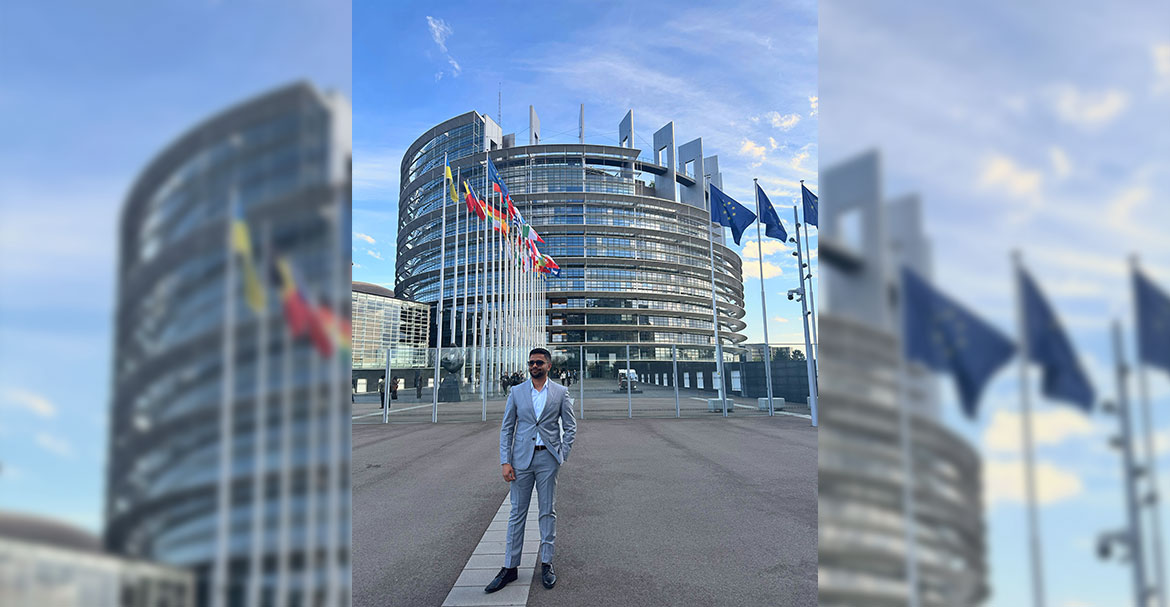
Albin Babu: I had the opportunity to take part in the ESA 2026 in Strasbourg as a representative of EDUC and the University of Potsdam. This was more than just a formal event on student politics; it was a deeply meaningful experience for me. As I come from India and am studying in Germany, visiting the European Parliament and taking part in a pan-European political discussion was like a dream come true.
What was the aim of the conference?
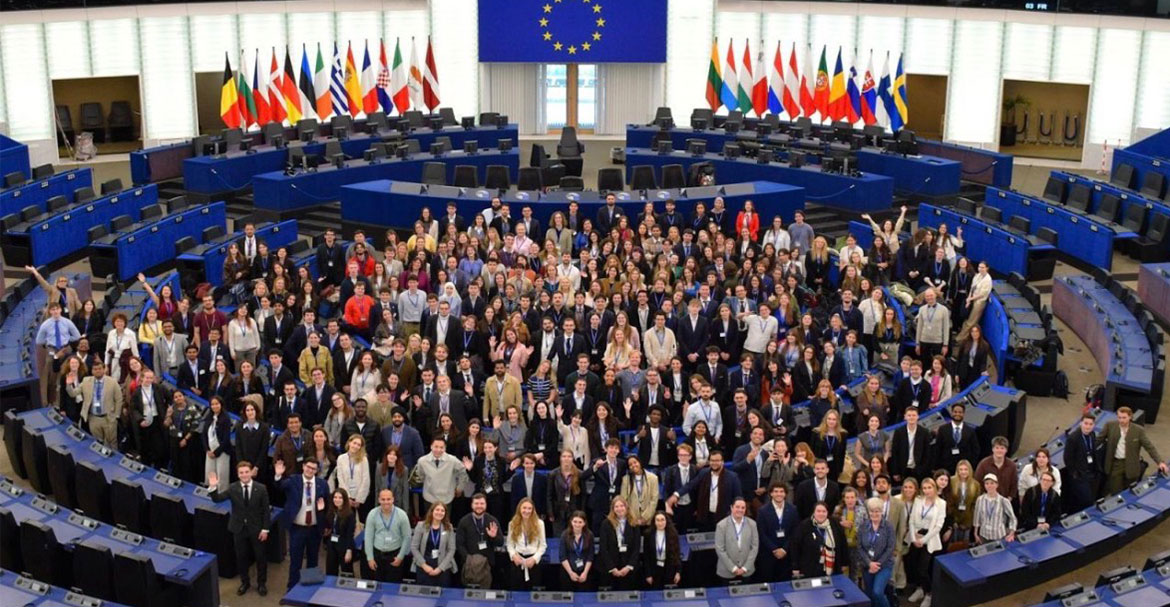
Albin Babu: The gathering brought together around 250 selected students from 34 countries to debate Europe’s major challenges and draw up policy recommendations. Our aim was to present student perspectives to a wider European audience and to discuss how the EU can address demographic change and promote the participation of older generations in society.
Participants discussed important current issues for Europe in various panels. Topics included how democracy can be strengthened and ways to promote a more circular economy. But there were also debates on mobility, education, digitalisation and Europe’s autonomy. You were part of Panel 7, which dealt with intergenerational solidarity. What did you achieve there?
Albin Babu: In the panel, we addressed topics such as social isolation, digital inclusion, active ageing and intergenerational participation. I was able to put forward two recommendations, which were accepted by the panel. The first focused on treating loneliness among older adults as a preventive public health issue. We argued that loneliness should be identified at an early stage through routine screenings within the healthcare system. Our second recommendation centred on intergenerational participation to prevent social isolation and should support the EU in promoting locally adapted structures, particularly in rural, remote and ageing regions. For me, the work on the panels was a practical lesson in policy-making – including the challenge of developing a societal proposal that is morally compelling, administratively realistic, legally sound and financially feasible.
You also took part in a major discussion on democracy and civic participation. What did you take away from that?
Albin Babu: This discussion helped me to link intergenerational solidarity with broader democratic issues. Issues such as social exclusion and democratic exclusion often overlap. People with fewer resources may be absent from civic spaces, not because they lack opinions, but because participation itself entails hidden costs. The debate made it clear that democratic participation must be designed with socio-economic inequalities, time and economic security in mind.
Now that the conference is over, how do you view the way politics is conducted in Europe?
Albin Babu: ESA 2026 has shown me that policy-making requires attentive listening, a willingness to compromise and institutional awareness. Good ideas must be feasible both legally and financially, and they must be socially just. Democracy is more than just voting; it requires access to information, opportunities for participation and protection against disinformation. The strong link between intergenerational solidarity and democratic participation is particularly crucial in this regard.
The conference took place in Strasbourg …
Albin Babu: The beauty of the city was an unexpected highlight for me. I was particularly impressed by the area along the banks of the Ill, in Petite France, around Gutenberg Street and near Strasbourg Cathedral. During my visit, I explored Notre-Dame Cathedral and marvelled at the architectural wonder of the Maison Kammerzell.
As someone with a keen interest in history, culture and political narratives, I also spent time reading up on Strasbourg and Alsace. One small historical detail particularly struck me: the connection between Alsatian culture and the dog breed known as the ‘Alsatian’ or German Shepherd. I learnt that the breed became known as the “Alsatian” in Britain after the First World War because anti-German sentiment made the word “German” politically unpalatable. This example shows how names, narratives and rhetoric can be reshaped by political contexts. It serves as a reminder that language is never neutral; it can preserve memories, defuse conflicts or, in other circumstances, contribute to exclusion and hostility.
This historical reflection connected unexpectedly with the themes of the ESA. Democratic life is shaped not only by institutions, but also by narratives: who belongs, who is trusted, who is represented, and how societies describe one another.
In your view, what role does EDUC play for the University of Potsdam?
Albin Babu: I am very grateful to the alliance for enabling me to take part in ESA 2026. But it offers so much more: at EDUC, I don’t feel like an outsider, but rather as a committed student who benefits from the many opportunities on offer. Before ESA 2026, I had already taken part in the Youth Integration Lab in Cagliari and will be attending the Research Summer School in Norway. These experiences have shown me that European university alliances do not just exist on paper, but actually broaden students’ academic, intercultural and professional horizons.
One tip I would give to other students is: read the university newsletter carefully, as many valuable opportunities remain undiscovered if you don’t actively look for them.
The European Student Assembly (ESA) is the main initiative of the EUC Voices Erasmus+ project and brings together around 250 students from across Europe every year. The event offers a platform where selected European students can engage with key challenges facing the European Union, hold meaningful discussions and promote intercultural exchange. Interested students can apply either as participants or as coordinators and contribute to the assembly’s discussion panels.
Further information: https://www.eucvoices.eu/european-student-assembly/european-student-assembly-2026-5th-edition