
Herzlich Willkommen am MenschenRechtsZentrum der Universität Potsdam!
Die Bibliothek des MenschenrechtsZentrum ist als Präsenzbibliothek angelegt. Sie steht Angehörigen und Studierenden der Universität Potsdam zur Nutzung nach Anmeldung offen.
Literatur stellen wir gern für Sie bereit; bitte vereinbaren Sie hierfür einen Termin: mrz [at] uni-potsdam.de.
Aus dem Institut
- Ankündigungen -
- Info -
OSCE Quo Vadis? The Organization for Security and Co-operation in Europe 50 Years after the Helsinki Final Act
The Ladenburg Roundtable “OSCE quo vadis? 50 Years after the Helsinki Final Act,” held on 5–6 March 2026 at the Daimler and Benz Foundation. Initiated by the Human Rights Centre of the University of Potsdam, the conference brought together scholars and practitioners to assess the current role and future prospects of the Organization for Security and Co-operation in Europe (OSCE). The discussions addressed the organisation’s role in armed conflicts, the protection of human and minority rights, emerging policy challenges, and its position within the contemporary rules-based international order. While participants highlighted the significant political constraints facing the OSCE—particularly in light of geopolitical tensions and the war in Ukraine—they also emphasised the organisation’s continuing relevance as a forum for dialogue, a norm-shaping institution, and a repository of operational expertise in conflict management and confidence-building measures.

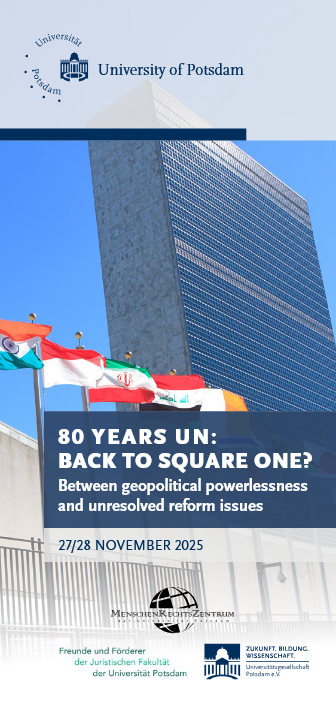
Konferenz 80 Years UN: Back to Square One?
80 Years UN: Back to Square One? Between Geopolitical Powerlessness and Unresolved Reform Issues
Human Rights Centre of theUniversity of Potsdam, 27–28 November 2025
In late November 2025, the Human Rights Centre of the University of Potsdam hosted an international academic workshop marking the eightieth anniversary of the United Nations. Under the provocative title “80 Years UN: Back to Square One?”, leading scholars, practitioners, and diplomats examined the organisation’s current state, its continued normative relevance, and the prospects of reform at a time of stark geopolitical confrontation. Across eight panels, the discussions revealed a mixture of deep concern and cautious optimism: the UN faces unprecedented pressure, yet retains an indispensable—if fragile—role in global governance.
The workshop was financially supported by Verein der Freunde und Förderer der Juristischen Fakultät der Universität Potsdam, by Universitätsgesellschaft der Universität Potsdam, and by Verein der Freunde und Förderer des MenschenRechtsZentrums der Universität Potsdam.