
Advanced Photocatalysis Lab (Dr. Koopman)
Light fundamentally sculpts the word we live in. Through complex molecular architecture, nature converts sunlight into stored chemical potential. This process relies on the rigorous orchestration of light absorption and chemical transformations at the nanoscale. Achieving a similar precise photochemical control by artificial photocatalysts presents a formidable challenge that might require fundamentally new approaches. Yet, unlocking this capability would mark a huge advance for green chemistry and global sustainability.
The Advanced Photocatalysis Lab, led by Dr. Koopman, investigates novel concepts for photocatalysis. Our work focuses on the dynamic interface between light absorption and chemical transformation. Specifically, we aim to engineer plasmonic antennas that govern photon harvesting and direct energy flow toward reaction centers. We further explore how the local environment of the catalyst dictates reactivity, including how quantum fluctuations can be leveraged to enhance selectivity toward desired products by strong light matter interaction.
Our efforts are a part of the Collaborative Research Center 1636 on Elementary Processes in Nanoscale Metals
We are currently offering two experimental Master's thesis projects (Physics or Chemistry) focused on the investigation of advanced photocatalysts.
Topics
Fundamentals of Plasmon Chemistry
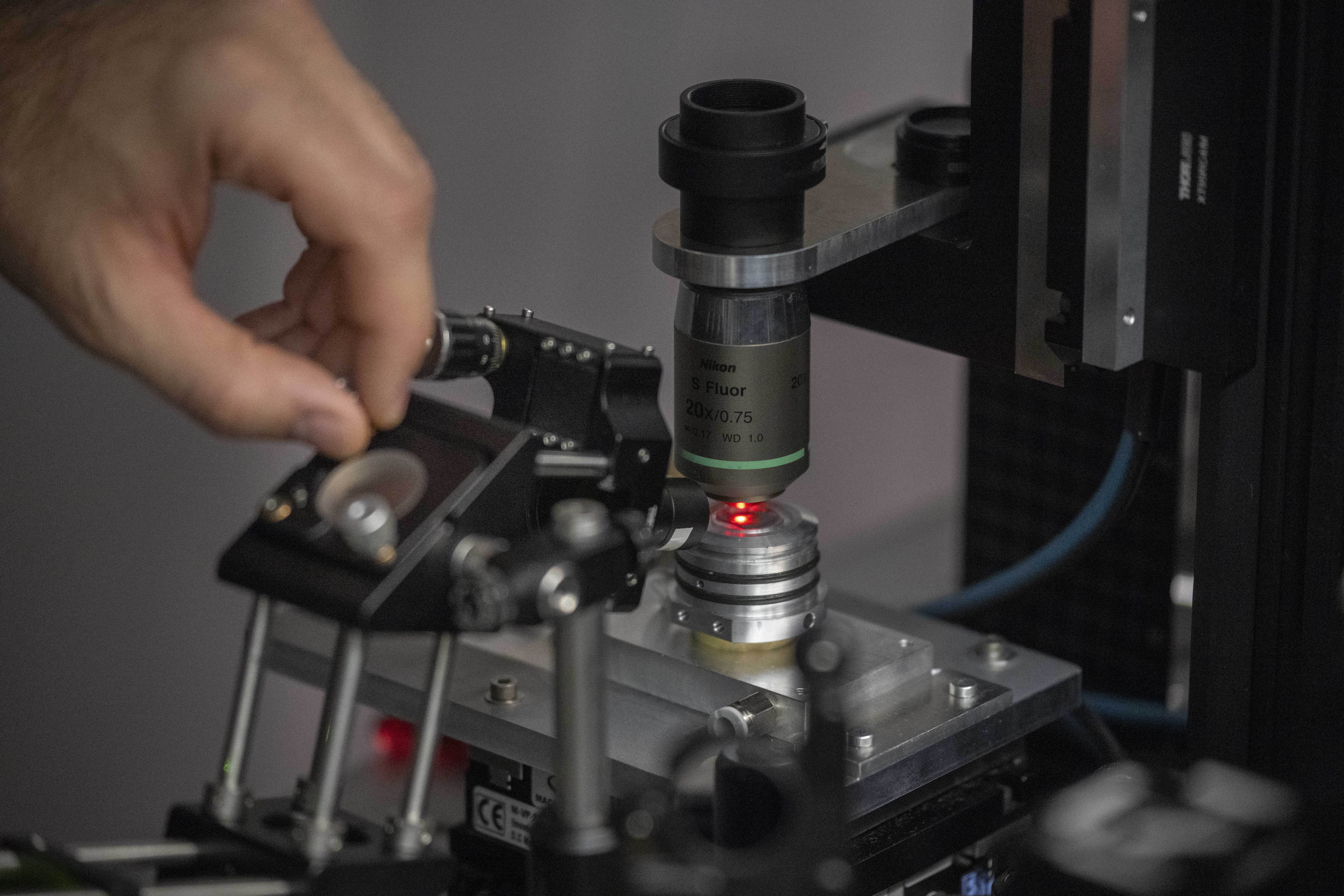
Plasmonic nano-antennas possess the unique ability to concentrate light energy below the conventional diffraction limit. Using micro-spectroscopy, we study how this sub-wavelength confinement can be utilized to power and control chemical reactivity. Most recently, we have identified that Auger processes lead to significant charge excitation in metal particles. This finding indicates that Auger-mediated pathways may be fundamental to the functionality of plasmonic photocatalysts.
People: Alexandra Faber, Anton Bauer, Kyra Peikert
Paper
Koopman, W.; Kutschera, J.; Stete, F; Bargheer, M.
Auger-Excited Photoluminescence from Gold Nanoflowers
ACS Nano, 2025, 19, 39, 34517–34526
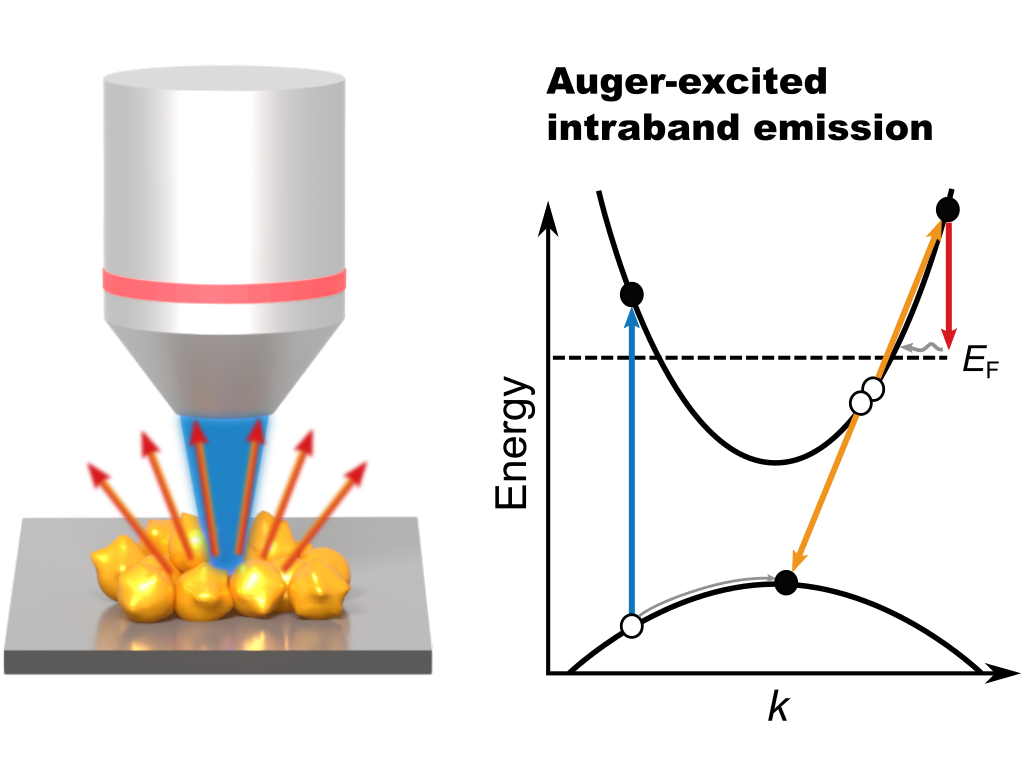
Photoluminescence from metal nanostructures offers a promising means of studying excited charge processes in metal nanostructures. Moreover, they have many potential applications in sensing, imaging, and nanothermometry. However, a general understanding of the emission from metal nanoparticles has not yet been achieved. In particular, the possible presence of sequential emission mechanisms involving the excitation of conduction band electrons via interband Auger scattering remains unclear.
In this article, we provide spectroscopic evidence of Auger-excited intraband emission from gold nanoflowers. We employ a combination of photoluminescence and photoluminescence excitation spectroscopy to investigate the excitation pathways in films of gold nanoflowers. While, on the one hand, the excitation spectrum clearly demonstrates absorption by interband transitions, the emission spectra can be unequivocally assigned to intraband recombination. The combination of these two observations can be conclusively explained only by Auger-excited intraband emission. These results suggest Auger excitation to be a promising route to generate energetic nonthermal electrons with energies substantially above the Fermi level. Exploiting this effect could strongly benefit applications for nanoluminescent probes and the progress of plasmon catalysis.
Stete, F.; Bargheer, M.; Koopman, W.; Capacitive Photocharging of Gold Nanorods. Nat. Commun. 2025, https://doi.org/10.1038/s41467-025-67130-8
Koopman, W.; Titov, E.; Sarhan, R. M.; Gaebel, T.; Schürmann, R.; Mostafa, A.; Kogikoski Jr., S.; Milosavljević, A. R.; Stete, F.; Liebig, F.; Schmitt, C. N. Z.; Koetz, J.; Bald, I.; Saalfrank, P.; Bargheer, M. The Role of Structural Flexibility in Plasmon-Driven Coupling Reactions: Kinetic Limitations in the Dimerization of Nitro-Benzenes. Adv. Mater. Interf. 2021, 8 (22), 2101344. https://doi.org/10.1002/admi.202101344.
Koopman, W.; Sarhan, R. M.; Stete, F.; Schmitt, C. N. Z.; Bargheer, M. Decoding the Kinetic Limitations of Plasmon Catalysis: The Case of 4-Nitrothiophenol Dimerization. Nanoscale 2020, 12 (48), 24411–24418. https://doi.org/10.1039/D0NR06039A.
Sarhan, R. M.; Koopman, W.; Pudell, J.; Stete, F.; Rössle, M.; Herzog, M.; Schmitt, C. N. Z.; Liebig, F.; Koetz, J.; Bargheer, M. Scaling Up Nanoplasmon Catalysis: The Role of Heat Dissipation. J. Phys. Chem. C 2019, 123 (14), 9352–9357. https://doi.org/10.1021/acs.jpcc.8b12574.
Sarhan, R. M.; Koopman, W.; Schuetz, R.; Schmid, T.; Liebig, F.; Koetz, J.; Bargheer, M. The Importance of Plasmonic Heating for the Plasmon-Driven Photodimerization of 4-Nitrothiophenol. Sci Rep 2019, 9 (1), 3060. https://doi.org/10.1038/s41598-019-38627-2.
Liebig, F.; Sarhan, R. M.; Sander, M.; Koopman, W.; Schuetz, R.; Bargheer, M.; Koetz, J. Deposition of Gold Nanotriangles in Large Scale Close-Packed Monolayers for X-Ray-Based Temperature Calibration and SERS Monitoring of Plasmon-Driven Catalytic Reactions. ACS Appl. Mater. Interfaces2017, 9 (23), 20247–20253. https://doi.org/10.1021/acsami.7b07231.
Nanoscale Reactors for Photocatalysis
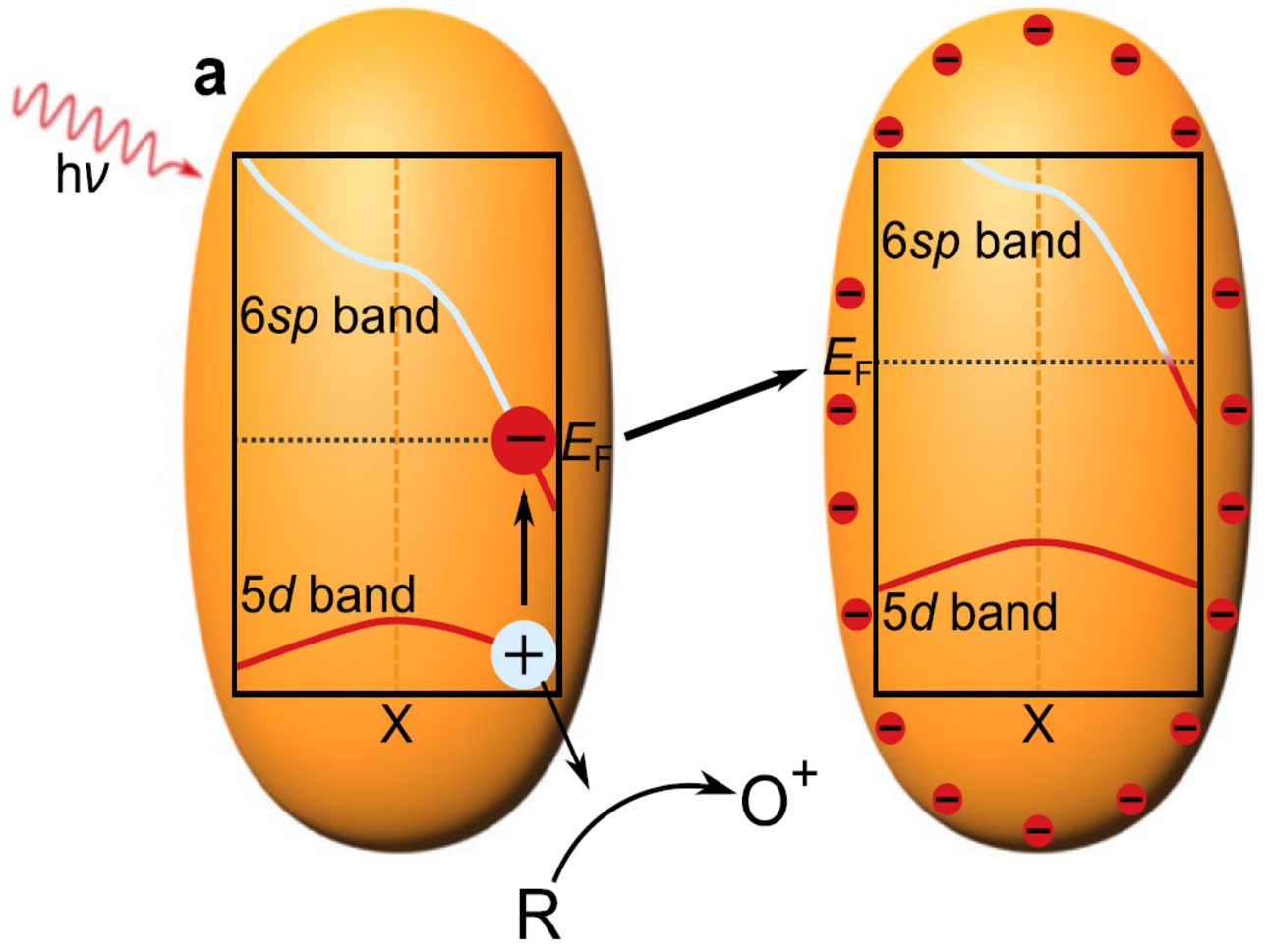
The efficacy of a photocatalyst is not intrinsic; it critically depends on its immediate surroundings. We investigate how a tailored nanoscale environment can dictate the rate and selectivity of photocatalytic reactions. In a recent breakthrough, we demonstrated that the ligand shell encasing plasmonic particles can be engineered to function as a molecular capacitor. By storing photoexcited charge, this shell allows for effective regulation of the particle's redox potential.
People: Steven Berth, Christopher Flohr
Paper
F. Stete, M. Bargheer, W. Koopman
Capacitive photocharging of gold nanorods
Nature Communications 17, 1 (2026)
Light can charge plasmonic nanoparticles by photoredox reactions, significantly modifying their optical and chemical properties. However, the charging process has been challenging to track experimentally, severely hindering its thorough evaluation. In this study, we investigate the charging of gold nanorods during a light-induced reaction in situ, utilizing the sensitivity of the rods’ longitudinal localized surface plasmon resonance to charge accumulation. Describing the particles as nanocapacitors, we present a model to quantify the number of charges on the particles and their connection to the illumination intensity. We find that the Fermi level, together with all other energy bands, is raised because of the repulsive potential of the additional charges. Experimental observations of the dependence on the solvent, the particle size, and ligand type further corroborate the proposed capacitor model. The results presented in this study lay the groundwork for the rational engineering of dynamic charge accumulation during plasmon-driven photoreactions.
Olorunnisola, C. G.; Olorunnisola, D.; Neumann, C.; Koopman, W.; Günter, C.; Seitz, H.; Rawel, H. M.; Unuabonah, E. I.; Taubert, A. Zn-Doped Porous Graphitic Carbon Nitride: A High-Performance Catalyst for the Photodegradation of Pharmaceuticals and Personal Care Products. ACS Omega 2025, 10 (36), 41395–41412. https://doi.org/10.1021/acsomega.5c04537.
Adesina, M. O.; Alfred, M. O.; Seitz, H.; Brennenstuhl, K.; Rawel, H. M.; Wessig, P.; Kim, J.; Wedel, A.; Koopman, W.; Günter, C.; Unuabonah, E. I.; Taubert, A. Orange Peel Biochar/Clay/Titania Composites: Low Cost, High Performance, and Easy-to-Reuse Photocatalysts for the Degradation of Tetracycline in Water. Environ. Sci.: Water Res. Technol.2024. https://doi.org/10.1039/D4EW00037D.
Xu, X.; Sarhan, R. M.; Mei, S.; Kochovski, Z.; Koopman, W.; Priestley, R. D.; Lu, Y. Photothermally Triggered Nanoreactors with a Tunable Catalyst Location and Catalytic Activity. ACS Appl. Mater. Interfaces 2023, 15 (41), 48623–48631. https://doi.org/10.1021/acsami.3c09657.
Zhao, Y.; Sarhan, R. M.; Eljarrat, A.; Kochovski, Z.; Koch, C.; Schmidt, B.; Koopman, W.; Lu, Y. Surface-Functionalized Au–Pd Nanorods with Enhanced Photothermal Conversion and Catalytic Performance. ACS Appl. Mater. Interfaces2022, 14 (15), 17259–17272. https://doi.org/10.1021/acsami.2c00221.
Mitzscherling, S.; Cui, Q.; Koopman, W.; Bargheer, M. Dielectric Function of Two-Phase Colloid–Polymer Nanocomposite. Phys. Chem. Chem. Phys.2015, 17 (44), 29465–29474. https://doi.org/10.1039/C5CP04326C.
Strong Light Matter Interaction
Even in the absence of light, quantum fluctuations of photonic modes can hybridize with matter. We seek to exploit this phenomenon, known as light-matter strong coupling, by confining reactants within specific optical cavities. This approach allows us to utilize the vacuum itself as a pervasive 'catalyst.' Our goal is to steer chemical pathways and enhance selectivity by coupling molecular vibrations to the fluctuations of empty space.
People: Athena Majlesi
Paper
Stete F., Bargheer M., and Koopman W.
Ultrafast dynamics in plasmon–exciton core–shell systems: the role of heat
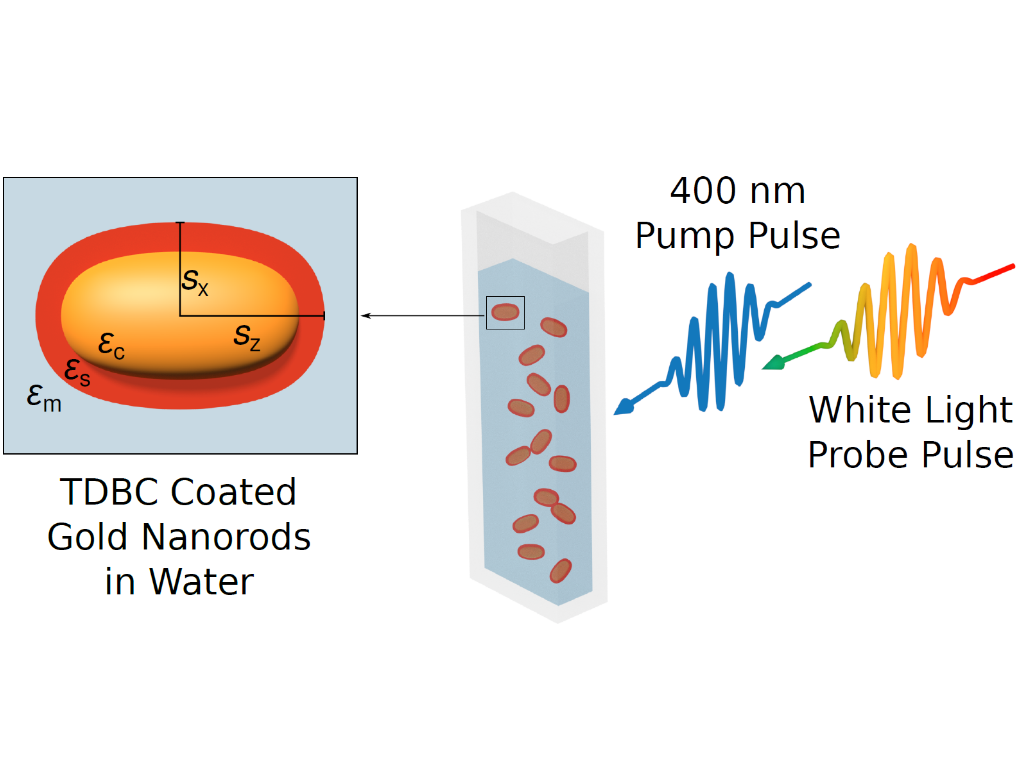
Strong coupling between plasmons and excitons gives rise to new hybrid polariton states with potential applications in various fields. Despite a plethora of research on plasmon–exciton systems, their transient behaviour is not yet fully understood. Besides Rabi oscillations in the first few femtoseconds after optical excitation, coupled systems show interesting non-linear features on the picosecond time scale. Here, we conclusively show that the source of these features is heat that is generated inside the particles. Until now, this hypothesis was only based on phenomenological arguments. We investigate the role of heat by recording the transient spectra of plasmon–exciton core–shell nanoparticles with excitation off the polariton resonance. We present analytical simulations that precisely recreate the measurements solely by assuming an initial temperature rise of the electron gas inside the particles. The simulations combine established strategies for describing uncoupled plasmonic particles with a recently published model for static spectra. The simulations are consistent for various excitation powers, confirming that heating of the particles is indeed the root of the changes in the transient signals.
Stete, F.; Bargheer, M.; Koopman, W. Ultrafast Dynamics in Plasmon–Exciton Core–Shell Systems: The Role of Heat. Nanoscale 2023, 15 (40), 16307–16313. https://doi.org/10.1039/D3NR02817H.
Stete, F.; Koopman, W.; Henkel, C.; Benson, O.; Kewes, G.; Bargheer, M. Optical Spectra of Plasmon–Exciton Core–Shell Nanoparticles: A Heuristic Quantum Approach. ACS Photonics 2023, 10 (8), 2511–2520. https://doi.org/10.1021/acsphotonics.2c01975.
Stete, F.; Schoßau, P.; Bargheer, M.; Koopman, W. Size-Dependent Coupling of Hybrid Core–Shell Nanorods: Toward Single-Emitter Strong-Coupling. J. Phys. Chem. C 2018, 122 (31), 17976–17982. https://doi.org/10.1021/acs.jpcc.8b04204.
Stete, F.; Koopman, W.; Bargheer, M. Signatures of Strong Coupling on Nanoparticles: Revealing Absorption Anticrossing by Tuning the Dielectric Environment. ACS Photonics 2017, 4 (7), 1669–1676. https://doi.org/10.1021/acsphotonics.7b00113.
People
Wouter Koopman, Team Leader
Dr. Wouter Koopman heads the Advanced Photocatalysis lab. His research is dedicated to understanding and developing novel methods for harnessing and utilizing light to drive and steer photochemical transformations. In his work, light is viewed not only as a sustainable energy source but critically, as a highly precise quantum-optical instrument capable of modulating reaction pathways and achieving high degrees of chemical selectivity. More on Wouter can be found on his personal webpage.

Athena Majlesi, PhD Student
As one of the three doctoral researchers in Project A04 of the Collaborative Research Center 1636, Athena's research investigates the influence of vibrational light-matter strong coupling on reaction selectivity in chemical processes. Here goal is to study the spatial coherence of vibrational coherence by Raman interference spectroscopy in order to understand their extension though space.

Steven Berth, Master Student
Steven concentrates on designing hybrid photocatalysts by decorating the widely used semiconductor TiO2 with metallic light-harvesting antennas. This work aims to significantly boost the efficiency of the TiO system by extending its absorption into the visible, ultimately facilitating the large-scale, solar-driven production of hydrogen fuel via artificial photosynthesis.

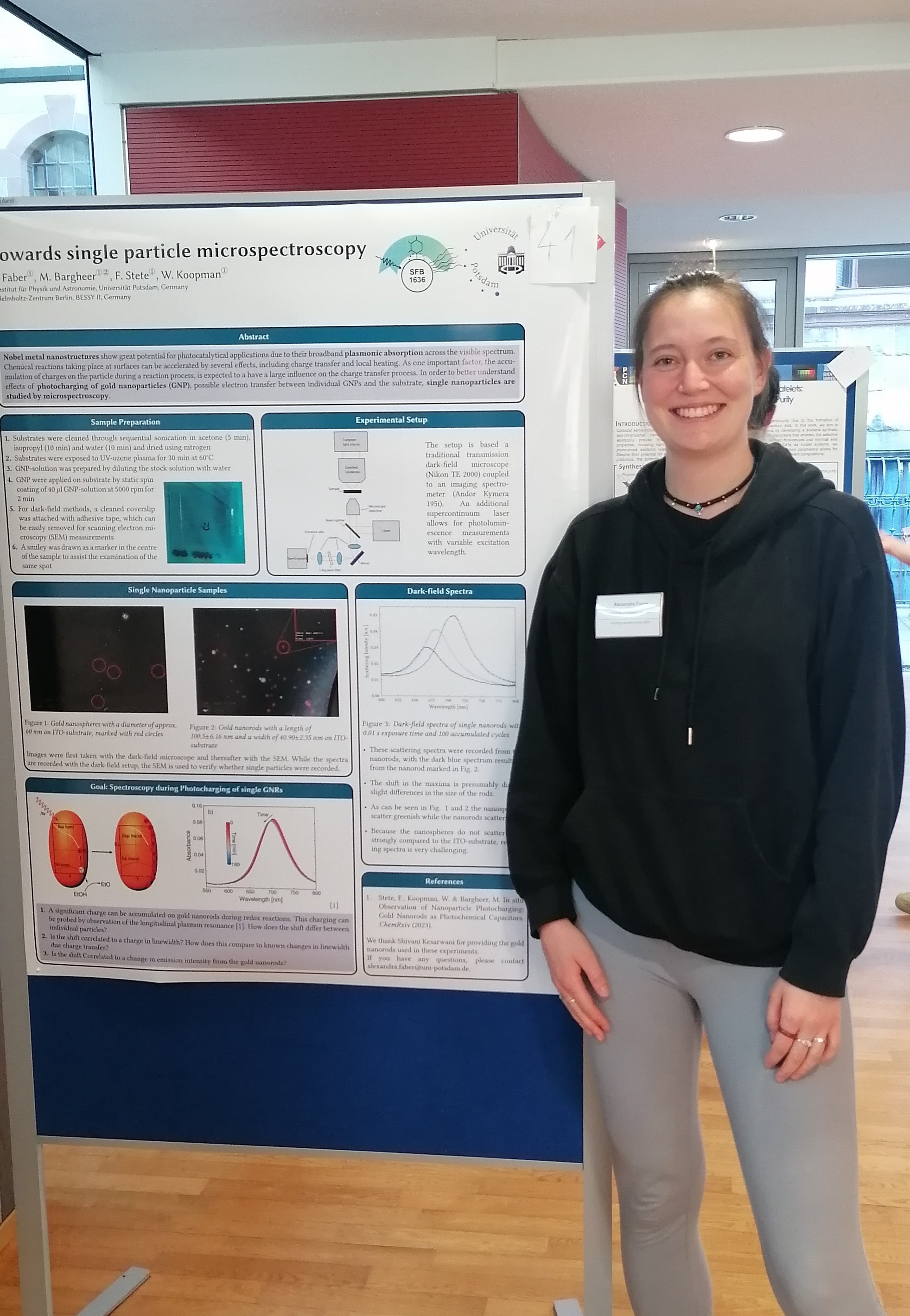
Alexandra Faber, Master Student
Alexandra's research employs dark-field micro-spectroscopy to study the fundamental properties of single plasmonic nanoparticles in a reactive environment. Building upon recent work showing that gold nanoparticles acquire a significant electric charge during light-induced redox processes, her current goal is to correlate this particle charging mechanism directly to the geometry of individual gold nanorods.
Anton Bauer, Bachelor Student
Anton develops a numerical simulation for the optical response of charged gold nanorods using the finite elements method as implemented in COMSOL.

Christopher Flohr, Bachelor Student
Christopher investigates the excitation dynamics of metal-semiconductor hybrid systems, such as gold-decorated TiO2 and InGaN by picosecond time-resolved PL spectroscopy.
Kyra Peikert, Student Researcher / Master Student
Steven concentrates on designing hybrid photocatalysts by decorating the widely used semiconductor TiO2 with metallic light-harvesting antennas. This work aims to significantly boost the efficiency of the TiO system by extending its absorption into the visible, ultimately facilitating the large-scale, solar-driven production of hydrogen fuel via artificial photosynthesis.

Associated Members
The following people work closely together with us on a daily basis:
- Felix Stete, Post Doc, Coordinator CRC1636
- Jan Kutschera, PhD Student, CRC1636 Project Z01 (with Marc Herzog)
- Helena Polouse, PhD Student, CRC1636 Project A04 (with Henrike Müller-Werkmeister)
- Matias Noell, PhD Student, CRC 1636 Project A04 (with Carsten Henkel)
- Lisa Mehner, PhD Student, CRC 1636 Project A01 (with Matias Bargheer)
- Gregor Stockmann, PhD Student CRC1636 Project A06 (with Svetlana Santer)
Former Members
- Lisa Mehner, Master Thesis , 2025
- Gregor Stockmann, Bachelor Thesis, 2021; Master Thesis, 2025
- Kyra Peikert, Bachelor Thesis.2025
- Jona Scheibe, Bachelor Thesis , 2024
- Jan Kutschera, Master Thesis, 2023
- Mareike Wübbenhorst, Bachelor Thesis, 2022
- Phillip Gerald Schoßau, Master Thesis, 2020
- Felix Stete, PhD Thesis, 2020
- Radwan M. Sarhan, PhD Thesis, 2019