


The reason for the great interest in her work is that this seaweed, which lives in the North Sea, can be cultivated very successfully inland, specifically in deep saline water. The natural brine from Bad Saarow provides a nearly perfect growth medium, where a completely new, particularly sustainable approach is being tested in the project “Brine-Based Cultivation Systems for Inland Macro- and Microalgae” – SolKuBiM for short. Here, cultivation is essentially integrated into the operations of SaarowTherme. “We use their infrastructure, energy, and already-treated brine to produce high-quality algae free of contaminants under controlled conditions,” reports lead project manager Dr. Anna Fricke from the Leibniz Institute for Vegetable and Ornamental Crops (IGZ) in Großbeeren. Initially, skin-care products will be manufactured from these regionally grown algae. In the future, however, Ulva compressa could also find its way onto the menu of the spa restaurant as a sea salad, the scientist notes.
Rich in fiber
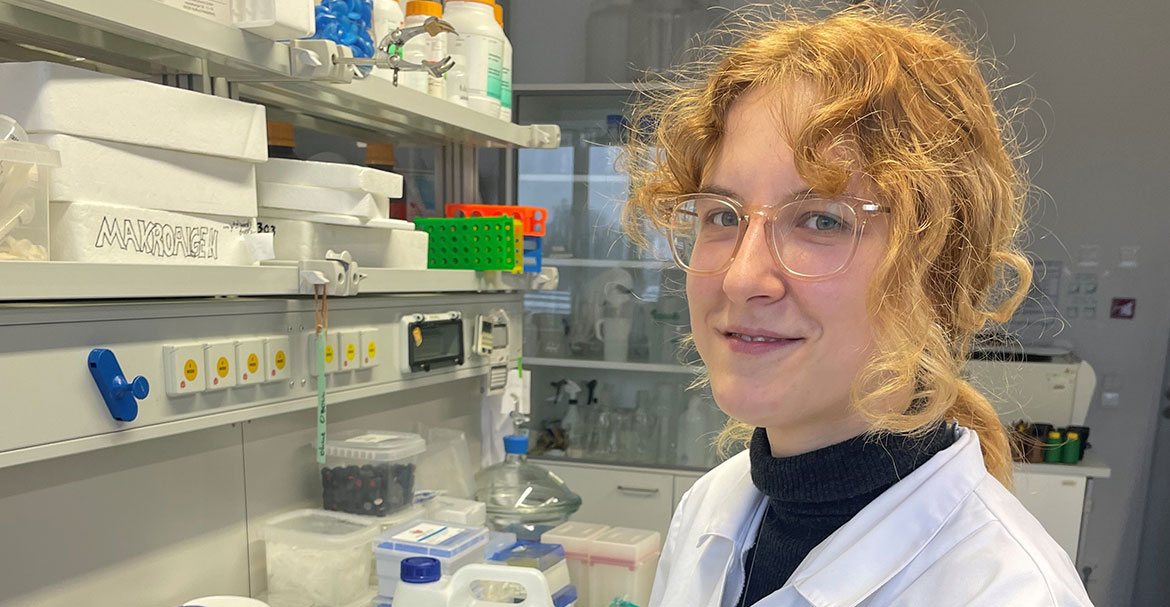
To uncover the algae’s health-promoting potential and determine its nutritional value, Dr. Fricke brought Potsdam student Valeriya Denisova on board two years ago. In the federally funded “food4future” project, intensive research into alternative food sources is being conducted in Großbeeren. Thanks to close collaboration with Professor Harshadrai M. Rawel from the University of Potsdam, Denisova had the opportunity to base her master’s thesis there.
And she used this opportunity. Her chemical analyses showed that the biomass produced in Bad Saarow is rich in dietary fiber and, with several essential amino acids, can serve as a good source of protein. In addition, the algae contain significant amounts of health-promoting carotenoids and chlorophylls. Even the small amount of fat—the content lies between one and three percent—is of the “good kind,” says the researcher, referring to the anti-inflammatory and cardiovascular-strengthening omega-3 fatty acids.
But how much of this actually reaches the human organism? To test this, Denisova simulated digestion in the mouth, stomach, and pancreas in the lab using enzymes from pigs. “It’s not that easy to replicate,” she notes critically, “but it was sufficient for the first stage of my research.” She wanted to find out whether the enzymes could extract the amino acids and peptides from the algae that play a role in protein synthesis in the body. “Some were detected; others were not. And some remained completely undigested: the polysaccharides then have to be metabolized by bacteria in the intestine,” the researcher explains.
The high fiber content is particularly valuable for nutrition, even though the Ulva compressa algae are somewhat harder to digest due to the structure of their cell walls. “The human microbiome in Europe is only partially adapted to the consumption of algae,” she says. In Asia, where fresh algae are widely consumed, the situation is different. “Perhaps we could also ferment the algae, just like sauerkraut, to make them easier to digest,” Denisova muses, convinced that the microbiome can also adapt to changes in diet. After all, Europeans had already been eating algae long before the Middle Ages. This has been shown by dental remains in which traces of algae have been detected.
Seaweed in urban areas
Cultivating algae also has ecological advantages: “You can grow them in a tank in the basement, in a supermarket, or in a restaurant. It requires no farmland, no pesticides, and no long transport routes into the city. Depending on the type of algae and conditions, the first biomass can be harvested after just a few weeks. And it keeps growing back,” Denisova says enthusiastically about the great potential she sees, especially for geographical areas where traditional agriculture has reached its limits. Not least, algae cultivation in structurally weak regions offers new, green job opportunities.
When Valeriya Denisova envisions the future and refers to a broader societal perspective, a glimpse of her original career path – one the now 32-year-old could not pursue – becomes visible. She wanted to become a diplomat. Immediately after passing the exams for the general qualification for university entrance at age 16 in Yekaterinburg, Russia, she studied international relations, learned languages, and perfected her German. But after the annexation of Crimea, it was clear that she would not be joining the foreign service in Germany. At just 20 and already holding a bachelor’s degree, she worked in her home country for a supermarket chain, and later for an advertising agency. She felt lost; her knowledge remained unused. So she hit the ground running again, applied to natural sciences programs at German universities, and, after receiving several acceptances, chose to study ecotrophology in Giessen. “That’s where I discovered my interest in microbiology. And in research.”
That was also the reason she moved to the Institute of Nutritional Science at the University of Potsdam for her master’s degree, even though she had to complete two missing modules to do so. “She’s tenacious,” says Dr. Fricke, who appreciates such qualities and is glad to have brought Valeriya Denisova onto her team while she was still a student. “She’s open-minded and determined, has learned her craft, and knows her subject inside out,” praises the marine biologist, who enjoys collaborating with researchers from other disciplines. “That’s what really drives innovation.”
“Lightsaber” in the algae tank
Valeriya Denisova is now a research assistant in Dr. Fricke’s SolKubiM project and is pursuing her doctorate under Prof. Dr. Susanne Baldermann at the University of Bayreuth. For her dissertation, she is investigating how to improve the cultivation conditions for algae. What increases the efficiency of cultivation? What kind of light is optimal? “At first, we had installed an LED light in the lid of the 100-liter barrel where the algae grow here at the institute. But that didn’t illuminate the entire contents,” Denisova describes the problem. The solution came in the form of programmable “lightsabers” that are suspended into the barrel through an opening in the lid and fully illuminate it. This development from the food4future project is a result of the collaboration between Dr. Fricke and the team led by Prof. Dr. Christian Dreyer from the Technical University of Applied Sciences in Wildau.
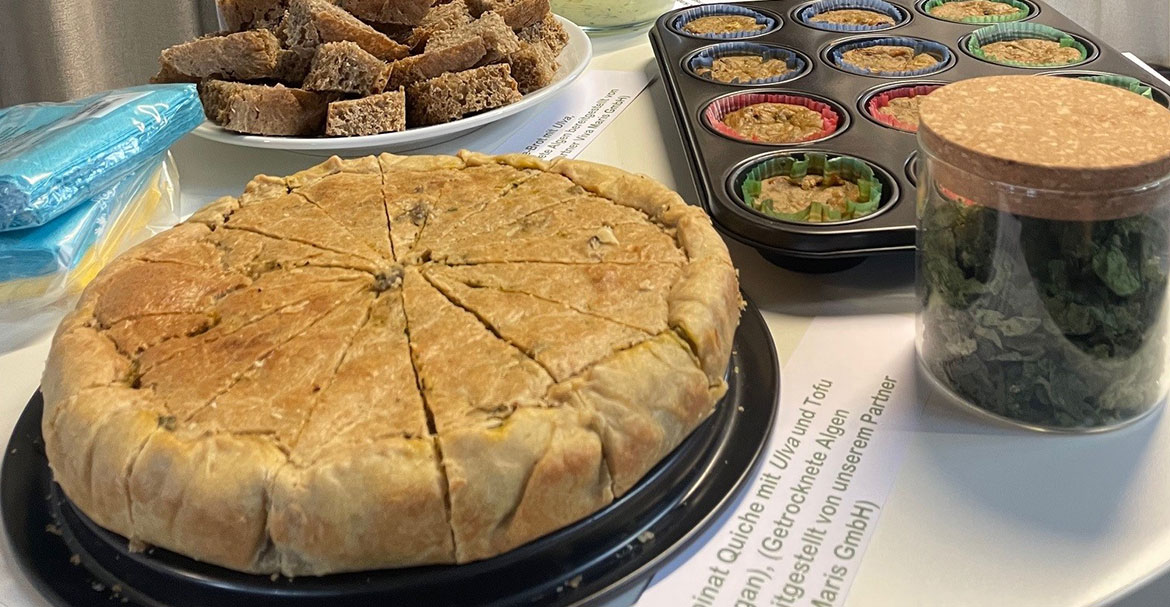
Meanwhile, at the German Institute of Human Nutrition in Bergholz-Rehbrücke, researchers are testing which carotenoids the algae contain and how much of them – when consumed through food—ends up in the blood. “You could also extract proteins from algae to enrich foods or produce dietary supplements,” Denisova says, looking into the future, while – right in the present – she offers a slice of the homemade algae quiche she brought to Potsdam for the “Better World Award” ceremony.
The Better World Award is jointly presented every year by the Universitätsgesellschaft Potsdam e. V. and Land Brandenburg Lotto GmbH. The prize, worth 3,333 euros, is awarded to young researchers whose scientific work makes a decisive contribution to the further development of society.
More Information on the Better World Award (in German): https://www.uni-potsdam.de/de/uniges/foerderungen-preise/better-world-award-bwa
Brine-based cultivation systems for freshwater macro- and microalgae (SolKuBim)
Establishment of an innovative, brine-operated aquaculture facility for the land-based production of high-quality algal biomass and thus the opening up of new areas of application, such as cosmetics, food, and animal feed, as a case study for the Bad Saarow site. Lead project manager: Dr. Anna Fricke, Leibniz Institute for Vegetable and Ornamental Crops e.V.
Funded by the Federal Ministry of Agriculture, Food, and Regional Identity.
food4future – Food of the Future (f4f) is a collaborative project funded by the Federal Ministry of Research, Technology, and Space (BMFTR) in which, since 2019, radical innovations for a sustainable and healthy food supply have been investigated and put into practice.
https://www.food4future.de/en/home
This article appeared in the university magazine Portal - Eins 2026 „Inklusion“.