
DFG funded projects
DFG-NSF Physics: Maximizing the science return of target of opportunity observations connected to compact binary mergers
The multi-messenger detection of GW170817 has led to a wealth of information about matter under extreme densities, high-energy astrophysical phenomena, the structure of spacetime, and the evolution of our Universe. Given the importance of this observation, the next multi-messenger observation of a compact binary merger is eagerly awaited. Given the ongoing observing run of the international gravitational-wave detector network, the next detection could happen in the very near future, but even if the ongoing observing run does not reveal additional multi-messenger observations, the increasing sensitivity expected for the fifth observing run and the planned third-generation gravitational-wave detectors will yield hundreds of multi-messenger detections over the next decades. Once a gravitational-wave trigger is found in online searches, rapid analysis of the source is important to understand if electromagnetic signals could arise from the merger and if expensive follow-up searches have to be initiated. Improving this decision-making is the central goal of the proposed research project. We will improve our ability to perform low-latency interpretations by speeding up our nuclear physics and multi-messenger astrophysics (NMMA) code infrastructure to analyze compact binary mergers. Low-latency data products can then be used to estimate potential observable signatures. This includes not only gravitational-wave triggers but also electromagnetic observations during serendipitous searches that might reveal interesting transient events that are worth following up on and that we will investigate with the help of NMMA.
Period: Approved in 2024; funding started August 2025
Black Hole - Neutron Star mergers: Theoretical Modeling, Numerical Simulations, and Data Interpretation
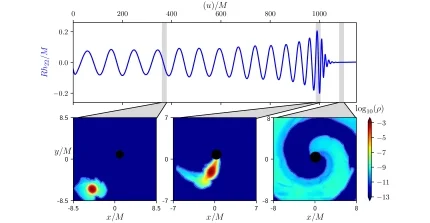
The first direct detection of gravitational waves inaugurated a new era in astronomy. Since then numerous compact binary mergers have been detected, among them gravitational waves emitted from the collision of a black hole with a neutron star. Such black hole - neutron star systems can reveal information about the state of matter at supranuclear densities or allow for a more precise measurement of the Hubble constant. Because of this, it is essential to enable an accurate cross-correlation between theoretical models and observational data. This requires a reliable theoretical description of the black hole - neutron star coalescence, the emitted gravitational-wave signal, and potential electromagnetic counterparts. Unfortunately, the number of available numerical-relativity simulations for black hole - neutron star systems is small and the corresponding waveform models for this class of systems are in their infancy. Within this research project, we plan to fill these gaps. For this purpose, we will extend the code infrastructure of the pseudo-spectral code Elliptica to allow the construction of accurate black hole - neutron star initial data. These data will be evolved with the BAM code and our new simulation results will be the fundament for the development of new gravitational-wave models and phenomenological estimates of the disk mass and ejecta outflows. We plan to make all our results and codes publicly available.
Period: Approved in 2022; funding started July 2023
Heinz Maier-Leibnitz Prize
"Since 1977, the annual Heinz Maier-Leibnitz Prize has been awarded to young scientists for their outstanding achievements. The prize is named after the physicist and former President of the German Research Foundation Heinz Maier-Leibnitz. A total of ten prizes, each endowed with 20,000 euros, are awarded by the German Research Foundation (DFG) and the Federal Ministry of Education and Research (BMBF) on the recommendation of third parties. The management of the University of Potsdam nominated Prof. Dietrich for the prize. The selection decision is made by a committee whose members are appointed by the DFG and the BMBF."
The award ceremony took place online on 4th of May 2021.