
Flash flood in Nepal
What happened?
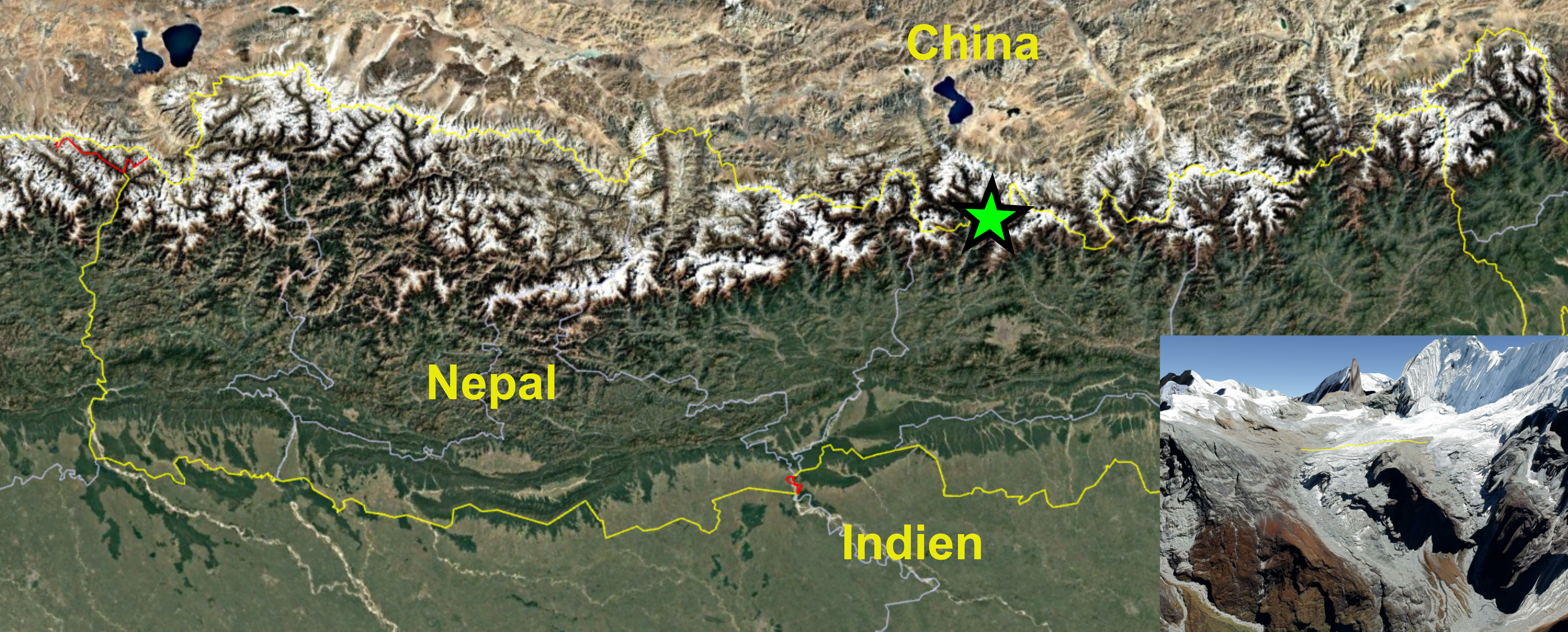
Initial satellite imagery indicates that a large part of a steep glacier tongue in the Nepalese Himalaya broke away. The bedrock beneath and alongside the glacier may also have been dislodged. The mixture of ice and rock then plunged several hundred metres down a steep slope. The enormous energy released in the process likely caused some of the entrained ice to melt, transforming the original ice-and-rock avalanche into something resembling a debris flow and eventually a flood.
Initial estimates suggest that the mass involved several hundred million cubic metres of material and, due to the steep topography, reached velocities of more than 50 metres per second (!). Within just a few minutes, the flood reached the border crossing into China, which was completely destroyed. Initial analyses of water-level gauges showed that even several tens of kilometres downstream, water levels were still around 10 metres higher than usual as the peak of the flood wave passed the monitoring stations. Elevated water levels were even recorded in India, meaning that the wave was able to travel more than 100 km. This was therefore a disaster of multinational scale.
What is known about the causes?
Very little so far. To my knowledge, the area was not specifically monitored for the potential occurrence of an event of this kind. Initial analyses of the glacier's flow behaviour over recent months and years do not, for the time being, indicate any major irregularities. At first, an earthquake was discussed as a possible trigger. This has since been revised: it was the enormous energy released when the mass of ice and rock impacted the slope that generated a seismically detectable signal. Scientists from different disciplines — glaciology, geology, seismology and meteorology — now need to work together to better understand the causes and, ultimately, to improve monitoring and forecasting.
How common are events like this?
Events of this magnitude, both in terms of the volume of glacier ice and rock that became detached and the enormous discharge generated, are rare even in the Himalaya, with its large glaciers and steep mountain valleys. However, they are not unprecedented. In recent years, similar events have repeatedly been documented along the Himalayan–Karakoram mountain arc, for example in 2021 in the Chamoli district of the Indian Himalaya. Such extreme events therefore occur with a certain recurrence rate, although certainly not necessarily every year.
Do we have to expect such events to become more frequent in the future?
I think so. As a result of global warming, permafrost in mountain slopes is thawing, reducing the strength and stability of the rock. At the same time, glaciers are continuing to retreat into increasingly steep terrain, where stresses and fractures can develop within the glacier ice. Taken together, these processes could — at least theoretically — create the conditions for such events to become more frequent and potentially larger as these developments continue or even accelerate. In addition, frequent seismic activity and the annual monsoon can both contribute to triggering such events and transporting the resulting masses downstream.
How can we protect ourselves against such events?
We definitely need better and more comprehensive monitoring. Local solutions can be useful, but given the enormous scale of the Himalayan mountain arc, we need methods that can provide near-real-time coverage across the entire region. A dense network of seismometers could be particularly useful, potentially detecting initial changes and vibrations before the main event occurs. Daily, high-resolution satellite imagery could also help identify cracks and instabilities in glaciers and bedrock. In principle, these technologies offer the possibility of establishing precise monitoring systems and, consequently, early-warning systems. In practice, however, especially given the multinational nature of the region, a coordinated approach would be needed to improve preparedness for such extreme events. I consider technical protection measures, such as dams, levees or barriers, to be largely impractical at this scale. Instead, I would advocate keeping floodplains free from development and construction.

Dr. Georg Veh
Geohazards | Researcher