

Welcome to the homepage of the Chair of Information Systems and Digital Transformation
The research group led by Prof. Dr. Stefan Stieglitz (currently on leave, Dr. Irina Heimbach works as an interim professor until April 2027) investigates digital transformation and its impact on companies and other organizations, as well as on society and individuals. The research is interdisciplinary and based on advanced methods of data collection and analysis. We contribute to basic research as well as to application-oriented issues in industry and administration. The working group cooperates with selected companies and with outstanding international and national research institutions.
New Research Project at the Department: BOSNET Strengthens Government Agencies' Ability to Address Digital Disinformation

How can public safety agencies and organizations (BOS) identify, assess, and respond effectively to disinformation on social media more quickly? This is the question being addressed by the newly launched BOSNET research project, which is being conducted under the direction of Prof. Dr. Stefan Stieglitz at the Chair of Business Informatics, with a focus on digital transformation.
Digital disinformation, AI-generated content, and deepfakes are posing increasingly significant challenges for public authorities. Misinformation spreads rapidly on social media and can undermine public trust in government institutions. At the same time, there is often a lack of suitable technical solutions and mechanisms for rapid, cross-agency knowledge sharing.
This is precisely where BOSNET comes in. The project’s goal is to sustainably strengthen the capacity of public authorities and organizations with security responsibilities to address digital disinformation. To this end, the project partners are developing an AI-supported system that facilitates the detection, assessment, and collaborative management of disinformation.
At the heart of the system is an analysis module that uses explainable artificial intelligence to identify multimedia and multilingual disinformation on social media. The AI’s decisions are presented transparently so that experts can review the results and correct them if necessary. The system is supplemented by a networking module and a shared knowledge database, which enable rapid information exchange among government agencies and the coordination of joint communication strategies, particularly in crisis situations.
“The project helps strengthen trust in government institutions and addresses current debates on AI-generated disinformation, deepfakes, and coordinated campaigns on social media,” explains project leader Prof. Dr. Stefan Stieglitz.
In the long term, BOSNET aims to help increase the resilience of government institutions against digital disinformation and to sustainably strengthen cross-agency cooperation.
The project is being carried out in collaboration with the University of Bamberg, the University of Tübingen (IZEW), the University of Cologne, Virtimo AG, and the Federal Agency for Technical Relief (THW). Together, the project partners are pooling their expertise in the fields of artificial intelligence, information systems, ethics, crisis communication, and public administration to develop innovative solutions for addressing digital disinformation.
Further information: here (german)!
New publication in the *Journal of the Association for Information Systems*!
How does contact via social media change attitudes toward other social groups? A study by the Chair of Digital Transformation provides new experimental evidence on this topic and shows that the effects extend beyond the group directly involved. The research paper “Social Media-Enabled Intergroup Contact: Evidence of Primary and Spillover Effects from an Intervention Study” by Georg Voronin, Olga Abramova (Leuphana University of Lüneburg), Stefan Stieglitz, and Chee-Wee Tan (Hong Kong Polytechnic University) has been accepted for publication in the Journal of the Association for Information Systems (JAIS).
The study draws on one of the most influential theories in social psychology—Gordon Allport’s Intergroup Contact Theory—and applies it to digital environments. An intervention study examined whether and how contact via social media affects attitudes toward social groups. The results show two things: First, attitudes toward the group with which contact occurred improve (primary effect). Second, spillover effects can be demonstrated for groups that were not involved in the interaction at all.
The article thus addresses a central question for the design of digital platforms: Under what conditions do social media promote social participation rather than exacerbating polarization? The findings are relevant both for platform design and
for intervention programs aimed at combating prejudice and exclusion.
The Journal of the Association for Information Systems is part of the “Senior Scholars” category and is thus one of the leading journals in international information systems research.
Have a look at the publication!
Voronin, Georg; Abramova, Olga; Stieglitz, Stefan; and Tan, Chee-Wee, "Social Media-Enabled Intergroup Contact: Evidence of Primary and Spillover Effects from an Intervention Study" (2026). JAIS Preprints (Forthcoming). 249.
DOI: 10.17705/1jais.01007
Great News! Explorer Grant for Till Schirrmeister's Research Project on AI and Multimodal Data

Our research associate, Till Schirrmeister, has been awarded the Explorer Grant from the Faculty of Economic and Social Sciences at the University of Potsdam. This grant supports particularly innovative research ideas that have the potential to drive new scientific advancements.
In his project, “Unbias with Bias: Addressing Unobserved Covariates Using Multimodal Embeddings and Double/Debiased Machine Learning,” Till investigates how modern AI methods can be used to intelligently link information from different data sources, such as text, images, or audio. The goal is to better account for previously unobserved influencing factors, thereby enabling more robust scientific analyses and more well-founded insights. The project thus makes an important contribution to the further development of data-driven research and the application of artificial intelligence in the economic and social sciences.
Research and teaching go hand in hand at our department. Current projects and research findings are directly incorporated into our courses, offering students the opportunity to engage early on with innovative topics related to artificial intelligence, data science, and digital transformation.
We congratulate Till on this achievement and look forward to further developing the project’s results together with our students and research partners.
An exciting and successful summer semester 2025 is now behind us!
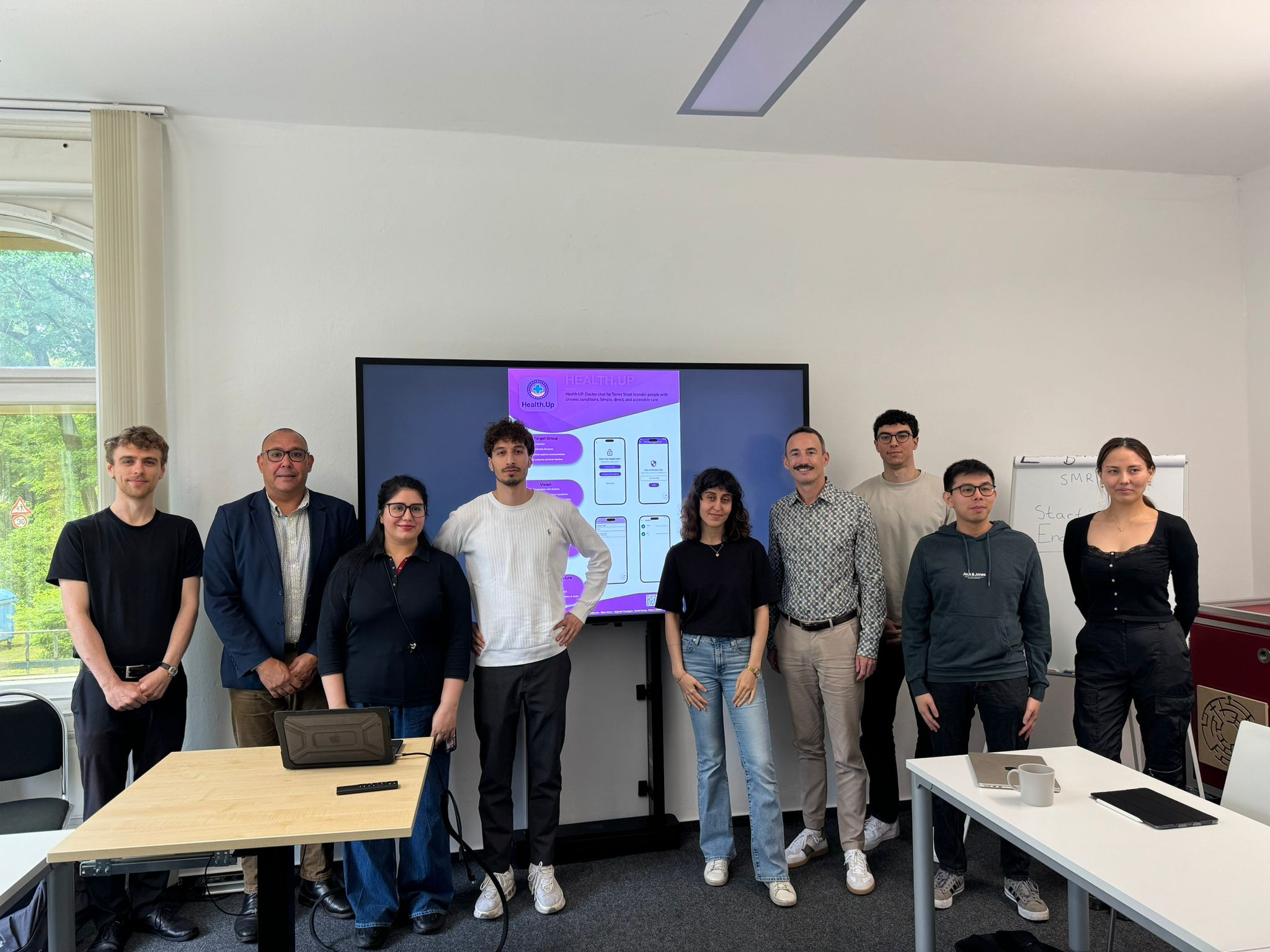
As the summer semester draws to a close, we can look back on a host of exciting events, innovative projects, and inspiring encounters.
The bachelor's seminar “Business Informatics Project” took a practical approach: working in small groups, students successfully developed functional prototypes of health apps that support effective patient communication. The successful completion of the project demonstrated not only the technical competence of our students, but also a strong sense of user-centered design and collaborative innovation processes. A highlight of the closing event was the visit of Prof. Sean Taylor (University of Melbourne, Australia), who was able to provide the students with very special insights into current research on medical care and doctor-patient communication.
The “Research Studies” seminar, in which our master's students analyzed literature on topics related to digital transformation, demonstrates the breadth of issues and the diversity of topics covered in our field. Among other things, they dealt with research data management in the age of AI, parasocial relationships with AI avatars, and utopian or dystopian visions of the future. The topics provided ample opportunity for reflection and discussion about business informatics and the role of digital transformation in various interdisciplinary fields.
We would like to thank everyone involved for their commitment, curiosity, and open exchange this semester and wish all students and colleagues a relaxing break from lectures!
HICSS 2026: Two mini-tracks with participation from the Chair of Information Systems and Digital Transformation

The Chair of Information Systems and Digital Transformation, headed by Prof. Dr. Stefan Stieglitz, will be represented with two mini-tracks at the renowned Hawaii International Conference on System Sciences (HICSS) 2026. The conference is one of the most important events in the field of business informatics and brings together international scientists every year to discuss current developments in research and practice.
In the mini-track “Potentials and Risks of Artificial Intelligence for Researchers”, Stefan Stieglitz and Till Schirmeister (University of Potsdam) as well as Alexander Richter (University of Auckland) and Shahper Richter (Victoria University of Wellington) will focus on the diverse applications of artificial intelligence in scientific research. The focus is particularly on the potential of AI systems, for example in the automation of literature searches, the generation of synthetic data, or the analysis of complex relationships in research data. AI-supported conversational agents and virtual avatars that support researchers in brainstorming and study development are also part of the thematic spectrum. The mini-track invites contributions from various methodological perspectives—whether qualitative, quantitative, theoretical, computer-assisted, or practice-oriented.
In parallel, the second mini-track, “Digital Democracy and Social Cohesion,” deals with the effects of digital transformation on democratic processes and social cohesion. Under the direction of Prof. Dr. Stefan Stieglitz (University of Potsdam), Dr. Olga Slivko (Erasmus University Rotterdam), Prof. Dr. Christof Weinhardt, and Dr. Jonas Fegert (both from the Karlsruhe Institute of Technology), current research approaches dealing with the interactions between digital technologies, democratic participation, and social dynamics will be presented and discussed. Especially in an era primarily shaped by technological and political developments, we are looking for approaches to understand digital platforms and their influence on democratic processes.
The mini-tracks reflect the central research focuses of the Chair of Business Informatics and Digital Transformation. We look forward to receiving numerous submissions by June 15, 2025, and to the professional exchange during the conference! Here you will find all the important dates and facts: HICSS 2026!
Die Minitracks spiegeln zentrale Forschungsschwerpunkte des Lehrstuhls für Wirtschaftsinformatik und Digitale Transformation wider. Wir freuen uns auf zahlreiche Einreichungen bis zum 15.06.2025 und den fachlichen Austausch im Rahmen der Konferenz! Hier finden sich nochmal alle wichtigen Daten & Fakten: HICSS 2026!
The BMBF-funded PREVENT project has come to a successful conclusion!
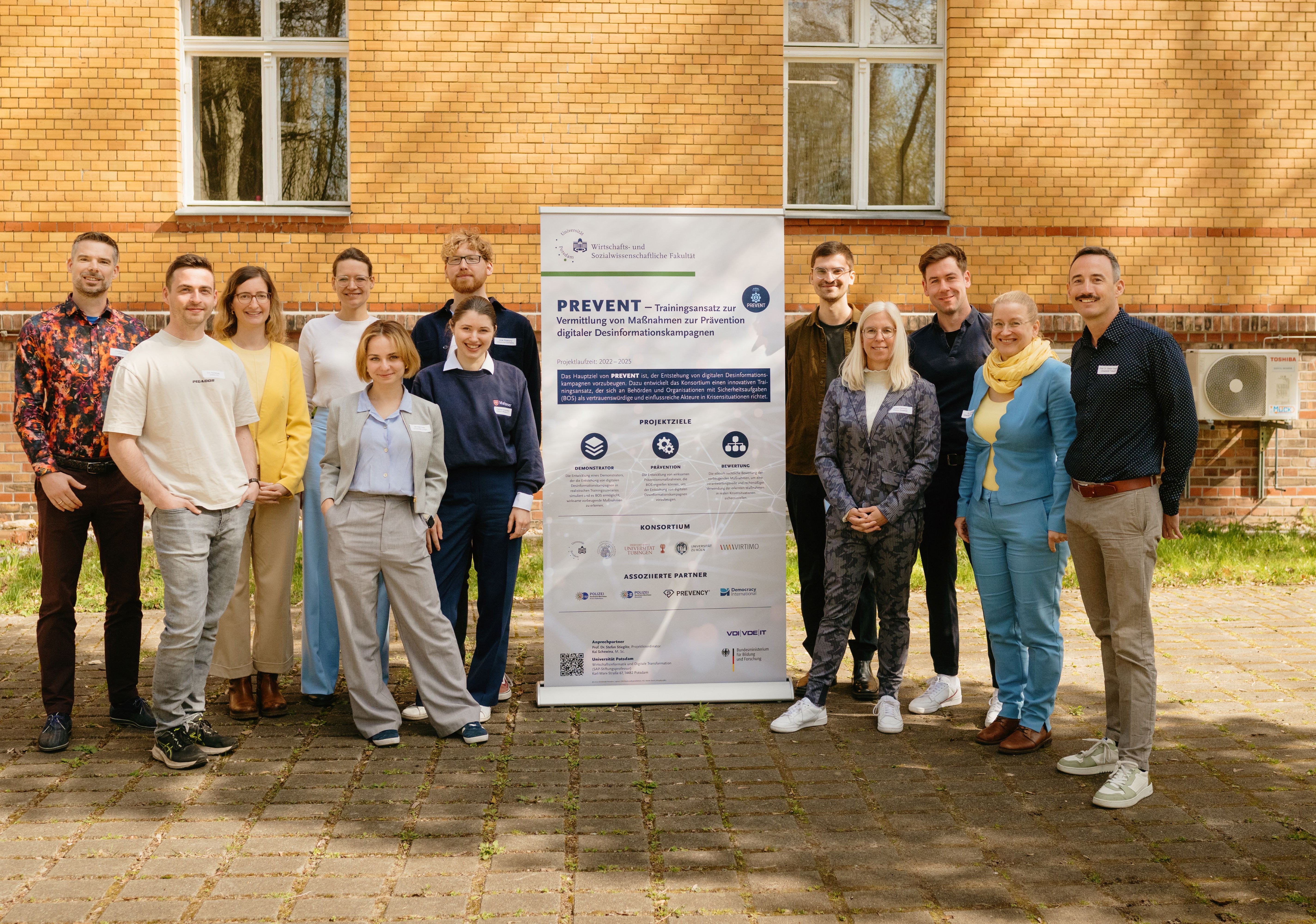
On April 8, 2025, the closing event of the interdisciplinary research project PREVENT took place at the University of Potsdam. The project was funded as part of the BMBF announcement “Agile Research - Recognizing and Combating Digital Disinformation Campaigns” and is dedicated to the question of how authorities and organizations with security tasks (BOS), such as the police, THW, or Malteser, can more effectively counter digital disinformation. The project focuses not only on the technical perspective of combating disinformation, but also on the ethical and legal classification of countermeasures. The goal of PREVENT is to develop an innovative training approach for BOS that, on the one hand, presents measures against disinformation and classifies them ethically and legally and, on the other hand, realistically depicts the emergence and spread of disinformation on the basis of simulations.
Four key results of the project include:
- The development of a category system for measures and their ethical and legal evaluation, as well as their practical application. For example, deleting and blocking comments on one's own platforms is carried out, but has high ethical and legal barriers.
- Early debunking (i.e., the provision of counter-information) is effective in combating disinformation.
- Existing legislation is already sufficient to combat disinformation in a legally secure manner. Platform regulation is becoming increasingly important.
- Training tools are effective approaches to improving the ability of emergency services to act in relation to disinformation.
In the morning, the project partners presented the key findings of the three-year research process. In addition to methodological and technical insights, specific use cases were presented in which the automated simulation and analysis of disinformation processes can provide practical insights for emergency services.
The afternoon focused on exchange and reflection with practitioners. Five representatives from different emergency services organizations took part in an interactive workshop. The discussion centered on the potential and challenges of using automated countermeasures.
A big thank you goes to the participating organizations from the field, whose insights are interesting and, above all, highly beneficial for our research: the Bielefeld Police, the German Police University, the Berlin Senate Department for the Interior and Sport, the Baden-Württemberg State Office for the Protection of the Constitution, and the Malteser Hilfsdienst e.V.
The closing event marked not only the successful end of an intensive and productive project, but also an important step towards stronger networking between research and practice in the field of disinformation defense. We would like to express our sincere thanks to all those involved—especially the BOS representatives—for the constructive exchange and the great interest in our project.
Further information on the PREVENT project can be found at:
The Digicat team at ICIS 2024 in Bangkok: Research in international exchange

The International Conference on Information Systems (ICIS) is one of the world's leading conferences in the field of business informatics and provides a platform for researchers, practitioners, and experts to exchange the latest developments and findings. The event promotes interdisciplinary dialogue and contributes significantly to the further development of theory and practice in the field of digital information systems.
Our research assistants Kai and Gosha were in Bangkok and took the opportunity to present their research in this high-profile environment. Kai presented his paper “Information Privacy and User Satisfaction in Mobile Applications: A Cross-National Analysis,” while Gosha discussed his work on the “Effects of an orderly vs. cluttered online environment on user behavior and choices.”
In addition to exciting workshops such as the Social Inclusion Workshop and the Theory Development Workshop, the conference offered numerous opportunities for networking and intensive technical discussions. Paper-a-thons and presentations created space for valuable scientific impulses and new approaches to cooperation.
The inspiring week in Thailand ended with many new ideas and contacts—a successful step on the path to innovative research projects.
Completion of the international research project RISE_Social Media Analytics: Crisis Communication and Society
The international research project RISE_Social Media Analytics (RISE_SMA) came to an end with a closing ceremony at the University of Potsdam. Over a period of five years, an outstanding network of scientists from Germany, Indonesia, Norway, Australia, Brazil, and the Netherlands was established. The aim was to develop innovative approaches in the field of social media analytics and crisis communication and to advance these through interdisciplinary collaboration. The project was funded under the European Union's Horizon 2020 program, which ran from 2014 to 2020 and had a budget of around €80 billion. Horizon 2020 is the world's largest funding program for research and innovation and aims to strengthen Europe's competitiveness. It supports projects across the entire innovation chain – from basic research to the development of marketable products and services.
A key success of the project was the publication of more than 20 scientific articles that provided crucial impetus for research. RISE_SMA made a significant contribution, particularly during the global challenges of the coronavirus pandemic. The approaches and findings developed helped to improve understanding of the use of social media in crisis situations and to develop effective communication strategies.
In addition, the project not only promoted scientific productivity, but also intercultural exchange and personal connections between the participants. Joint trips, events, and intensive collaboration helped to create a strong sense of togetherness within the team and laid the foundation for future cooperation.
Although the formal project period has now come to an end, the partners reaffirmed their determination to continue to maintain and expand the relationships they have built. The network will contribute to addressing new issues and achieving further milestones in research in future projects.
Special thanks go to all those involved who contributed significantly to the success of the project through their commitment and expertise. The end of RISE_SMA does not mark a conclusion, but rather the beginning of a new phase of scientific cooperation—with the common goal of sharing and further developing knowledge across country and disciplinary boundaries.

From Duisburg to Potsdam!
As a research group and as the Chair of Business Informatics and Digital Transformation, we are now part of the Faculty of Economics and Social Sciences at the University of Potsdam! After eight years of successful research and teaching at the University of Duisburg-Essen, we are delighted to be able to strengthen the field of business informatics at the University of Potsdam. We have already received a warm welcome from Prof. Dr. Gronau, Prof. Dr. Krasnova, and their teams at the Digitalvilla.

