from bystander to actor: literature, collaboration and participation

Project Description
More than any other art form, literature has in Western modernity been established as strictly non-collaborative: a solitary practice in terms of both production and reception where authors write in isolation for readers who read alone. But at the same time, literature has also always been understood and 'used' as a deeply intersubjective force that, ideally, allows for specific forms of connecting with and participating in other worlds. In that view, literature has world- and community-building potentials, yet these potentials remain mostly unenacted. The reader is not so much a participant in, not even a participant-observer of, the stories they read; readers are rather posited as bystanders looking in from the outside at an inside that yet may exert a strong appeal and trigger what Immanuel Kant, in a different context, has dubbed "wishful participation".
This joint project proceeds from the observation that over the past two or three decades, literary practices have (re)emerged that foreground the partcipatroy and collaborative dimensions of both writing and reading. This is no doubt owed to a significant degree to the medial shifts in the wake of the digital revoution, but it clearly affects 'traditional' print literature as well, as indicated by a range of budding modes of cooperative and multi-authored textual production as well as by the manifold forms of collaborative reading. Our project aims to provide a number of case-specific analyses but also to develop a systematic and conceptual vocabulary for the current trend to rearticulate 'literature' as collaborative and participatory. This endeavour can only be pursued with a view on the worldly dimension of literature as 'species-wide faculty' (Dimock). It is for this reason that we explicitly attempt to bring Western notions of literature, however volatile these may be at this conjuncture, into conversation with concepts, schools and traditions from outside Europe and the US. Next to Dirk Wiemann, the Principal Investigator, early-career scholar Shaswata Ray will contribute to the project with a PhD research project on collaborative and distributed authorship within contemporary cultures of sharing. Moreover, Prof. Dr. Satish Poduval (English and Foreign Languages University Hyderabad, India) will act as a visiting Mercator Fellow and substantially widen the scope of the project with his expertise.
Together we wish to explore and acknowledge (some of) the manifold collaborative and participatory formats in which contemporary literature happens, both in terms of production/writing and reception/reading. The aim is a) to develop a theoretical model of reception as transformation of the reader-bystander into a collaborator akin to the spect-actor envisaged by Augusto Boal; b) to generate and specify that model in the course of case-specific analyses of concrete literary collaborative events and their respective modes of recipient address; and c) to bring the model into conversation with alternate conceptualizations of verbal world-making beyond the confines of dominant notions of ‘literature’ – as, e.g., exemplified in the South Asian tradtions of sahitya as a praxis that posits writing as inherently ‘being-together’.
Events and Publications
upcoming events
past events
Protest Literature!
Workshop conducted by Tracy Fuad (Berlin Writers' Workshop) followed by public reading with Craig Santos Perez, Atefe Asadi, Cristina Bendek, and Tracy Fuad. Co-organized with Research Unit Project 03: Oceanian Poetic Collaborations.
June 5, 2026 11 am - 9 pm. Subkontinent (Donaustraße 84, 12043 Berlin)
John Berger: The Poetics and Politics of Collaboration
International Conference. Co-organized with Christian Schmitt-Kilb (University of Rostock).
University of Potsdam, June 11-13, 2025.
publications
* Forthcoming: Shaswata Ray, “O is for Ownership”. Alphabet of Collaboration. 2026.
* Forthcoming: Dirk Wiemann and Christian Schmitt-Kilb (eds.). Collaborations: Essays on John Berger and Collective Creativity.
Bristol (Intellect Books) 2027.
* Dirk Wiemann. "The Critic as Producer(?)" Journal of Literary Theory 20.1 (2026). DOI: 10.1515/jlt-2026-2009.
* Dirk Wiemann and Satish Poduval. "Against Literary Activism". Public Humanities. Special Issue: Global Public Literary Humanities. Sept 2025.
DOI: 10.1017/pub.2025.10041
Project Team
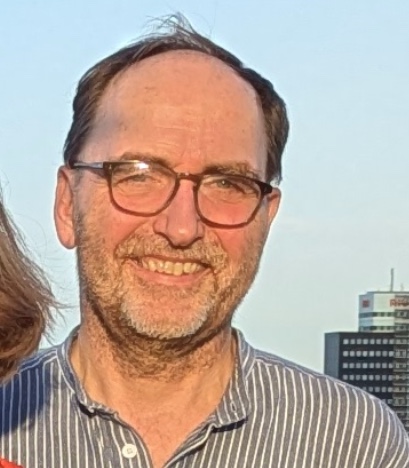
Dirk Wiemann
I am a professor of English Literature at the University of Potsdam with a background in postcolonial studies, world literature, and genre theory. In the eraly 2000s, I spent a couple of years as a visiting professor at universities in India (Hyderabad and Delhi), and I have ever since remained keenly interested in literary, cultural and sociopolitical processes in South Asia. In some of my earler research I have tried to analyse how the Indian subcontinent figures as a specific 'zone' of the mordern world-literary system, where literature itself may be conceptualized and practiced in ways slightly different from the Eurocentric 'norm': rather than an essentially intimate and individualistic form, literature can be grasped as an inherently community-facing, community-building, and community-relevant cultural resource.
My project within this Research Unit will explore a number of instances where literature in Western contexts is practiced against the grain as collaborative -- be it in terms of mulit-authored text production, of communal reading, or of participatory and interventionist forms of staging literature as public event. I will investigate
1. some historical instances of the 'collective novel', including a childrens' book about a mysterious orange-coloured cat, which, at the height of the Cold War, was written by 10 authors from 10 different countries on both sides of the dividing line between capitalism and socialism;
2. the 'neighbourhood book store' as a space of engaging literature as community;
3. activist deployments of literature as a means of articulating protest and alternate horizons of possibilities, as exemplified most prominently in the 'Refugee Tales' project curated by the Gatwick Detainees Welfare Group in the UK.
For further information visit my website at
____

Satish Poduval
I am a teacher of literary and cultural studies at the English and Foreign Languages University in Hyderabad (India). After my initial training in historical fiction and popular politics in postcolonial India, I was involved in the setting up one of the earliest and highly-regarded cultural studies programmes in India at the EFL University along with inspiring colleagues such as Susie Tharu, Madhava Prasad, and K. Satyanarayana.
My early research was on the history of Indian television, activist documentary films, and the politics of popular cinema. I contributed entries on Malayalam cinema in Encyclopaedia of Indian Cinema (OUP/BFI), and later was part of the editorial team that set up the online indiancine.ma archive. These collaborative initiatives led to my interest in questions of political modernity within the emerging Indian digital media ecosystem, and my early collaboration with Potsdam University through my contributions “Governmentality and the Enthusiasm for Democracy” to the volume The Politics of Passion edited by Dirk Wiemann and Lars Eckstein, and “Hacking and Difference: Reflections on Authorship in the Postcolonial Pirate Domain” to the volume Postcolonial Piracy edited by Lars Eckstein and Anja Schwarz. Subsequent indicative publications by me include “The Affable Young Man: Civility, Desire and the Making of a Middle-Class Cinema in the 1970s” (South Asian Popular Culture), “Acts of Culture: Religion and the Question of Democracy in India” (Critical Quarterly), and “Against Literary Activism” (co-written with Dirk Wiemann in Public Humanities).
As a teacher, I have always been interested in working with students and colleagues to create synergies in critical humanities education. My close involvement with Anveshi Research Centre for Women’s Studies in Hyderabad has kept me alert to public debates outside the university, while the experience of academic partnerships with German universities, especially my decade-long collaboration with Potsdam University, has shaped my thinking about critical postcolonial theory and minor cosmopolitanisms.
My research under the project ‘From Bystander to Actor: Literature, Collaboration and Participation’ is focused on the public significance of visual culture in contemporary India. It will take forward my ongoing work on the paintings of K.P. Reji, the cartoons of Surendra, and the films of younger film-makers from Kerala.
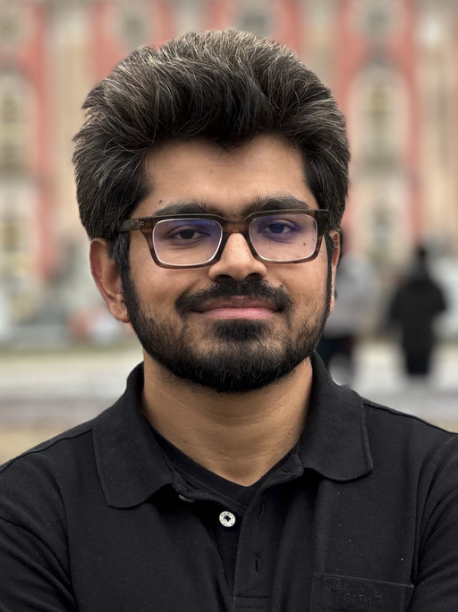
Shaswata Ray
I am currently a Doctoral Fellow at the University of Potsdam, working within the “From Bystander to Actor: Literature, Collaboration, and Participation” project situated within the “Collaborations” research unit. Prior to this I graduated from The English and Foreign Languages University in Hyderabad with an MA in Literary and Cultural Studies. My MA dissertation studied piracy in the digital age, considering its discursive history and the ethical implications surrounding its characteristic cultures of sharing, following a Kantian framework of ethics. I also hold a BA English (Major) from the Indira Gandhi National Open University, with a minor focus in Contemporary Western Philosophy and Epistemology. I also enjoy watching, analyzing and writing on cinema, and have helped co-write Whispers of Fire & Water which was selected for competition at the 2023 Locarno Film Festival.
My PhD project explores the literary and cultural impact of media piracy and open-access projects in our contemporary era of digital networks–specifically focusing on the challenge posed by the domestication of piracy in South Asian postcolonial contexts to Eurocentric conceptions of literary property, authorship/authorial rights, and individualistic creativity.