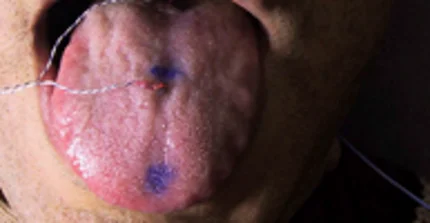
We investigate speech perception and production in people with and without speech disorders and hearing loss in order to understand the underlying mechanisms of communication difficulties.
We develop computational models of human sentence comprehension, focusing on both impaired and unimpaired populations. We are also interested in statistical theory and practice.
We investigate the structure of morphosyntactic objects from a theoretical (generative) perspective. We have a strong interest in the interfaces, understudied varieties and experimental methods.
We develop theory, do experiments (EMA, Ultrasound, chronometric studies) and apply math tools to understand the relation between the continuity of the phonetic signal and the discreteness of grammar.
Our research focuses on the compositional derivation of sentence meanings from their atomic parts, adopting an explicit cross-linguistic perspective.
Multilingualism
The Potsdam Research Institute for Multilingualism (PRIM) investigates the nature of multilingualism in children and adults, including patients with language disorders.
We study linguistic processing on the level of discourse: monologue text, or dialogue. On the one hand, this includes theoretical investigations on various aspects of discourse structure.
Using various methodological tools and measures (behavioral experiments, acoustic analyses, corpus data, event-related potentials), our research aims at better understanding the cognitive mechanisms
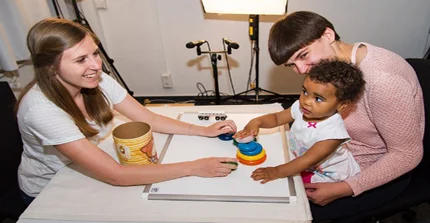
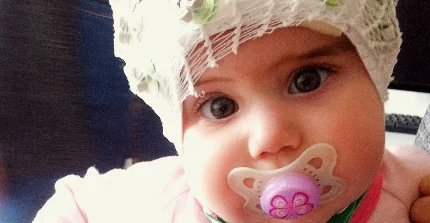
The developmental psycholinguistics group focuses on the experimental study of early language acquisition, with a special focus on phonological and lexical acquisition.
The SFB 1287 “Limits of Variability in Language” will evaluate the limits, relations, dependencies, and commonalities of variability across a range of linguistic phenomena from different perspectives.
The research group is investigating the interactions between language, cognition, social cognition and their neurocognitive foundations in child development during the first years of life.
At the Laboratory for Oral Language Acquisition, we are interested in the (a)typical development of speech motor control and its interactions with perceptual, phonological and lexical developments.
The network within the framework of the Marie Skłodowska-Curie Actions conducts research into the understanding and prediction of language development skills and disorders in multilingual Europe.