
Magnetisation Dynamics
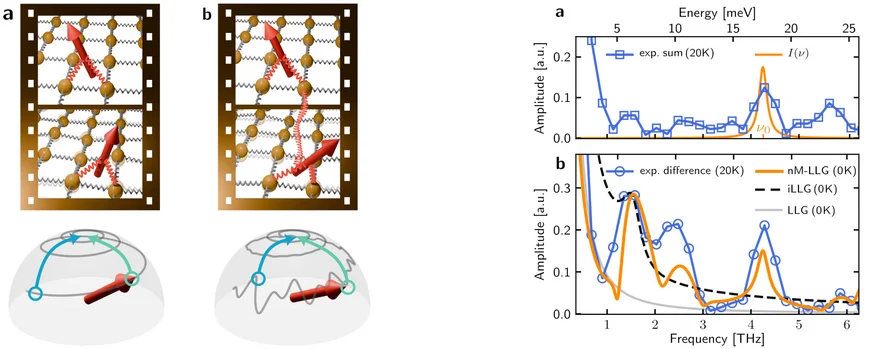
The most widely used equation to describe magnetisation dynamics is the Landau-Lifshitz-Gilbert (LLG) equation, which predicts the precession and relaxation of a classical spin vector. In our group we study a generalised LLG equation which takes into account physically relevant additions to the LLG paradigm: coloured noise and memory effects. Our research explores how the dynamics and the equilibrium state of the spin vector is affected. In particular, we show how non-trivial spin-phonon interactions give raise to a complex THz-frequency spectrum, which has been measured experimentally also (see figure). These effects are not captured by the standard LLG equation dynamics and show the need to incorporate non-Markovian memory kernels on ultrashort timescales, where system and bath timescales are no longer well separated.
If you want to read more about the topic, you can start here:
- Quantum Brownian Motion for Magnets, J. Anders, C.R.J. Sait, and S.A.R. Horsley., New J. Phys. 24 033020 (2022)
- SpiDy.jl: open-source Julia package for the study of non-Markovian stochastic dynamics S. Scali et al., J. Open Source Softw. 9(97), 6263 (2024)
- Accounting for quantum effects in atomistic spin dynamics M. Berritta, S. Scali, F. Cerisola, and J. Anders, Phys. Rev. B 109, 174441 (2024)
- Anisotropic signatures in the spin-boson model, F. Hartmann , S. Scali, and J. Anders., Phys. Rev. B 108, 184402 (2023)
- Intrinsic non-Markovian magnetisation dynamics, F. Hartmann, V. Unikandanunni, M. Bargheer, E.E. Fullerton, S. Bonetti, and J. Anders, arXiv quant-ph (2025)
- Atomistic spin dynamics with quantum colored noise, F.C. Weber, F. Hartmann, M. Bargheer, J. Anders, and R.F.L. Evans, Phys. Rev. B (2025)