


Welcome to the Chair for Theoretical Physics
Our research focuses on non-equilibrium statistical physics, soft matter and theoretical biological physics, as well as physically motivated data science. Key topics include the theory and applications of normal and anomalous stochastic processes, gene regulation, crowding in biological cells, (bio)polymer physics, as well as Bayesian maximum likelihood and machine learning analyses. Effects of disorder, annealed or quenched, interacting particles, or non-stationary dynamics are studied. Our methods are analytics, numerics (Mathematica etc), and simulations (Langevin dynamics, Monte Carlo, etc). We collaborate with a number of theoretical and experimental groups worldwide.
Improved mean squared displacement analysis for anomalous single particle trajectories
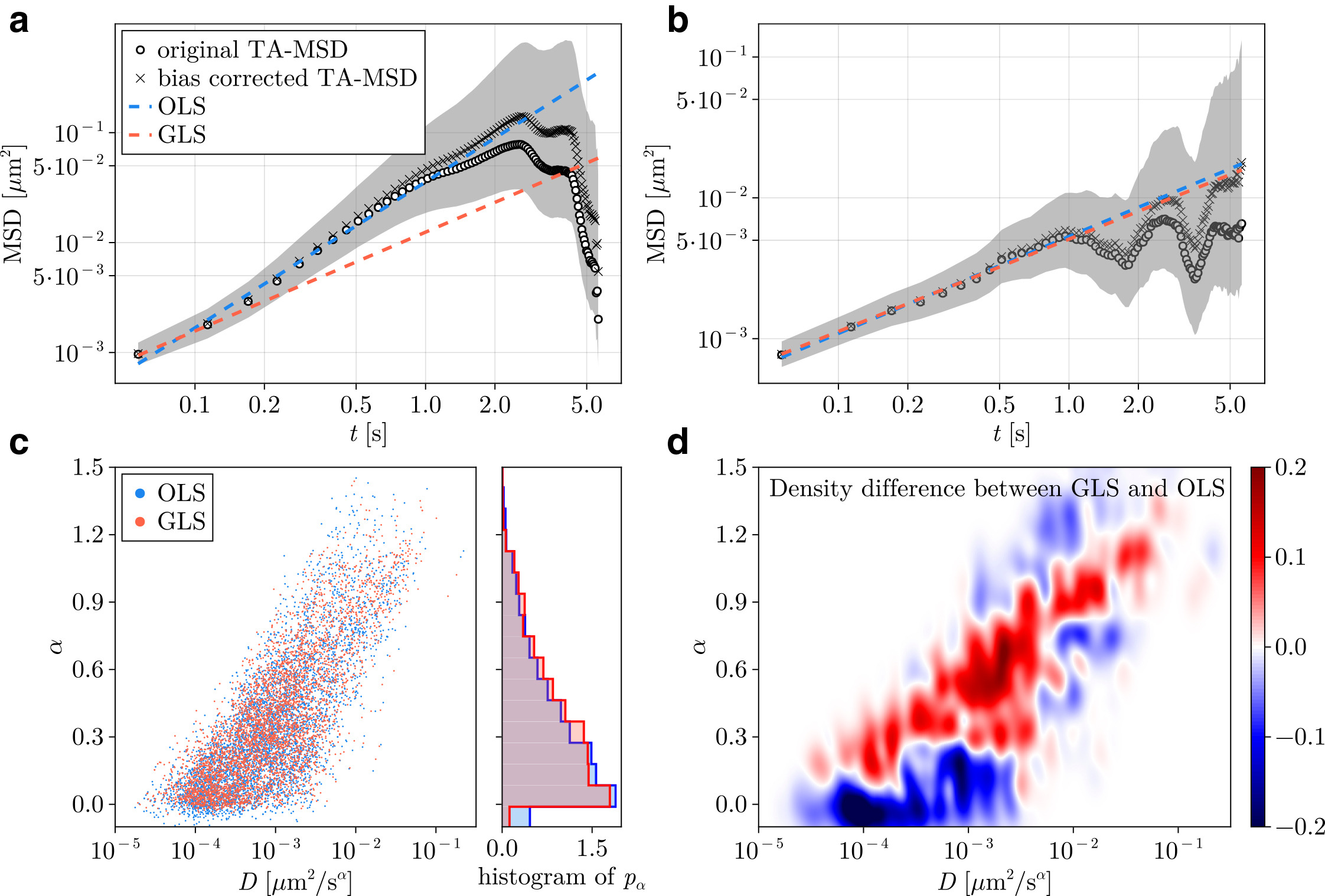
Statistically analysing the mean squared displacement is a fundamental task in understanding multiple facets of molecular kinetics. Due to experimental limitations the considered trajectories are often quite short which causes errors to significantly affect the estimated population structure of studied particles. Under these common conditions the proposed method for decreasing these errors and predicting their amplitude can directly increase the control of the experimentalist. It is also a mathematically necessary step to unambiguously answer questions like if there are distinct subpopulations of particles in the data or are the observed features only statistical artefacts. The study shows the method works for simulations which imitate experimental measurements and yields new information for real anomalous diffusion data. Read more in Biophysical Journal, 125 (2026).
The AnDi Challenges: Benchmarking Methods for Anomalous Diffusion and Motion-Change Detection
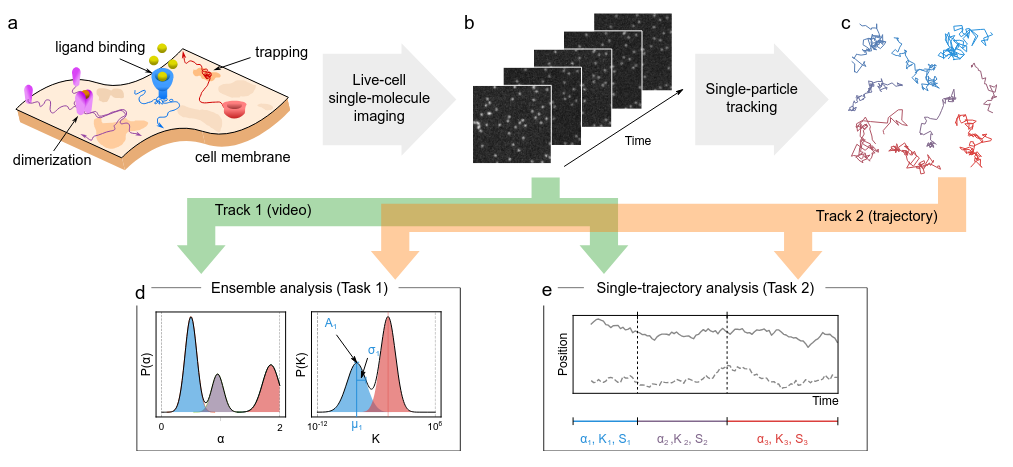
The 2nd AnDi Challenge stems from the success of the 1st AnDi Challenge in 2021, which focused on evaluating methods for detecting anomalous diffusion. The 2nd Anomalous Diffusion (AnDi) Challenge evaluates methods for detecting motion changes in single-particle behaviour.
Deviations from Brownian motion leading to anomalous diffusion are found in transport dynamics from quantum physics to life sciences. The characterisation of anomalous diffusion from individual trajectories is a challenging task, traditionally relying on the mean squared displacement, which breaks down for short or noisy trajectories, heterogeneous behaviour, or non-ergodic processes. New approaches have been proposed, building on the machine-learning revolution. To perform an objective comparison of methods, we gathered the community and organised open competitions (AnDi challenges). Participating teams applied their algorithms to commonly-defined datasets including diverse conditions; although no single method performed best across all scenarios, machine-learning-based approaches achieved superior performance.
Stemming from the success of the first challenge, the second challenge evaluated methods for detecting motion changes in single-particle behaviour, as seen in the analysis of live-cell single-molecule imaging experiments revealing heterogeneity of transport processes and interactions. We implemented a software library that simulates realistic data corresponding to widespread diffusion and interaction models, both in the form of trajectories and videos obtained in typical experimental conditions. These competitions constitute the first objective assessment of these methods, providing insights into current limitations, fostering the development of new approaches, and guiding researchers to identify optimal tools for analysing their experiments, while offering a benchmark for developers.
Read more in Nature Communications 12, 6253 (2021) from the first challenge (see also the ICFO press release ) and in Nature Communications 16, 6749 (2025) from the second challenge (see also the Stage 1 Registered Report on figshare).
Bayesian deep learning for error estimation in the analysis of anomalous diffusion
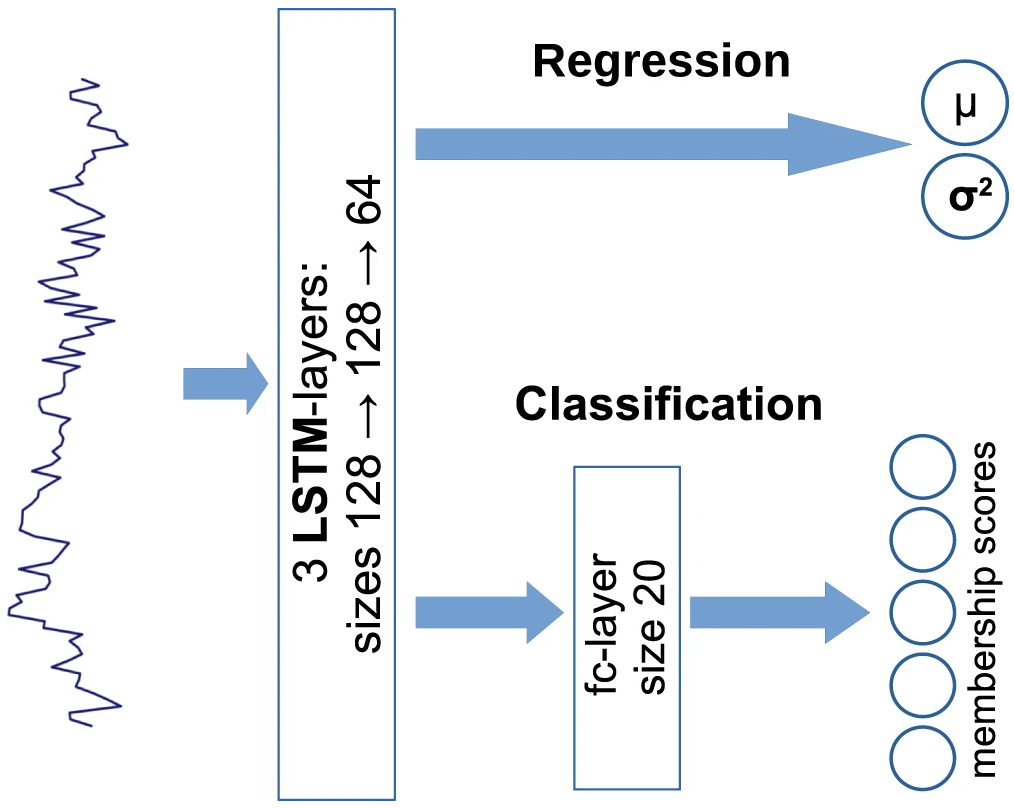
Modern single-particle-tracking techniques produce extensive time-series of diffusive motion in a wide variety of systems, from single-molecule motion in living-cells to movement ecology. The quest is to decipher the physical mechanisms encoded in the data and thus to better understand the probed systems. We here augment recently proposed machine-learning techniques for decoding anomalous-diffusion data to include an uncertainty estimate in addition to the predicted output. To avoid the Black-Box-Problem a Bayesian-Deep-Learning technique named Stochastic-Weight-Averaging-Gaussian is used to train models for both the classification of the diffusion model and the regression of the anomalous diffusion exponent of single-particle-trajectories. Evaluating their performance, we find that these models can achieve a well-calibrated error estimate while maintaining high prediction accuracies. In the analysis of the output uncertainty predictions we relate these to properties of the underlying diffusion models, thus providing insights into the learning process of the machine and the relevance of the output.
Read more in Nature Communications 13, 6717 (2022).
See also Editors Highlights.
Strange interfacial molecular dynamics
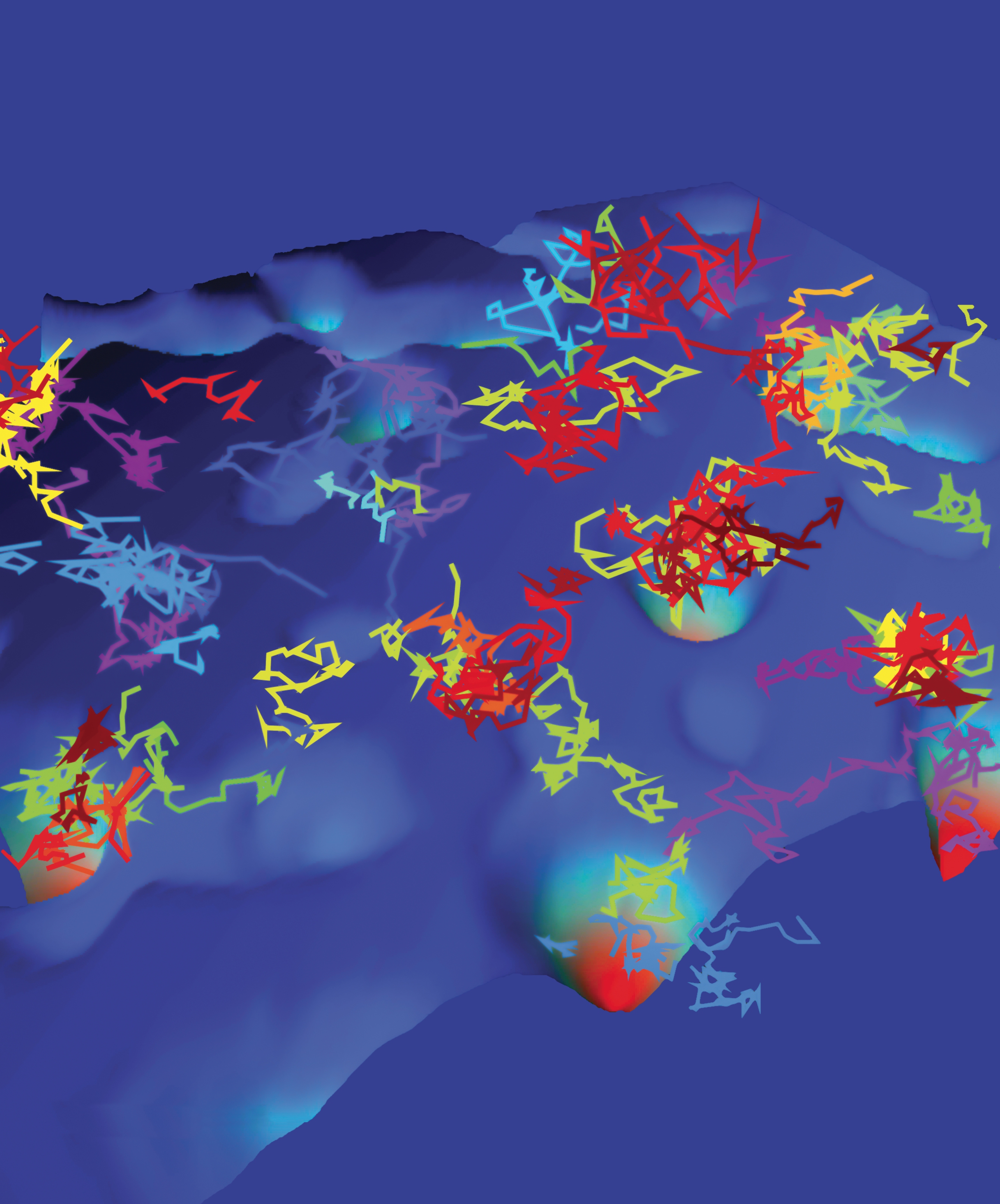
The motion underlying contact interactions that are vital for biology has farther-reaching implications than previously thought.
Biological functions such as gene regulation and metabolism in living cells rely on highly specific molecular interactions. The structure and dynamics of interfaces—from the nanoscale surfaces of intramolecular domains and the molecular surfaces of proteins, to the mesoscale surfaces of organelles, and even to the microscale surfaces of live cells-mediate those interactions. Our understanding of how interfaces evolve and how they couple to their complex environments is still developing, and several Nobel Prize–winning technologies have aided the endeavor to understand them. Read more in Physics Today 2019.