The Project MuDiRe
Social diversity is increasingly shaping everyday school life. Students differ not only in their learning prerequisites, but also in terms of social background, multilingualism, gender, motivation and special educational needs. At MuDiRe, we see this diversity not as a challenge but as an opportunity for collaborative learning.
The aim of the project is to develop instructional approaches that do justice to this multidimensional diversity and actively use it as a resource in collaborative learning processes. MuDiRe combines findings from research on learning and instruction, school development, media education and democracy research and consistently focuses on participatory cooperation with actors from schools and educational practice.
Project Objectives
MuDiRe focuses on developing a scientifically sound yet practical and scalable conceptual framework for instruction in lower secondary education. This conceptual framework detailshow individualized and collaborative modes of learning can be combined meaningfully to
- improve educational and participatory opportunities,
- strengthen social integration and collaborative, and
- promote democratic values and skills.
We particularly focus on linking digital and analog learning formats to connect with learners' everyday lives and enable democratic learning in both digital and analog spaces.
Implementation in School
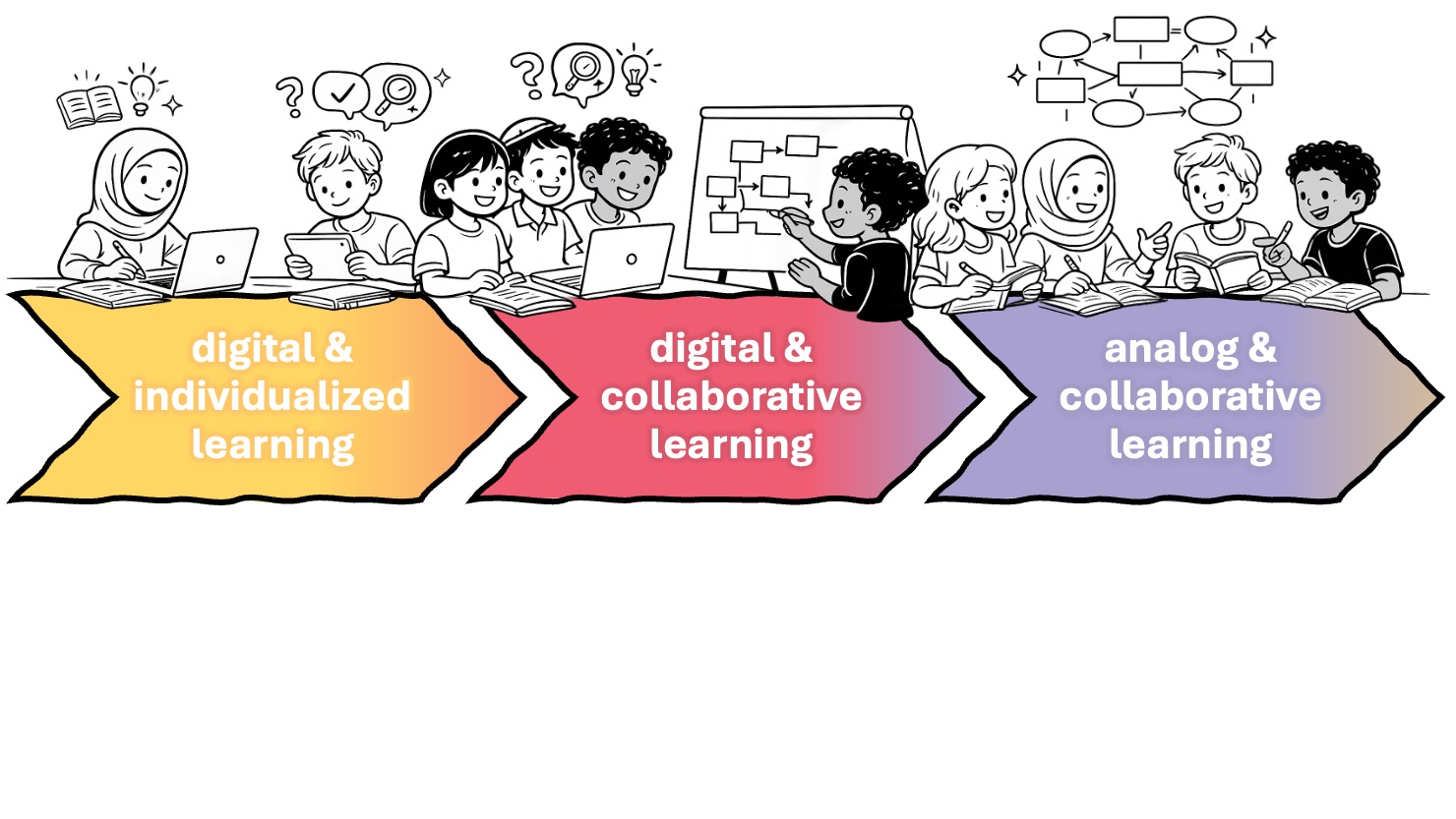
Based on the conceptual framework, we will develop three diversity-sensitive teaching sequences for lower secondary school. These sequences will follow a joint didactical pattern consisting of
- preparatory digital-individualized learning phases
- digital-collaborative learning settings, and
- analog-collaborative learning phases in the classroom.
The lesson series promote both subject-specific skills (e.g. reading skills or democratic skills) and cross-curricular skills such as the ability to cooperate, social integration and interest in learning. All materials are designed to be resource-efficient, flexible and applicable in different school contexts.
Research and Evaluation
MuDiRe closely links teaching sequences and research. The effectiveness of the teaching series and factors for successful implementation will be investigated utilizing an experimental pre-post follow-up design. The aim is to gain insights into the conditions under which diversity-sensitive, collaborative teaching is particularly effective for learning and how it can be sustainably integrated into school practice.
Collaboration, Transfer and Consolidation
A key objective of the project is to transfer itsresults into educational practice. The materials and concepts developed will be incorporated into teacher training, made available as open educational resources (OER) and disseminated via existing networks. In addition, a permanent network comprising academia, schools, practitioners and administrators will be established to promote exchange and support the further development of the approaches beyond the project period.
As a project, MuDiRe aims to contribute to the development of inclusive, effective and future-oriented learning environments in which diversity is used as a resource for collaborative learning and democratic coexistence.