


Welcome to the Chair for Theoretical Physics
Our research at the Institute of Physics and Astronomy focuses on non-equilibrium statistical physics, soft matter and theoretical biological physics, as well as physically motivated data science. Key topics include the theory and applications of normal and anomalous stochastic processes, gene regulation, crowding in biological cells, (bio)polymer physics, as well as Bayesian maximum likelihood and machine learning analyses. Effects of disorder, annealed or quenched, interacting particles, or non-stationary dynamics are studied. Our methods are analytics, numerics (Mathematica etc), and simulations (Langevin dynamics, Monte Carlo, etc). We collaborate with a number of theoretical and experimental groups worldwide.
Genuine and Spurious (Non-)Ergodicity in Single Particle Tracking

In single-particle tracking experiments measuring anomalous diffusion dynamics, understanding ergodicity is crucial, as it ensures that the time average of an observable matches the ensemble average—and can thus be fitted with known ensemble-averaged observables. A commonly used criterion for assessing the ergodicity of a stochastic process is based on the comparison of the mean-squared displacement (MSD) with the time-averaged MSD (TAMSD). This approach has been widely applied and proves effective in cases of weak ergodicity breaking across various systems in both theoretical and experimental studies. However, there is relatively little discussion regarding the theoretical justification and limitations of this definition. Here, we demonstrate that this widely accepted criterion to some extent contradicts the classical definition of ergodicity as well as physical intuition, leading to spurious (non-)ergodicity results when applied to several well-known stochastic models. To address this limitation, we propose using the mean-squared increment (MSI) instead of the MSD for comparison of ensemble- and time-averaged observables. For processes with stationary increments, the results for MSI and MSD coincide. However, if the increments of the process reach stationarity at long times only, they differ, and the MSI-TAMSD comparison still provides the test for ergodicity. Several well-established examples demonstrate, through both trajectory simulations and theoretical analysis, that our MSI-TAMSD criterion provides a more accurate characterization of the genuine (non-)ergodicity of systems where the MSD-TAMSD method fails. Additionally, for systems exhibiting “ultraweak” ergodicity breaking, the MSI can reveal the asymptotic stationarity and ergodic nature of the process’s increments. Our findings emphasize the important role of the MSI observable for SPT experiments and anomalous diffusion studies.
Read more in Physical Review X 16, 031071 (2026).
Chirality enhances diffusion in disordered environments

Chirality, a systematic rotational bias in the motion of a particle, arises in a wide range of physical and biological systems, from charged colloids in magnetic fields to swimming bacteria near surfaces. While its effects in homogeneous environments are well understood, the interplay between chirality and structural disorder has remained largely unexplored. Here, we investigate the chiral random walk on two-dimensional percolation clusters above the percolation threshold, combining numerical simulations with an analytically tractable annealed-disorder approximation. We find that the long-time diffusion coefficient depends non-monotonically on both the chirality parameter and the obstacle density: for every obstacle density above the percolation threshold, there exists an optimal chirality that enhances diffusion relative to the achiral walk. We show that the optimal chirality is set by an edge-adhering mechanism: maximum diffusion is achieved when the persistence length of the wall-adhering motion matches half the typical obstacle cluster perimeter. This yields a closed-form prediction for the optimal chirality in terms of geometric properties of the medium alone, which we verify across the full range of obstacle densities studied. The enhancement extends to first-passage statistics, where chirality shortens typical search times at strong disorder while lengthening them at weak disorder, with direct implications for biological navigation in disordered environments.
Read more in The Journal of Chemical Physics 165, 124118 (2026).
Fastest First-Passage Time for Multiple Searchers with Finite Speed

Deploying 𝑁 Brownian searchers reduces the mean search time for an immobile target merely by a factor 1/ln𝑁. We show that this conclusion is highly sensitive to the short-time dynamics of individual searchers. Based on the telegrapher’s equation we demonstrate that the classical logarithmic scaling is only an intermediate asymptotic and ultimately crosses over to a much faster exponential decay with 𝑁. For anomalous diffusion with finite speed, we also show that superdiffusion leads to faster search than subdiffusion, as intuitively expected. Our findings provide a clear physical picture of redundancy and minimal search times in collective search relevant for many biological and physical systems.
Read more in Physical Review Letters 137, 127102 (2026).
The AnDi Challenges: Benchmarking Methods for Anomalous Diffusion and Motion-Change Detection
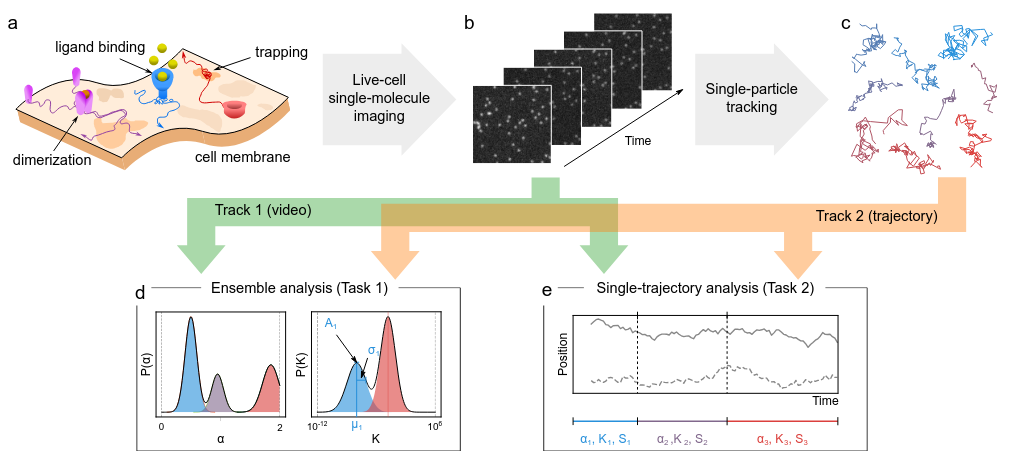
The 2nd AnDi Challenge stems from the success of the 1st AnDi Challenge in 2021, which focused on evaluating methods for detecting anomalous diffusion. The 2nd Anomalous Diffusion (AnDi) Challenge evaluates methods for detecting motion changes in single-particle behaviour.
Deviations from Brownian motion leading to anomalous diffusion are found in transport dynamics from quantum physics to life sciences. The characterisation of anomalous diffusion from individual trajectories is a challenging task, traditionally relying on the mean squared displacement, which breaks down for short or noisy trajectories, heterogeneous behaviour, or non-ergodic processes. New approaches have been proposed, building on the machine-learning revolution. To perform an objective comparison of methods, we gathered the community and organised open competitions (AnDi challenges). Participating teams applied their algorithms to commonly-defined datasets including diverse conditions; although no single method performed best across all scenarios, machine-learning-based approaches achieved superior performance.
Stemming from the success of the first challenge, the second challenge evaluated methods for detecting motion changes in single-particle behaviour, as seen in the analysis of live-cell single-molecule imaging experiments revealing heterogeneity of transport processes and interactions. We implemented a software library that simulates realistic data corresponding to widespread diffusion and interaction models, both in the form of trajectories and videos obtained in typical experimental conditions. These competitions constitute the first objective assessment of these methods, providing insights into current limitations, fostering the development of new approaches, and guiding researchers to identify optimal tools for analysing their experiments, while offering a benchmark for developers.
Read more in Nature Communications 12, 6253 (2021) from the first challenge (see also the ICFO press release ) and in Nature Communications 16, 6749 (2025) from the second challenge (see also the Stage 1 Registered Report on figshare).