Why
Grassmann?
>>> Download:
Conference Flyer

A small-town genius
Potsdam
philosopher Hans-Joachim Petsche on
mathematical genius
By Mark Minnes
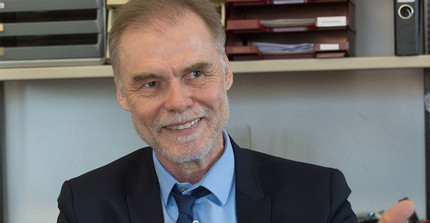
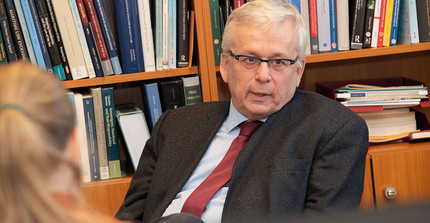
Hans-Joachim
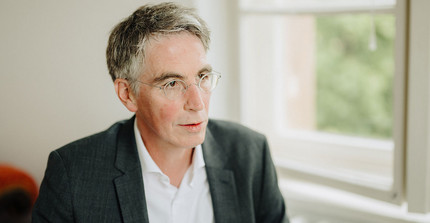
Petsche’s voice vibrates with
enthusiasm when he brings up Hermann Grassmann. And the Potsdam
professor of philosophy is perfectly
capable of bringing his enthusiasm across to the listener. With every
word
Petsche says on the topic, it becomes clear that he is fascinated by
the work
of Hermann Grassmann, a mathematician from the once Prussian town of Stettin.
Professor Petsche received his academic training in mathematics and
philosophy.
At times, Petsche’s voice will pause. He will interrupt his thoughts,
just to place special emphasis on a point just made: “Modern,
strange… brilliant!” This is
how Prof. Petsche sees the work of this mathematician, who was born in
1809.
And he should know: Hans-Joachim Petsche has published an extensive
intellectual biography on the brilliant man. The book tells the story
of an exceptional scholar.
Hermann
Grassmann, a school teacher in the town of Stettin,
which today is north-western Poland,
played a key role in a philosophical and mathematical revolution which
took place in
the 19th century. Grassmann’s 1844
“Ausdehnungslehre” brought
geometry and algebra together, creating a new mathematical discipline.
Almost without using mathematical formulas, Grassmann worked out a way
to calculate
directly in terms of geometrical bodies. By doing this in his unique
way, the
mathematician crossed an ancient line of demarcation. He completed a
project
that had already puzzled great minds such as Descartes and Leibniz.
It
took some time for people to realize that Grassmann had brought a
revolution to philosophy, physics and mathematics: a
new concept of spatial expansion had been born, and an ancient
intellectual
dogma was losing its power. This dogma had been the notion that we
inevitably
must conceptualize our world as a three dimensional one. By the end of
the 18th
century, the great Immanuel Kant had given this dogma its philosophical
foundation. But with Grassmann, it was beginning to lose its grip.
Today,
as in his day, only specialists know who came up with “n-dimensional
vector algebra”. In his
lifetime, hardly anybody reacted to Hermann Grassmann’s theories. This
school
teacher’s thoughts were too new and too hard to grasp. Also, he was a
self-taught
mathematician. He attempted in vain to become a university professor,
he took a stand in
the political turmoil of 1848, he taught, he thought, and he became the
father of
eleven children. When in 1860 his lack of success in mathematics seemed
definite, he turned to linguistics. With brilliant effect: His
dictionary of
Sanskrit is still in print today.
So
Grassmann was not just the creator of a groundbreaking theory on
n-dimensional space. Hans-Joachim Petsche is
convinced that the man from Stettin
represents a special phase in German intellectual history. “The whole
situation in
Stettin
was that of a small town: limited, provincial, brilliant”, as Prof.
Petsche
told PNN. To him, Grassmann’s great scientific achievement is linked to
the
German world of small towns. This was the world of school professors,
of the petite bourgeoisie, and of
learned
societies. As Prof. Petsche points out, it was also a world of
narrow-minded German nationalism and political backwardness. Certainly,
curious mixture of
influences.
But
Grassmann’s story is also linked to the Berlin
university, where he
studied theology: his only venture beyond the Stettin
city limits. In Berlin he was
influenced by the philosopher and theologian Friedrich Schleiermacher.
Schleiermacher’s thoughts, this is one of Prof. Petsches key insights,
prepared the
ground for Grassmann’s brilliant intellectual movements. But Grassmann
needed small-town
quietude to work. “A small-town genius”, as Hans-Joachim Petsche likes
to call
the school teacher, who had a reputation of being modest and friendly.
“At
first glance, Grassmann’s scientific approach is quite simple”, says
Hans-Joachim Petsche. “But
then Grassmann shows an extreme will to expand and generalize his
thoughts. He develops his concepts
with extreme rigor, exploring their meaning to the very end.” This is
how, according
to Prof. Petsche, Grassmann left behind the notion of three-dimensional
space.
To Grassmann, the word “expansion” meant more than just expansion in
space.
Instead, his theory embraces a given number of directional aggregates,
which
his “vector calculations” handle better than any other previous
approach.
According to Prof. Petsche, Grassmann’s vector algebra is fundamental
to
complex optimization processes. It is used in satellite navigation
systems, in
computer technology and in aeronautics.
Hans-Joachim
Petsche sees Grassmann as a case where disciplinary limitations, even
academic specializations, were superseded.
Grassmann stands for brilliant innovation. We should see this as a
“piece of
advice German history holds in store for the present”, as Petsche puts
it in
his biography. Hermann Grassmann moved freely between the fields of
mathematics, physics, philosophy and linguistics. “A beautiful system
of
coordinates, full of creativity”, says Prof. Petsche. He sees this
networked
approach as an important bearing for scientific work today. So it seems
like
the perfect time for an English translation of Prof. Petsche’s book,
which is
underway. Next year, 200 years after Grassmann’s year of birth, Prof.
Petsche
hopes to bring an international conference to Potsdam. Right
now, he is looking for supporters. Hans-Joachim Petsche would like to
renew the intellectual spirit
Grassmann brought to the small town of Stettin
– in Potsdam.
And with the spirit of Grassmann, Hans-Joachim Petsche would like to
bring back a
spirit of innovation and creativity.
Petsche,
Hans-Joachim: Grassmann. Basel: Birkhäuser Verlag.
(Published
in the Potsdam
daily newspaper “Potsdamer Neueste Nachrichten”/ PNN on 3/26/2008;
translated from German by
Mark Minnes)
|